
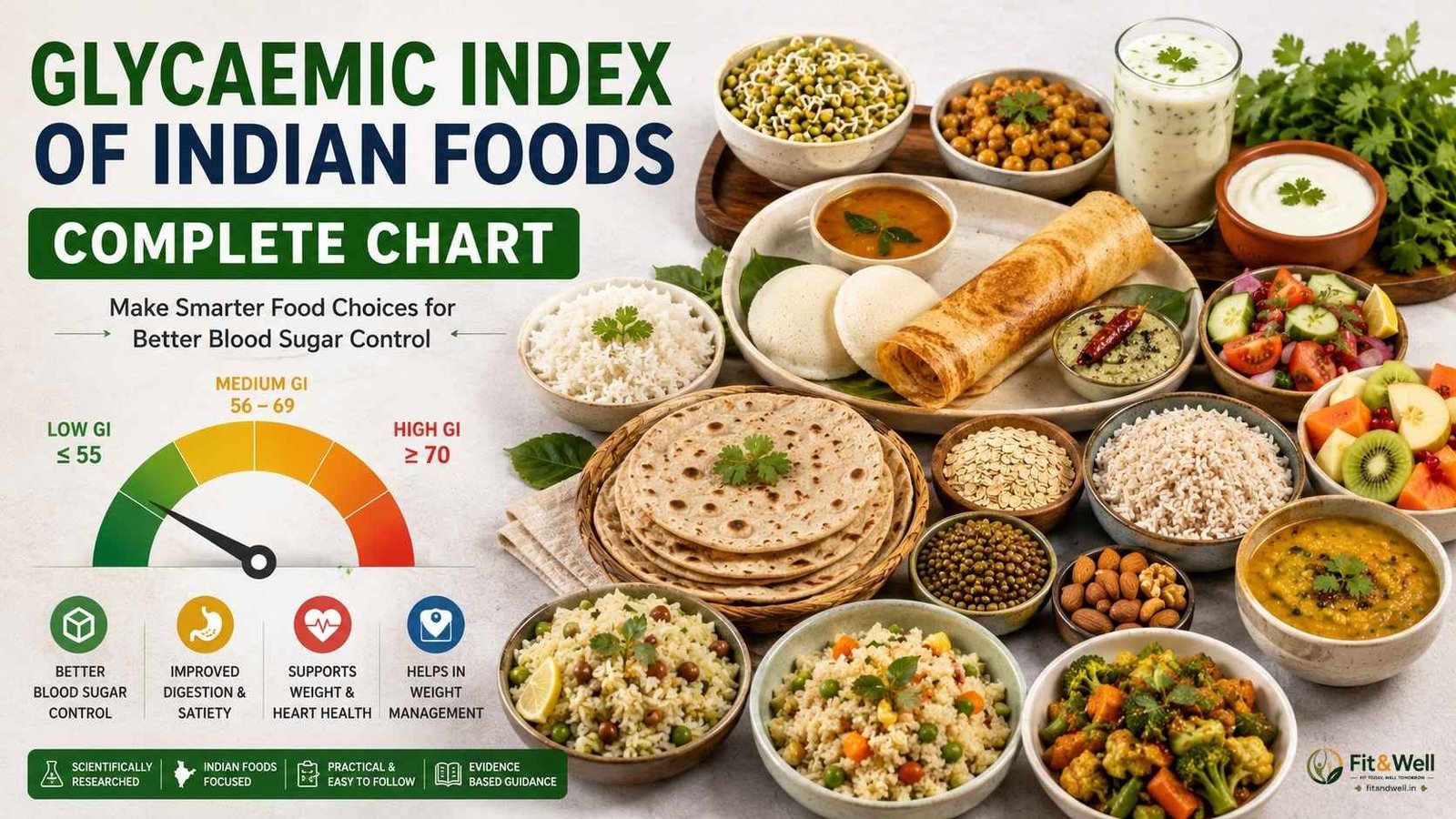
Every meal affects your blood sugar differently. A bowl of rice, a whole wheat roti, a serving of idli, or even a ripe banana can produce very different glucose responses, even when they contain similar amounts of carbohydrates. That is where the glycaemic index (GI) becomes useful. It helps explain how quickly carbohydrate-containing foods raise blood sugar, allowing you to make informed food choices instead of relying on myths or blanket dietary restrictions.
Whether you are managing diabetes, prediabetes, PCOS, or simply trying to build healthier eating habits, understanding the glycaemic index of common Indian foods can help you create balanced meals without giving up the foods you enjoy.
In this guide, you will learn what the glycaemic index is, how it differs from glycaemic load, what affects a food’s GI, and how common Indian foods compare based on current scientific evidence. You will also find practical tips for building balanced meals and using GI as one part of an overall healthy eating pattern.
Table of Contents
What Is the Glycaemic Index?
The glycaemic index (GI) is a ranking system that measures how quickly a carbohydrate-containing food raises blood glucose compared with pure glucose, which has a reference value of 100.
Foods are grouped into three categories:
| GI value | Classification | Typical blood‑sugar effect |
| ≤ 55 | Low GI | Slower, more gradual rise in blood glucose |
| 56–69 | Medium (moderate) GI | Moderate rise in blood glucose |
| ≥ 70 | High GI | Faster, larger spike in blood glucose |
These categories are internationally accepted and widely used in nutrition research.
A lower GI does not automatically mean a food is healthier. For example, chocolate may have a relatively low GI because its fat slows digestion, but that doesn’t make it a nutritious everyday choice. Likewise, some higher-GI foods, such as potatoes, still provide valuable nutrients and can fit into a balanced diet.
GI vs Glycaemic Load: What’s the Difference?
Many people confuse glycaemic index with glycaemic load (GL).
Although related, they answer different questions.
| Glycaemic Index | Glycaemic Load |
|---|---|
| Measures how quickly carbohydrates raise blood sugar | Measures the total blood sugar impact of a typical serving |
| Does not consider serving size | Includes serving size |
| Based on 50 g available carbohydrate | Based on actual portion consumed |
The formula for glycaemic load is:
GL = (GI × grams of available carbohydrate in one serving) ÷ 100
This means that a food can have:
- High GI but low GL if you eat only a small serving.
- Moderate GI but high GL if you eat a large quantity.
For everyday eating, glycaemic load often gives a more realistic picture than GI alone.
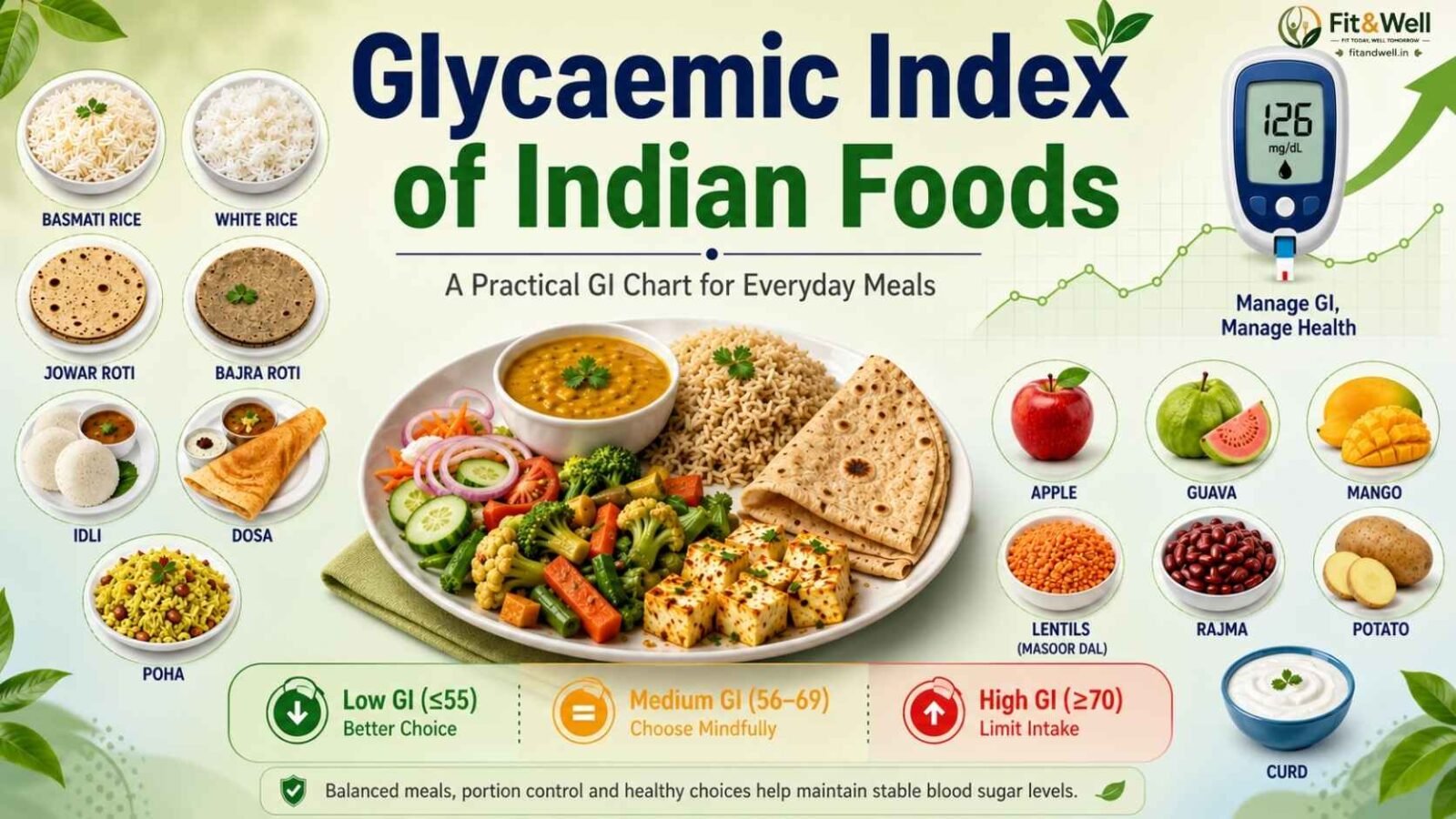
Glycaemic Index of Indian Foods
Indian food is often treated as if it were one thing, but its glycaemic impact varies widely by grain, pulse, cooking method, and portion size. A useful way to understand it is through the glycaemic index, a system explained in the International GI tables, which ranks carbohydrate foods by how quickly they raise blood glucose. For Indian diets, that matters because the same base ingredient can behave very differently once it is polished, fermented, ground, boiled, cooled, or fried.
The most reliable way to use GI is as a guide, not as a rigid scorecard. A helpful overview in the compendium of non-Western foods shows why many Indian staples need to be interpreted food by food rather than assumed to fit one universal pattern. That is especially true for rice, rotis, breakfast dishes, and traditional snacks.
Indian Food GI Chart
The values below are practical, approximate ranges derived from published GI patterns and food charts, not fixed, universal numbers. GI can change with variety, soaking, fermentation, boiling time, cooling, reheating, and serving size.
| Food | Approx | GI Category |
| Brown rice | 50 | Low |
| Basmati rice | 55–65 | Low to medium |
| White rice / short-grain rice | 73–80 | High |
| Parboiled rice | 65–70 | Medium |
| Whole wheat chapati / phulka | 52–60 | Low to medium |
| Maida naan / white-flour bread | 70–75 | High |
| Jowar roti | 45–55 | Low |
| Bajra roti | 45–55 | Low |
| Ragi roti | 50–60 | Low to medium |
| Poha | 65–70 | Medium to high |
| Upma | 65–70 | Medium to high |
| Dalia / broken wheat | 48–55 | Low |
| Idli | 60–65 | Medium |
| Plain dosa | 65–70 | Medium to high |
| Rice dosa | 75–80 | High |
| Lentils/dal | 30–45 | Low |
| Chana dal | 30–40 | Low |
| Rajma | 30–40 | Low |
| Moong dal | 30–40 | Low |
| Black chana | 35–45 | Low |
| Boiled potato | 78–85 | High |
| Sweet potato | 50–60 | Low to medium |
| Okra (bhindi) | 15–20 | Low |
| Bitter gourd (karela) | 15–20 | Low |
| Spinach (palak) | 10–20 | Low |
| Apple | 35–40 | Low |
| Guava | 30–35 | Low |
| Mango | 55–60 | Low to medium |
| Watermelon | 70+ | High GI, but often modest GL in a normal serving |
| Plain curd/yoghurt | 20–35 | Low |
| Paneer | 10–20 | Low |
| Eggs, chicken, fish | 0 | No carbohydrate |
| Puri | 80+ | High |
| Paratha with oil or ghee | 70–75 | High |
| Samosa / pakoda | 70–80 | High |
| Indian sweets | 75–95 | High |
Why These Foods Differ
Rice is a good example of why GI cannot be treated as a single number for all Indian foods. A study on Indian branded basmati rice reported a GI below 55, showing that basmati can sit in the lower-GI range compared with many other rice types Indian basmati rice study. At the same time, other rice varieties can produce much higher glycaemic responses, especially when polished and cooked soft.
Cooking changes starch behaviour too. When starch is boiled, it gelatinises and becomes easier to digest; when cooked starch is cooled, it can form resistant starch through retrogradation. Research on cooling and reheating rice suggests that this process can alter the post-meal glucose response, although the size of the effect depends on the exact food and method used in resistant starch and rice cooling research.
What Matters Most in Glycemic Index
The most useful lesson from GI is not that one food is always good and another is always bad. It is that blood sugar response depends on the food itself, the portion, and the other items eaten with it. A single roti with dal and vegetables behaves very differently from refined flour bread eaten alone.
That is why meal order also matters. Research on vegetables-first eating found that starting with vegetables and protein before carbohydrates can reduce post-meal blood glucose and insulin rises in a meal sequence study. This makes traditional Indian meals easier to manage without changing the whole cuisine.
Practical Indian Plate
A balanced Indian plate for blood sugar control can be built simply:
- Half the plate with non-starchy vegetables.
- One quarter with protein such as dal, paneer, curd, eggs, fish, or chicken.
- One quarter with grains or starches, preferably whole grains or less refined options.
This structure works because it keeps fibre, protein, and carbohydrate in better balance. It also helps explain why a meal of rice, dal, and sabzi behaves more favourably than a plate of polished starch alone. For readers who want a broader evidence base, the non-Western GI compendium is a useful starting point, and the international GI tables remain the classic reference.
Common Myths About Glycaemic Index
Myth 1: Brown Rice Always Has a Low GI
Fact: Brown rice often has a lower GI than many white rice varieties, but values still vary depending on variety and cooking method.
Myth 2: All Millets Are Low GI
Fact: Different millet species produce different GI values. Processing and milling also influence blood sugar response.
Myth 3: People with Diabetes Should Never Eat Rice
Fact: Rice can fit into a diabetes-friendly eating pattern when portion sizes are appropriate, and meals include protein, vegetables, and fibre.
Myth 4: Fruit Should Be Completely Avoided
Fact: Most whole fruits can be included as part of a balanced diet. Portion size and overall carbohydrate intake remain important.
Myth 5: GI Is the Only Number That Matters
Fact: Healthy eating depends on many factors, including:
- Total calories
- Fibre
- Protein
- Fat quality
- Micronutrients
- Portion size
- Overall dietary pattern
GI should support, not replace, good nutrition principles.
Key Takeaways on Glycemic Index
The glycaemic index is a practical tool for understanding how carbohydrate-containing foods may affect blood sugar, but it is only one part of healthy eating.
For Indian diets, the focus should not be on eliminating rice, roti, or fruit. Instead, aim to build balanced meals that combine whole grains, pulses, vegetables, protein, and healthy fats. This approach supports more stable blood glucose while also improving overall nutrition.
Remember these principles:
- Prefer minimally processed foods.
- Include vegetables in every meal.
- Eat adequate protein.
- Control portion sizes.
- Choose whole fruits over juices.
- Use GI as a guide—not a strict rule.
- Focus on long-term eating habits rather than individual foods.
A well-planned Indian diet can be both enjoyable and supportive of healthy blood sugar management. By understanding how GI works and applying it alongside balanced nutrition, you can make informed food choices without unnecessarily restricting the foods you enjoy.
At FitandWell our goal is to help you make informed health decisions with practical, evidence-informed guidance designed for Indian lifestyles. Explore our nutrition, fitness, yoga, and wellness resources to build healthier habits that fit your daily routine, one step at a time