
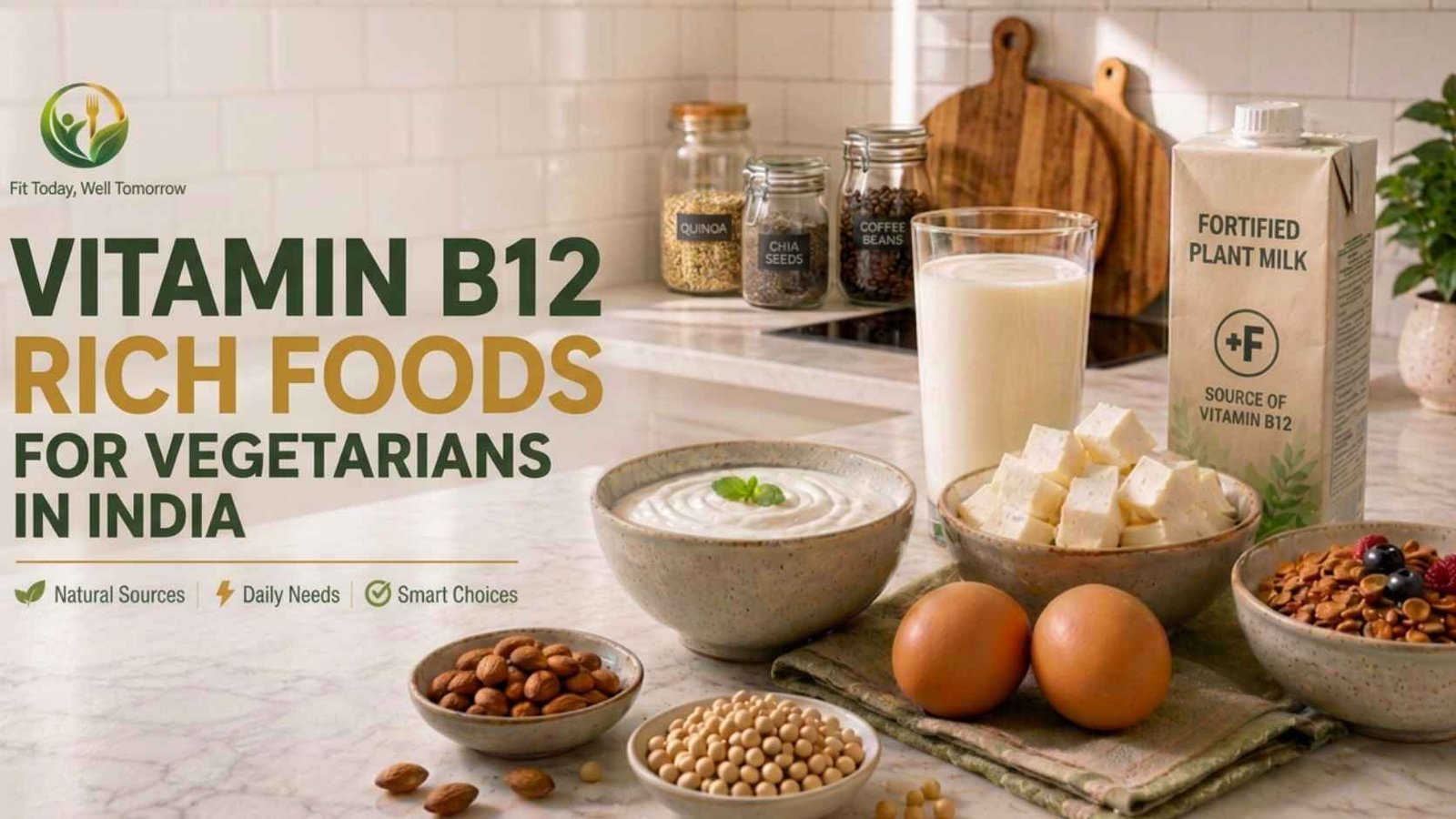
Vitamin B12 occurs naturally only in animal products, which makes it the one nutrient that vegetarian diets in India consistently struggle to cover. The good news is that most lacto-vegetarians, people who eat dairy and sometimes eggs but avoid meat and fish, can meet their B12 needs through food alone if they know which foods actually contain it and eat them regularly. Strict vegetarians and vegans usually need a supplement as well, since plant foods contain none of this vitamin unless it’s been added artificially.
This guide covers exactly which vegetarian foods provide meaningful amounts of B12, how much you’d realistically need to eat, and where the gaps are for those following a stricter plant-based diet.
Why Vegetarians Are Especially Prone to Low B12
Vitamin B12 is made by bacteria, and it accumulates in the tissues of animals that eat those bacteria or foods containing them. Plants don’t produce it, and they don’t absorb it from soil in any nutritionally useful amount. This means the only reliable natural sources are meat, fish, eggs, and dairy.
If you’d like a fuller picture of what happens when intake falls short, including symptoms, testing, and treatment, our detailed guide on vitamin B12 deficiency symptoms and causes covers that in depth. This article focuses specifically on the food side of the equation: what to eat, how much, and how far diet alone can realistically take you.
Vitamin B12 Rich Foods for Vegetarians in India
Dairy Products
Dairy is, by a wide margin, the most practical B12 source for Indian vegetarians, since milk, curd, and paneer are everyday staples in most households rather than occasional additions.
- Milk. A single cup of milk provides roughly a third to half of the average adult’s daily B12 requirement, depending on whether it’s whole or toned milk. Interestingly, research summarised by the NIH suggests the body absorbs B12 from milk somewhat more efficiently than it does from meat, fish, or eggs, which makes regular milk intake particularly useful.
- Curd and yoghurt. A standard serving of plain yoghurt or curd offers a similar contribution, and it comes with the added benefit of probiotics for gut health.
- Paneer and cheese. These contain B12 too, though generally less per serving than milk or curd, since much of the whey (where a good share of the B12 resides) is drained off during preparation.
For someone eating dairy two to three times a day, in a glass of milk with breakfast, curd with lunch, and a small portion of paneer or cheese elsewhere, daily B12 needs are often covered without any additional effort.
Eggs
For lacto-ovo vegetarians who include eggs, they’re a genuinely useful source. One egg provides a meaningful fraction of the daily requirement, and most of that B12 is concentrated in the yolk rather than the white, so recipes built around whole eggs are more useful here than egg-white-only preparations.
Fortified Foods
This is where things get more India-specific, and slightly more complicated.
Globally, fortified breakfast cereals and nutritional yeast are the go-to plant-based B12 sources. In India, however, these products aren’t yet a routine part of most diets, and fortified cereals with meaningful B12 content are still a niche, urban, higher-income category rather than something available on every kirana store shelf.
What is more relevant locally is government-backed staple fortification. FSSAI’s food fortification programme has, since 2016, permitted the fortification of wheat flour and rice with iron, folic acid, and vitamin B12, largely distributed through public distribution systems and safety-net schemes rather than sold widely as a labelled retail product. If you do come across packaged atta, rice, or plant-based milk carrying the official “+F” fortification logo, it’s worth checking the label, since the added B12 content can genuinely help close the gap, particularly for households that eat less dairy.
Fortified soy milk, oat milk, and almond milk, where available in Indian supermarkets, are also worth checking. Not all brands add B12, so the label is the only reliable way to know.
Roughly How Much B12 Common Foods Provide
To put this in perspective, here’s a rough guide to typical servings, based on figures reported by the NIH Office of Dietary Supplements. Adults generally need around 2.4 micrograms (mcg) a day.
| Food | Typical Serving | Approximate B12 |
|---|---|---|
| Milk | 1 cup (240ml) | 1.2–1.3 mcg |
| Curd or plain yoghurt | 1 bowl (~170g) | 1.0–1.4 mcg |
| Paneer | 100g | 0.4–0.7 mcg |
| Cheese | 1 slice (~20g) | 0.3–0.6 mcg |
| Large egg | 1 whole egg | 0.5–0.6 mcg |
| Fortified cereal | 1 serving | 0.6–2.0 mcg (brand-dependent) |
| Fortified plant milk | 1 cup | 0.6–2.1 mcg (brand-dependent) |
| Buttermilk (chaas) | 1 glass | Roughly a quarter to a third of a cup of milk’s content |
These are approximate figures, since actual content varies by brand, breed of cattle, processing, and fat content, but they’re useful for understanding roughly how far a typical day’s meals get you. Notice how consistently dairy performs here compared with fortified alternatives, which is exactly why it remains the backbone of vegetarian B12 intake in India rather than a supporting player.
Regional Differences Worth Knowing
B12 intake through diet isn’t uniform across India, and where you live and what’s traditionally on your plate can genuinely shift your risk.
North Indian and Punjabi diets, with their heavier reliance on milk, curd, ghee, and paneer, tend to provide more consistent B12 intake for vegetarians, simply because dairy shows up at nearly every meal.
South Indian vegetarian diets, built around rice, idli, dosa, and sambar, often include less dairy as a standalone food, though curd rice and buttermilk are common exceptions. Coconut-based cooking, while excellent for other nutrients, contributes nothing toward B12 essentially.
Gujarati and Rajasthani thalis typically include generous amounts of curd and buttermilk alongside meals, which works in their favour, though the broader vegetarian pattern in these states (often stricter, with less egg consumption) can offset that advantage somewhat.
This isn’t about any one regional diet being “better” or “worse.” It’s simply worth being aware that the type of vegetarian diet you eat, not just the fact that it’s vegetarian, affects how much B12 you’re likely getting without thinking about it.
Special Considerations for Certain Life Stages
B12 needs aren’t static, and a few groups need to pay closer attention to intake than the general adult population.
Pregnant and breastfeeding women need somewhat more B12 than usual, and a deficiency during this period can affect the baby’s neurological development. Vegetarian women who are pregnant or breastfeeding are routinely advised to discuss B12 status with their doctor, since dietary intake alone is often not considered sufficient during this stage, even for those who eat dairy regularly.
Growing children and teenagers on vegetarian diets need reliable B12 sources for normal nerve and cognitive development. A child who eats very little dairy, perhaps due to lactose sensitivity or simple fussiness, can fall short more easily than an adult would from the same pattern of eating.
Older adults, vegetarian or not, often absorb B12 less efficiently due to reduced stomach acid production, even when their diet looks adequate on paper. This is one of the reasons doctors sometimes recommend a B12 supplement for elderly vegetarians regardless of how much dairy they report eating.
If you fall into any of these groups, it’s worth treating B12 as something to actively monitor rather than assume is fine, since the margin for error is smaller than it is for a generally healthy adult.
Does Cooking Destroy Vitamin B12?
Partially, and it’s worth knowing this so you don’t assume a cooked dish is delivering as much B12 as the raw ingredients would suggest. B12 is somewhat heat-sensitive, and prolonged boiling, especially of milk, can reduce its content by a noticeable margin. It isn’t destroyed entirely, and typical home cooking- a quick boil for chai or a curry simmered for twenty minutes- doesn’t strip it out completely. But this is one more reason not to rely on a single daily glass of milk as your only source, especially if it’s boiled for a long time or used mostly in small quantities within larger dishes.
Curd and paneer, since they aren’t heated for extended periods during preparation, tend to retain their B12 content more reliably than milk that’s been boiled repeatedly.
What Changes for Strict Vegetarians and Vegans
If eggs are off the table and dairy intake is minimal or absent, food alone becomes a genuinely difficult way to meet B12 needs in India, since the fortified plant-food ecosystem here is still developing. This isn’t a criticism of the diet itself; it’s simply a nutritional reality that most dietitians and doctors are upfront about.
For strict vegetarians who eat little dairy, and for vegans in particular, a B12 supplement is usually the most reliable solution, rather than trying to stack enough fortified products to hit the daily requirement. This is widely recommended precisely because plant foods, even a genuinely well-planned diet, rarely close the gap on their own. A simple daily or weekly oral supplement, taken under a doctor’s guidance, solves this cleanly without needing to restructure your entire diet around chasing fortified products that may not always be available or clearly labelled.
Choosing a Supplement, if You Need One
If diet genuinely can’t cover your needs, a few practical points make the difference between a supplement that works and one that just sits in the cupboard:
Cyanocobalamin is the most common and least expensive form used in supplements, and it works well for most people with no absorption issues.
Methylcobalamin is a more “active” form some people prefer, though the evidence that it performs meaningfully better than cyanocobalamin for the average healthy person is limited.
Dosage matters more than form. A 500 to 1,000 mcg daily oral tablet is a fairly standard starting point for someone with mild dietary insufficiency, though this should still be confirmed with a doctor, particularly if you have a diagnosed deficiency rather than just a preventive concern.
Consistency beats occasional high doses. A modest daily or weekly tablet taken reliably tends to be more useful than sporadic, higher-dose use.
This isn’t a substitute for medical advice, particularly if a blood test has already shown a deficiency, in which case the dosing and monitoring should be guided by your doctor rather than a general recommendation like this one.
A Sample Day That Covers Most of Your B12 Needs
For a lacto-vegetarian, a fairly ordinary day’s eating can get close to, or past, the daily requirement without any special effort:
- Breakfast: a glass of milk with your tea or coffee, plus curd with your poha, upma, or paratha
- Lunch: a small serving of paneer in your sabzi, or a bowl of curd alongside your dal and rice
- Evening: a cup of milk, or buttermilk (chaas), which retains some B12 from the milk it’s made from
- Dinner: curd or a paneer-based dish again, depending on what you had earlier in the day
Layered together, this kind of everyday pattern, common in many Indian households already, tends to land close to the daily requirement without needing to think about it as a deliberate “B12 plan.”
For those who eat eggs, adding one to breakfast a few times a week closes the gap even further with very little effort.
Practical Ways to Boost B12 Without Overhauling Your Diet
If you’d rather make small, sustainable adjustments than plan every meal around a nutrient target, a few simple habits go a long way:
- Don’t over-boil milk. A quick heat is enough for chai or coffee; prolonged boiling for its own sake reduces B12 content unnecessarily.
- Include curd at least once daily. It’s minimally processed, widely available, and retains its B12 content well.
- Add an egg a few times a week, if you eat them, rather than treating it as an occasional weekend food.
- Check labels on packaged atta, rice, and plant milks for the FSSAI “+F” fortification logo, and don’t assume fortification if it isn’t stated.
- Space dairy across the day rather than having it all in one sitting, since the body absorbs B12 more efficiently in smaller, spread-out doses than one large one.
- Get tested periodically, especially if you fall into any higher-risk group, rather than assuming your diet is doing enough based on how it looks on paper.
None of these requires restructuring your diet. They’re small, realistic adjustments that compound over weeks and months.
A Quick Note on Absorption
Eating the right foods is only half the equation. Vitamin B12 from food has to be separated from protein by stomach acid and then bound to a substance called intrinsic factor before your gut can actually absorb it. This means that even someone eating plenty of dairy and eggs can still end up short if their stomach acid is low, whether from age, long-term use of acid-reducing medication, or an underlying digestive condition.
This is worth knowing because it explains a pattern that confuses a lot of people: two individuals can eat almost identical diets and end up with very different B12 levels, simply because one of them absorbs it less efficiently than the other. Diet determines how much B12 is available to absorb, but it doesn’t guarantee how much actually gets used.
When Food Alone Isn’t Enough
Even with a genuinely good diet, some people don’t absorb B12 well due to age, medication, or an underlying condition like pernicious anaemia, in which case no amount of dietary adjustment will fully correct the deficiency. If you’re eating dairy and eggs regularly and still experiencing fatigue, tingling, brain fog, or other symptoms, it’s worth getting tested rather than assuming diet has it covered. Our guide on vitamin B12 deficiency symptoms and causes walks through who’s at risk, what the early warning signs look like, and when to see a doctor.
Common Myths About Vegetarian B12 Intake
Spirulina, tempeh, and seaweed give vegans enough B12.
Not reliably. Some of these foods contain what are called B12 analogues, compounds that resemble B12 chemically but that the body can’t actually use, and in some cases these analogues can even interfere with the absorption of real B12. They shouldn’t be relied on as a primary source.
If I eat paneer and curd every day, I don’t need to worry about B12 at all.
It genuinely helps a great deal, but “enough” depends on portion size and consistency. Someone eating small amounts of dairy occasionally is in a very different position from someone having dairy at every meal, so it’s worth being honest about your actual intake rather than assuming it’s covered.
Boiled milk has the same B12 as fresh milk.
Not quite. Extended boiling reduces B12 content somewhat, though it doesn’t eliminate it. This matters more for households that boil milk for a long time out of habit.
Vegetarians in India don’t really get B12 deficient because our diets are traditionally dairy-heavy.
This isn’t accurate, and it’s a common misconception. Multiple hospital-based studies have found high rates of B12 deficiency even among people who consume dairy, partly because portion sizes and frequency vary a great deal between individuals and households.
Ghee is a good source of vitamin B12 since it’s made from milk.
It isn’t. Ghee is clarified butter, essentially pure fat with the milk solids removed, and B12 is a water-soluble vitamin that stays behind in those solids rather than transferring into the fat. Ghee offers other nutritional benefits, but B12 isn’t meaningfully one of them.
Frequently Asked Questions About Vitamin B12-Rich Foods for Vegetarians in India
Can vegetarians get enough B12 without supplements?
Lacto-vegetarians who eat dairy regularly, and especially those who also eat eggs, often can meet their needs through food. Strict vegetarians with minimal dairy intake, and vegans, generally cannot and are usually advised to take a supplement.
Is paneer a good source of vitamin B12?
Yes, though it contains somewhat less B12 per serving than milk or curd, since some of the whey is removed during preparation. It’s still a useful contributor alongside other dairy foods.
Do fortified foods actually contain vitamin B12 in India?
Some do. FSSAI permits fortification of wheat flour and rice with B12, largely distributed through government schemes, and some packaged plant-based milks and cereals are fortified too, but it isn’t universal. Checking the label or looking for the official “+F” logo is the only reliable way to know.
How much milk or curd do I need daily for enough B12?
Roughly two to three servings of dairy a day, such as a glass of milk plus a bowl of curd, typically covers most of an adult’s daily requirement, though this varies by product and portion size.
Are eggs necessary for vegetarians to get enough B12?
No, dairy alone can be sufficient for many people, but eggs make it considerably easier to consistently meet the daily requirement, since they add a reliable, concentrated dose without needing large portions.
Does curd have more vitamin B12 than milk?
They’re broadly comparable per serving, with curd sometimes offering a slight edge, since it isn’t heated for extended periods the way milk often is when boiled for chai or coffee. Neither is dramatically superior to the other, so the more useful approach is including both regularly rather than choosing one over the other.
Can I rely on spirulina or nutritional yeast instead of dairy for B12?
Nutritional yeast, if it’s specifically labelled as B12-fortified, is a genuine source, but it isn’t widely available or commonly used in Indian kitchens yet. Spirulina isn’t a reliable source at all, since it largely contains B12 analogues the body can’t use rather than active B12.
This article is for general information and does not replace personalised medical advice. If you’re concerned about your vitamin B12 intake, speak to a doctor or registered dietitian about testing and a plan suited to your diet.
This article is for general information and does not replace personalised medical advice. If you’re concerned about your vitamin B12 intake, speak to a doctor or registered dietitian about testing and a plan suited to your diet.