
The best yoga mat for most beginners in India is a 4mm to 6mm mat made from TPE or natural rubber, wide enough to fit your full stance and long enough to cover your height with a few inches to spare. Thickness matters less than density: a dense 4mm mat protects your joints better than a cheap, low-density 6mm mat that bottoms out under pressure. Material and texture then decide how the mat feels underfoot and how it grips once you start to sweat.
This guide breaks down exactly what to check before you buy, with a comparison dashboard so you can see the trade-offs at a glance rather than reading five product descriptions and guessing.
Affiliate disclosure: this article contains an Amazon affiliate link. If you buy through it, FitAndWell.in earns a small commission at no extra cost to you. That commission goes toward the research, testing and fact-checking behind guides like this one, and helps fund future equipment reviews on this site.
Why your mat choice actually matters
A yoga mat is not just a cushion between you and the floor. It sets how stable you feel in balancing poses, how much pressure your knees and wrists absorb in kneeling and plank-based poses, and whether your hands slide out from under you the moment you start to sweat in a Delhi summer or a heated studio class.
Buying guides across mat manufacturers consistently point to the same failure pattern for beginners: a mat that looks thick and soft in the shop photo turns out to be low-density foam that compresses flat under body weight within weeks, leaving knees and wrists back on hard ground with none of the promised cushioning.
For a refresher on the postures you’ll actually be doing on that mat, our complete guide to yoga for beginners in India walks through the foundational poses step by step.
The four things to check before you buy
1. Thickness, and why density matters more
Yoga mats generally range from ultra-thin 1.5mm travel mats up to plush 10mm restorative mats. There is no single “correct” thickness. The right one depends on what you’re doing on it.
Buying guides broadly converge on a few patterns. Thinner mats (1.5mm to 3mm) suit travel and hot yoga, where portability and a firm connection to the floor for grip matter more than cushioning. Mid-range mats (4mm to 6mm) are the most commonly recommended starting point for beginners and for active styles like Vinyasa, Ashtanga and Power yoga, balancing cushioning against stability in standing poses. Thicker mats (6mm to 10mm) are aimed at Yin, restorative, prenatal practice and anyone with sensitive knees, hips or wrists, since floor-based holds put sustained pressure on those joints.
The dashboard below lays out the typical range for each practice style.
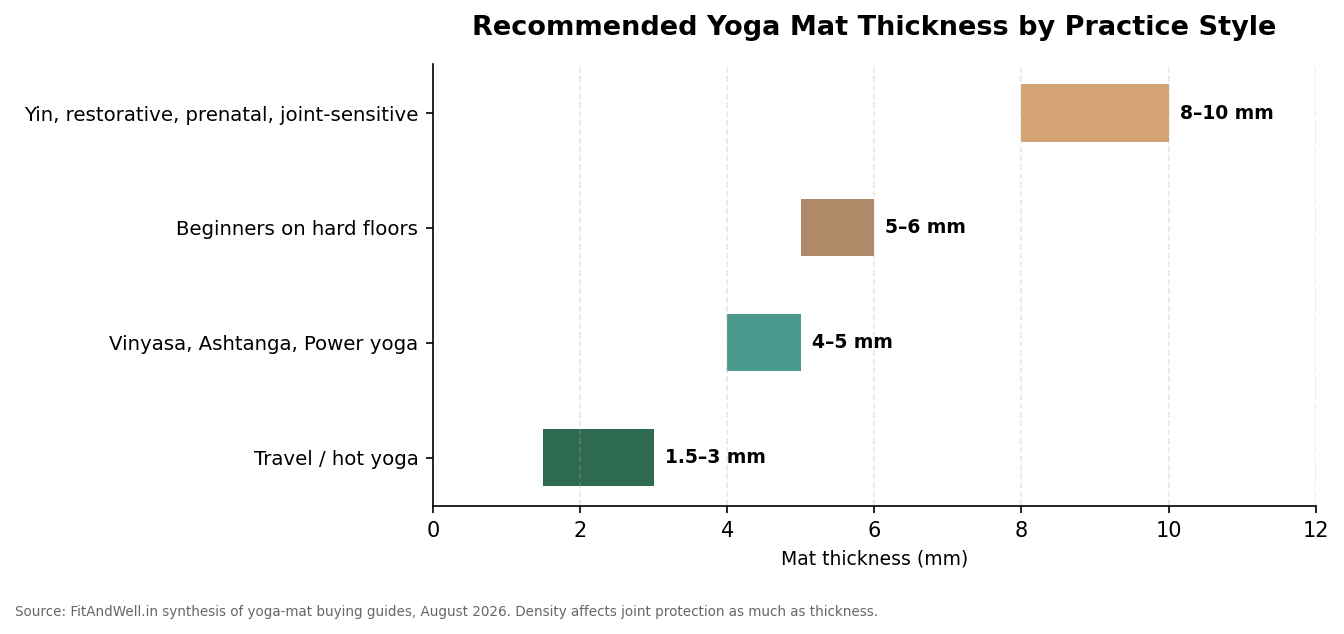
The important caveat, repeated across every buying guide checked for this piece: thickness alone doesn’t determine comfort. Density does. A high-density 4mm mat can protect joints better than a low-density 6mm mat, because cheap, low-density foam contains air pockets that collapse under pressure, a problem sometimes called “bottoming out”. A simple in-shop test is to press a thumb firmly into the mat. If it springs back quickly, the density is good. If your thumb sinks in and stays, expect it to compress underfoot within a few weeks of regular use.
If wrist pain is a specific concern, it’s usually a symptom of a mat that’s too soft rather than too thin: the heel of the hand sinks into the foam while the fingers stay higher, over-extending the wrist in poses like Downward Dog and Plank. A firmer, denser mat generally resolves this better than simply buying a thicker one.
2. Material: PVC, TPE, natural rubber, cork or jute
Material decides grip, eco-friendliness, weight, durability and price, roughly in that order of impact on your day-to-day experience.
PVC (polyvinyl chloride) is the most common and most affordable mat material. It’s durable, provides good cushioning, and holds its shape well over years of use. The trade-off is that it isn’t biodegradable, involves chemical processing, and its closed-cell structure means sweat sits on the surface rather than being absorbed, which can make PVC mats slippery once you start perspiring.
TPE (thermoplastic elastomer) is a blend of plastic and rubber polymers developed as a lighter, more eco-conscious alternative to PVC. TPE mats are typically non-toxic and recyclable, offer good anti-slip texture and elastic rebound, and are noticeably lighter to carry than rubber. The main downside is durability: TPE mats tend to wear out and lose their grip texture faster than PVC or natural rubber under heavy daily use.
Natural rubber is harvested from rubber trees and is generally rated the best performer for grip, particularly once the mat warms up during practice, since its open-cell structure responds to moisture rather than repelling it. That makes it a strong pick for hot yoga and anyone who sweats heavily. It’s also naturally antimicrobial. The trade-offs are weight, a noticeable rubber smell when new, a higher price, and the fact that anyone with a latex allergy needs to avoid it entirely.
Cork mats pair a cork surface (often bonded to a TPE or rubber base) and are prized for being naturally antimicrobial and for improving grip specifically when wet, since cork’s texture becomes tackier with moisture rather than more slippery. Cushioning tends to be lighter than a pure rubber or thick PVC mat.
Jute and cotton mats are the most natural, biodegradable options, soft underfoot and well suited to gentler practice, but they generally offer less cushioning and a looser weave than the synthetic and rubber alternatives, so they suit Hatha and restorative practice better than a sweaty Vinyasa flow.
The dashboard below scores each material across the five factors that matter most for a home practice: grip when dry, grip once you’re sweating, eco-friendliness, durability, and how kind it is to your wallet.
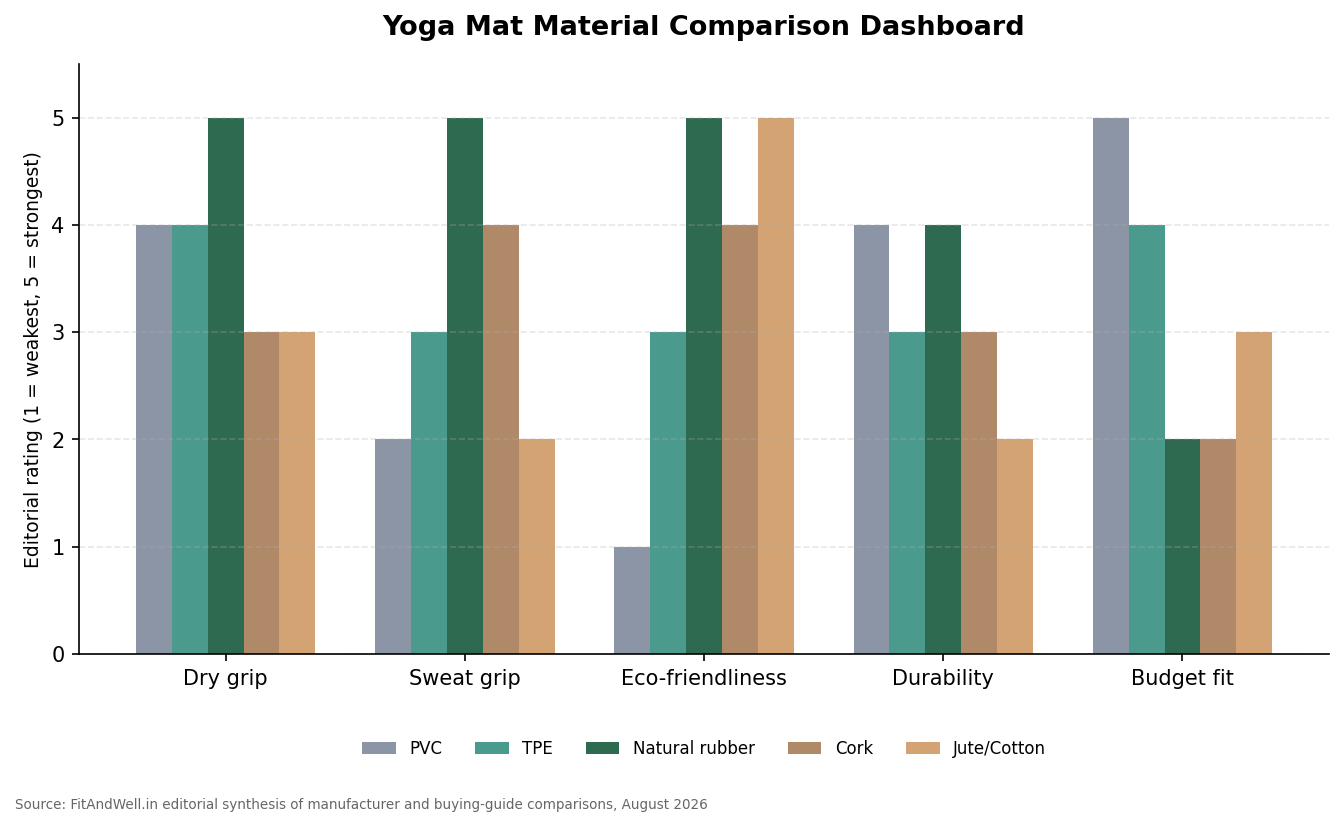
Read this as directional guidance rather than a lab measurement: it’s an editorial synthesis of how manufacturer and buying-guide sources consistently rank each material, not a controlled test FitAndWell ran on physical mats. If a specific product’s marketing claims conflict sharply with this pattern, treat that as a reason to check independent reviews before buying.
3. Grip and texture for Indian conditions
Grip is the one spec where “it depends on your climate” is genuinely the right answer. Practising in a non-air-conditioned room through an Indian summer, or in a heated studio class, puts far more sweat on a mat than a cool-weather practice does, and materials respond to that moisture very differently.
PVC’s smooth, closed-cell surface tends to get slippery once sweat pools on top, which is why practitioners of hot yoga on PVC mats often end up reaching for a separate towel. Natural rubber and textured TPE surfaces generally hold grip better as they get damp. If you sweat heavily or plan on hot yoga specifically, prioritise natural rubber or a textured, sweat-rated TPE mat over a smooth PVC one, even if PVC is cheaper.
4. Size, weight and portability
A standard mat is around 68 inches (173cm) long and 24 inches (61cm) wide, which is enough for most adults but can feel short if you’re above roughly 5’10” (178cm), in which case a longer 72-inch to 74-inch mat avoids your hands or feet running off the edge in poses like Downward Dog. Width matters less often, but if you tend to move your feet wide in standing poses, a slightly wider mat gives more margin.
Weight is a straightforward trade-off against thickness and material: a thick natural rubber mat that’s excellent for a home restorative practice is a poor choice if you’re carrying it to a studio class on the metro every other day. If portability matters, a thinner TPE mat or a foldable travel mat suits that use case far better than the plushest option in the shop.
A simple decision framework
If you’re a complete beginner starting a home practice on a hard floor (tile or wood), a 5mm to 6mm TPE mat gives the most forgiving combination of cushioning and price. If comfort matters more to you than balance work at this stage, a thicker NBR foam mat such as the AmazonBasics Extra Thick Exercise Yoga Mat is a reasonable, budget-friendly alternative, reviewed in more detail below.
If you sweat heavily, do hot yoga, or practise Vinyasa and Power yoga regularly, prioritise natural rubber or a sweat-rated textured mat over cushioning, since grip failure is a bigger risk than joint discomfort at that pace.
If your practice is mostly Yin, restorative, prenatal, or you have known knee, hip or wrist sensitivity, look at 8mm to 10mm mats and check density carefully rather than defaulting to the thickest one available.
If you’re travelling frequently or commuting to a studio, weight and foldability should outrank cushioning; a 1.5mm to 3mm TPE travel mat is the standard pick.
Once you’ve settled on the right mat, our guide to yoga for weight loss and our beginner-friendly weight-loss pose sequence are good next stops for what to actually practise on it. If your goal is winding down rather than building a sweat, yoga nidra for sleep and stress relief pairs well with a thicker, more cushioned mat. And if you’re practising through a specific life stage, our guide to yoga for menopause in India covers pose modifications worth knowing.
Our pick: AmazonBasics Extra Thick Exercise Yoga Mat
If you want a straightforward, budget-friendly mat that leans into cushioning rather than trying to be everything, the AmazonBasics Nitrile Butadiene Rubber 13mm Extra Thick Yoga and Exercise Mat with Carrying Strap is worth a look.
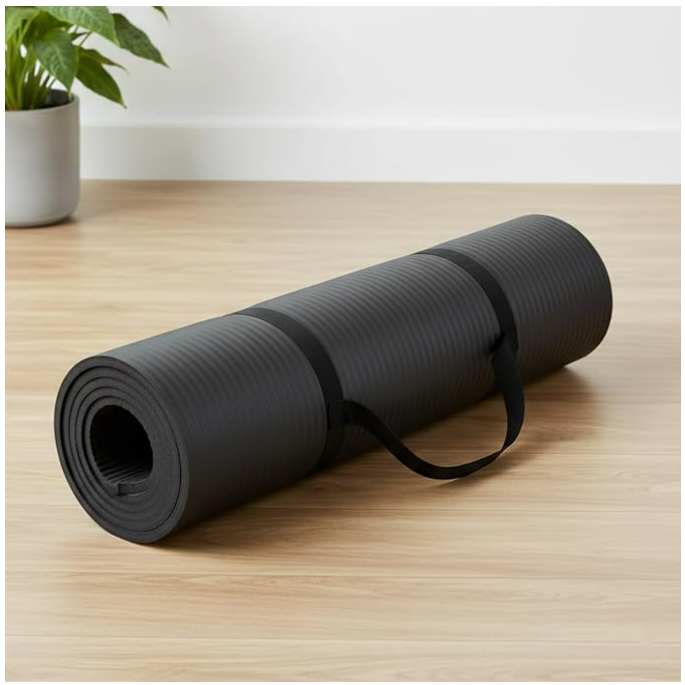
It’s a 13mm NBR (Nitrile Butadiene Rubber) foam mat with a textured, ridged surface, comes with an elastic carrying strap, and is listed on Amazon at 4.0 stars from over 33,000 ratings at the time of writing, priced at roughly ₹1,200 to ₹1,600 depending on ongoing offers. Amazon pricing and offers change frequently, so treat the exact figure on the product page as current rather than what’s printed here.
That thickness places it firmly in restorative and hard-floor-beginner territory rather than the 4mm to 6mm range this guide recommends for active Vinyasa or balance-heavy practice, so it’s a better fit if your priority is knee and hip comfort during floor-based poses than if you’re working on standing balances early on. NBR foam is a budget-friendly, cushioned material distinct from the PVC, TPE and rubber options covered above; it isn’t positioned as an eco-friendly or premium-grip material, so treat it as a comfort-first, price-conscious pick rather than a hot-yoga mat.
CHECK CURRENT PRICE ON AMAZON →
Frequently asked questions
Is a thicker yoga mat always better for beginners?
No. Thickness helps with knee and hip comfort during floor-based poses, but past roughly 6mm to 8mm it starts working against balance in standing poses, since a thick, soft surface makes the ankles work harder to stay stable. Density matters more than raw thickness: a firm 4mm mat can outperform a soft 8mm mat for joint protection.
What’s the best yoga mat material for hot, humid Indian weather?
Natural rubber and textured TPE mats generally hold their grip better as they get damp with sweat, compared with PVC, whose smooth, closed-cell surface tends to get slippery once moisture sits on top. If you sweat heavily or practise hot yoga, weigh that trade-off above price and cushioning.
How do I know if a yoga mat is good quality before buying it online?
Since you can’t do the thumb-press density test online, check the listed density or weight per square metre where the seller provides it (heavier usually means denser for a given thickness), read reviews specifically for comments about the mat flattening or losing grip within weeks, and prefer listed materials (TPE, natural rubber) over generic “eco foam” descriptions with no material named.
Do I need a yoga mat for beginner practice, or can I use a folded towel or blanket?
A folded towel works for the first session or two while you decide if yoga is for you, but it slides on hard floors and offers uneven cushioning under the knees and hands, which increases the chance of a slip in standing poses. A basic TPE mat is inexpensive enough that it’s worth buying before your second or third class.
How often should I replace my yoga mat?
There’s no fixed timeline, since it depends heavily on material, density and how often you practise. The clearer signal is the mat itself: once it stops springing back after the thumb-press test, develops a permanently indented “footprint” where your hands and feet land, or the surface texture has worn smooth and grip has noticeably dropped, it’s past the point of doing its job properly, regardless of how many months old it is.
Can I use a yoga mat for other workouts like Pilates or bodyweight training?
Yes, with a caveat on thickness. A standard 4mm to 6mm yoga mat works fine for Pilates and general bodyweight or stretching routines. For exercises involving jumping or repeated impact, a dedicated, denser exercise mat in the 10mm to 15mm range gives better shock absorption than a yoga mat designed primarily for stillness and balance.
The bottom line
For most beginners starting a home practice in India, a 4mm to 6mm TPE mat is the sensible default: enough cushioning to protect knees and wrists on a hard floor, light enough to move around the house or take to a class, and inexpensive enough that upgrading later to natural rubber, once you know your practice style and how heavily you sweat, isn’t a wasted purchase. Thickness and material both matter, but density is the variable most buying guides warn shoppers to check, and most beginners skip.
Sources
- Liforme. ‘How Thick Should a Yoga Mat Be? (2mm, 4mm, & 5mm Compared).’ Accessed August 2026. https://liforme.com/pages/how-thick-should-a-yoga-mat-be
- Yoga Design Lab. ‘What Is the Best Thickness for Yoga Mats? A Quick Guide.’ Accessed August 2026. https://yogadesignlab.com/blogs/yoga-gear/what-is-the-best-thickness-for-yoga-mats
- Hugger Mugger. ‘What Thickness for Yoga Mat? Guide to Comfort & Stability.’ Accessed August 2026. https://www.huggermugger.com/blogs/yoga-gear/what-thickness-for-yoga-mat-the-complete-guide-to-comfort-and-stability
- Hugger Mugger. ‘Are Thick Yoga Mats Better? Find the Best Support for You.’ Accessed August 2026. https://www.huggermugger.com/blogs/yoga-gear/are-thick-yoga-mats-better-finding-the-right-support-for-you
- Aeromats. ‘Choosing the Right Workout Mat Thickness: A Buyer’s Guide.’ Accessed August 2026. https://www.aeromats.com/blogs/resources/yoga-mat-thickness-guide
- Yune Yoga. ‘Choosing the Right Material for Your Yoga Mat: A Comprehensive Guide.’ Accessed August 2026. https://yuneyoga.com/blogs/yoga-blog/choosing-the-right-material-for-your-yoga-mat-a-comprehensive-guide-2
- disruptsports. ‘TPE vs PVC vs Rubber Yoga Mats.’ Accessed August 2026. https://branded.disruptsports.com/blogs/blog/tpe-vs-pvc-vs-rubber
- Matelier Lab. ‘PVC vs Natural Rubber Yoga Mats: Sweat Grip & Eco Truths.’ Accessed August 2026. https://www.matelier.world/blog/eco-materials-insights/pvc-vs-natural-rubber-yoga-mats-sweat-grip-eco-truths/
- Asana At Home. ‘Yoga Mat TPE vs PVC: Which is Best and How to Choose?’ Accessed August 2026. https://asanaathome.com/yoga-mat-tpe-vs-pvc/