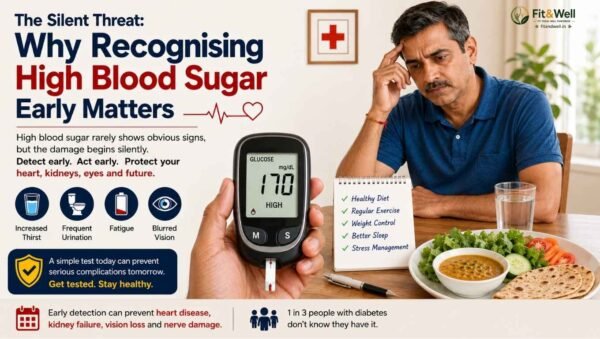

Finally, a Glucometer That Just Works!
After trying several blood glucose monitors over the years, I can confidently say the Accu-Chek Active Glucometer has become my go-to device for daily diabetes management. Here’s why this glucometer has earned a permanent spot in my healthcare routine.
Accu-Chek Active Glucometer Review: Accuracy, Running Cost and Who Actually Needs One
Accu-Chek Active Glucometer Review: Accuracy, Running Cost and Who Actually Needs One
Disclosure: This review contains affiliate links. If you buy through them, Fit & Well earns a small commission at no extra cost to you, and it never affects what we recommend. We bought this glucometer ourselves at retail price. Roche did not pay for, see or approve this review. Read our editorial policy.
The Accu-Chek Active is a basic, no-coding blood glucose meter that Roche states meets the ISO 15197:2013 accuracy standard. Roche lists a sample size of 1 to 2 microlitres and a result in about five seconds, and the starter kit sells for around Rs 1,043 on Roche’s own India store.
Ready to buy? Get the Accu-Chek Active on Amazon →
For most people managing type 2 diabetes at home in India, it does the job. The meter is also not the expensive part. The strips are, and that is where this review starts.
What the Accu-Chek Active actually is
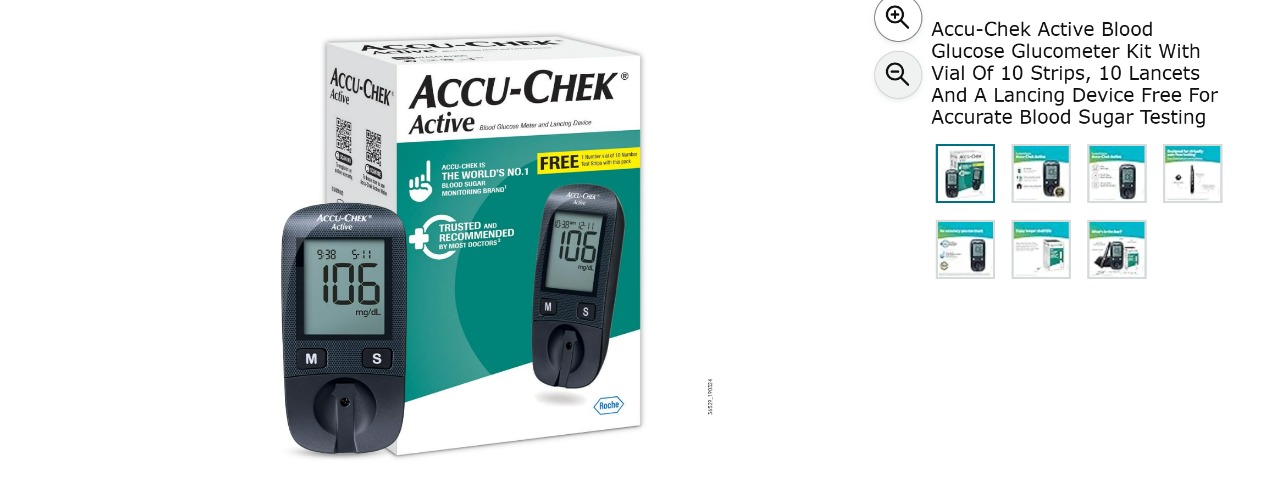
It is Roche’s entry-level meter, sold in India as a kit containing the meter, ten test strips, a Softclix lancing device, ten lancets, a carry case, a battery and the manual.
Here is what Roche publishes about it.
| Specification | Value stated by Roche |
|---|---|
| Blood sample needed | 1 to 2 microlitres |
| Time to result | About 5 seconds with the strip in the meter, about 8 seconds if applied outside |
| Measuring range | 10 to 600 mg/dL |
| Memory | 500 results with time and date, plus 7, 14, 30 and 90 day averages |
| Coding | Not required |
| Battery | One CR2032, about 1,000 tests or roughly a year |
| Data transfer | USB |
Two of these matter more in daily use than a spec sheet suggests.
Roche says the meter detects an underdose and allows about ten seconds to add more blood to the same strip. If it works as described, that saves a wasted strip and a second finger prick, which is not trivial at these strip prices.
Roche also describes the meter as running on two buttons, with pre-meal and post-meal markers. Simplicity is worth something when the person testing has poor eyesight or unsteady hands.
The no-coding design removes a step as well. Roche states only that “no coding reduces handling steps”, so treat that as a design claim rather than a measured benefit.
Is it accurate? What the standard actually requires
Most glucometer reviews wave at the word “accurate” and move on. It has a precise meaning.
ISO 15197 is titled In vitro diagnostic test systems: Requirements for blood-glucose monitoring systems for self-testing in managing diabetes mellitus. ISO’s catalogue lists the second edition, dated May 2013, as published, and says the standard covers the validation of performance by the intended users, not laboratory performance alone.
The 2013 criteria, as summarised by clinical biochemist Dr Gary Thorpe of the University of Birmingham for the Association of British Clinical Diabetologists, are these.
For each strip lot, 95 per cent of results must fall within 15 mg/dL of a laboratory reference when glucose is below 100 mg/dL, and within 15 per cent at 100 mg/dL and above. Separately, 99 per cent of pooled results must land in zones A and B of the consensus error grid.
The 2003 edition was looser, allowing 20 per cent deviation above 75 mg/dL. A meter that passed the old standard is not necessarily meeting the newer one. The full ISO text sits behind a paywall, so the thresholds here come from that summary rather than from the standard itself.
Roche states that the Accu-Chek Active bGM system meets the DIN EN ISO 15197:2013 requirements. That is the manufacturer’s own claim. Roche is a serious diagnostics company and the claim is plausible, but a manufacturer testing its own device is not an independent finding, and Roche does not publish a third-party evaluation of this model on its India pages.
Compliance with that standard is what the Research Society for the Study of Diabetes in India asks for. Its 2024 consensus states that SMBG devices should comply with the ISO 15197:2013 requirements. Whether the Active meets it rests, for now, on Roche’s word.
Two things are worth understanding before treating any home reading as final.
Passing is a floor, not a grade. In a 2018 evaluation published in Diabetes Therapy, systems that all cleared the same threshold still returned 96, 98 and 100 per cent of results within limits. All passed. They were not equally accurate.
In that same evaluation, three of the four systems tested met the ISO 15197:2013 criteria, so one did not. That paper does not concern the Accu-Chek Active, and nothing here should be read as evidence about this meter either way.
Meters do slightly worse in real hands. The same paper found that systems showed slightly better accuracy for study personnel than for lay users, with errors including not checking the strips’ expiry date and applying blood incorrectly. Its authors also warn that lot-to-lot variations between multiple test strips can markedly affect a system’s accuracy. That is a good reason to be suspicious of an unexplained shift in your readings after opening a new vial.
A useful benchmark from Mayo Clinic: results within 15 per cent of the lab reading are considered accurate. If yours are persistently further out, it is worth testing on the meter at the same visit as your next blood draw and comparing.
The real cost is the strips
The kit is a one-off. Roche’s India store lists it at Rs 1,043 against an MRP of Rs 1,098, checked on 26 August 2026. Strips come in packs of 10, 25, 50 and 100.
Strip pricing is where the arithmetic bites. The RSSDI consensus puts test strips in India at roughly Rs 660 to Rs 1,245 per 50 across brands, and lancets at Rs 105 to Rs 200 per 100.
Now apply the monitoring RSSDI actually recommends.
Someone newly diagnosed or poorly controlled, whether on tablets or insulin, is advised to test at least four times a day. That is about 120 strips a month, so a pack of 50 lasts under a fortnight. At RSSDI’s price range, that works out at roughly Rs 1,600 to Rs 3,000 a month, before lancets.
Once control is stable, the advice drops sharply, to four tests a week on consecutive or alternate days, including one fasting and three post-meal values. That is about 17 strips a month, so a pack of 50 lasts around three months, and the cost falls to roughly Rs 230 to Rs 430 a month.
So read the price tag this way. The meter costs about a thousand rupees once. The habit costs somewhere between roughly Rs 230 and Rs 3,000 a month depending on your treatment and how well controlled you are. Budget for the second number, because that is the one that makes people quietly stop testing.
Do you actually need a glucometer?
Not everyone with diabetes does, and buying one you will not use is worse than not buying one.
ICMR’s 2018 guidelines for type 2 diabetes list self-monitoring as indicated for everyone with diabetes wanting better control, all people on insulin, brittle diabetes, anyone prone to ketosis or recurrent hypoglycaemia, hypoglycaemia unawareness, and any situation needing tight control such as pregnancy, acute illness or complications. ICMR adds that frequency should be individualised.
The strongest case is insulin. If you adjust doses from readings, the meter is not optional and its accuracy is not academic, because a wrong reading becomes a wrong dose.
The weakest case is well-controlled type 2 diabetes on diet alone, tested at random once a fortnight. That produces anxiety and a number with no context. RSSDI is direct about this, stating that structured SMBG is preferred over unstructured SMBG to understand the blood glucose pattern. A planned week of paired before and after meal readings tells you something. A random Tuesday morning number does not.
If you have not been diagnosed and are buying a meter because you are worried, that is the wrong first step. Diagnosis needs a laboratory test, not a home meter. Read our guide to the early signs of high blood sugar and see a doctor.
The scale of the problem is worth stating. India had an estimated 101 million people with diabetes and 136 million with prediabetes in 2021, according to the ICMR-INDIAB study. WHO notes separately that more than half of people with diabetes in India are unaware of their status.
What the numbers should look like
Readings only mean something against a target. ICMR’s 2018 guidelines set these.
| Measure | Ideal | Satisfactory | Unsatisfactory |
|---|---|---|---|
| Fasting plasma glucose | 80 to 110 mg/dL | 111 to 125 mg/dL | Above 125 mg/dL |
| 2 hour post-meal | 120 to 140 mg/dL | 141 to 180 mg/dL | Above 180 mg/dL |
| HbA1c | Under 7% | 7 to under 8% | 8% or above |
These are general targets. Yours may be set differently, so agree them with your doctor rather than adopting the table.
Post-meal numbers are also easier to move than most people expect, largely through what is on the plate. Our guides to the glycaemic index of Indian foods and foods that help manage diabetes in India cover the practical side, and insulin resistance explains what is driving the numbers underneath.
What makes readings wrong
Most bad readings are not the meter’s fault. Mayo Clinic’s guidance covers the common causes.
Dirty or wet hands. Wash and dry hands and the test site with soap and water. Mayo Clinic advises against hand sanitiser before testing, and says that if you use an alcohol wipe, let it dry completely first.
A second drop of blood. Apply one generous drop, and do not add more after the first drop has gone on.
Old or badly stored strips. Keep them sealed and away from moisture and humidity, and throw away anything damaged or past its expiry date. In an Indian monsoon that matters more than the packaging suggests.
Anaemia and dehydration. Mayo Clinic notes that a low red blood cell count or dehydration can make results less accurate. That is worth knowing here, because iron deficiency anaemia is a common problem in India, particularly among women. If you are anaemic and your meter disagrees with your lab results, raise it with your doctor rather than blaming the device.
An old meter. Mayo Clinic recommends replacing the monitor every four to five years.
Roche adds its own operating limits for the Active. Testing should happen between 8 and 42 degrees Celsius and up to 85 per cent relative humidity, and the meter is rated from sea level to 4,000 metres. Roche also lists conditions under which a reading should not be trusted: ambient temperature outside that range, exposure to strong electromagnetic fields, and removing and reinserting a strip more than 20 seconds later.
Those temperature and altitude limits are easier to breach in India than they sound. A meter left in a parked car through a north Indian summer afternoon, or carried on a high-altitude trip, is worth a moment’s thought before you trust the next reading.
Where it falls short
The Active is deliberately basic, and the omissions are real.
Roche lists USB as the data transfer method, with no wireless option. If you want readings flowing automatically into a phone app for a doctor to review, this is the wrong meter. What you get instead is the 500-result memory and the on-device 7, 14, 30 and 90-day averages.
There is no continuous monitoring, and Roche’s specification lists no insulin dose calculator. Anyone on intensive insulin who wants dose support should be looking at a different class of device and discussing it with their diabetologist.
And as noted above, Roche publishes a compliance claim for this model but not the underlying evaluation data. You are trusting a manufacturer statement rather than reading a third-party result.
Frequently asked questions
Does the Accu-Chek Active need coding? No. Roche states that the design requires no coding.
How much blood does it need? Roche specifies 1 to 2 microlitres, which is a small drop. Roche also states that if you under-apply, the meter detects it and allows about ten seconds to add more to the same strip.
How often should I test if I have type 2 diabetes? It depends on your treatment and your control. RSSDI’s 2024 consensus advises at least four tests a day for anyone newly diagnosed or poorly controlled, on oral medication or insulin. Once stable, it advises about four tests a week on consecutive or alternate days, including one fasting and three post-meal readings. ICMR says frequency should be individualised, so agree a pattern with your doctor rather than testing at random.
Can I use it to find out whether I have diabetes? No. A home meter is for managing a known condition, not diagnosing one. Diagnosis needs laboratory testing.
Why does my meter reading differ from my lab result? Some difference is normal. Mayo Clinic treats results within 15 per cent of the lab reading as accurate. Persistent larger gaps are worth investigating, and anaemia, dehydration, expired strips, a new strip lot and testing outside the meter’s stated temperature range are all plausible causes.
How long does the battery last? Roche states about 1,000 tests or roughly a year on a single CR2032.
The bottom line
The Accu-Chek Active is a sensible, unglamorous choice for home glucose monitoring in India. It is cheap to buy, simple to operate, and Roche states it meets the current ISO accuracy standard.
Buy it if you have diagnosed diabetes, you and your doctor have agreed a testing pattern, and you can sustain the strip cost at the frequency your treatment actually requires. Look elsewhere if you want app connectivity, or if you are on intensive insulin and would benefit from dose support or continuous monitoring.
Do not buy it to find out whether you have diabetes. That is a job for a laboratory and a doctor.
Buy on Amazon
This article is for general information and is not a substitute for personalised medical advice. Do not start, stop or change any diabetes treatment, including insulin doses, based on what you read here. Discuss your monitoring plan and your glucose targets with your doctor or diabetes educator.
Sources
- International Organisation for Standardisation. ISO 15197:2013, In vitro diagnostic test systems: Requirements for blood-glucose monitoring systems for self-testing in managing diabetes mellitus. Edition 2, May 2013. iso.org
- Thorpe G, University of Birmingham. Presentation slides on blood glucose meter accuracy, Association of British Clinical Diabetologists, 2014. abcd.care
- Roche Diabetes Care India. Accu-Chek Active product specifications. accu-chek.in
- Roche Diabetes Care India. Accu-Chek Active support and operating conditions. accu-chek.in
- Roche Diabetes Care India. Accu-Chek Active Glucometer Kit. Official India store, prices checked 26 August 2026. shop.accu-chek.in
- Research Society for the Study of Diabetes in India. RSSDI Expert Consensus for Optimal Glucose Monitoring in Diabetes Mellitus in India and Recommendations for Clinical Practice. 2024. rssdi.in
- Indian Council of Medical Research. ICMR Guidelines for Management of Type 2 Diabetes. 2018. icmr.gov.in
- Freckmann G, et al. Diabetes Therapy, 2018. doi:10.1007/s13300-018-0392-6. link.springer.com
- Mayo Clinic. Blood glucose monitors: What factors affect accuracy? Last reviewed 15 December 2023. mayoclinic.org
- Madhu SV. Defying the Odds: Conquering Prediabetes for a Diabetes-Free Tomorrow. Indian Journal of Endocrinology and Metabolism, 2023;27(4):273-276, citing Anjana RM, et al, Lancet Diabetes Endocrinol 2023;11:474-89. pmc.ncbi.nlm.nih.gov
- World Health Organization India. Diabetes. who.int