
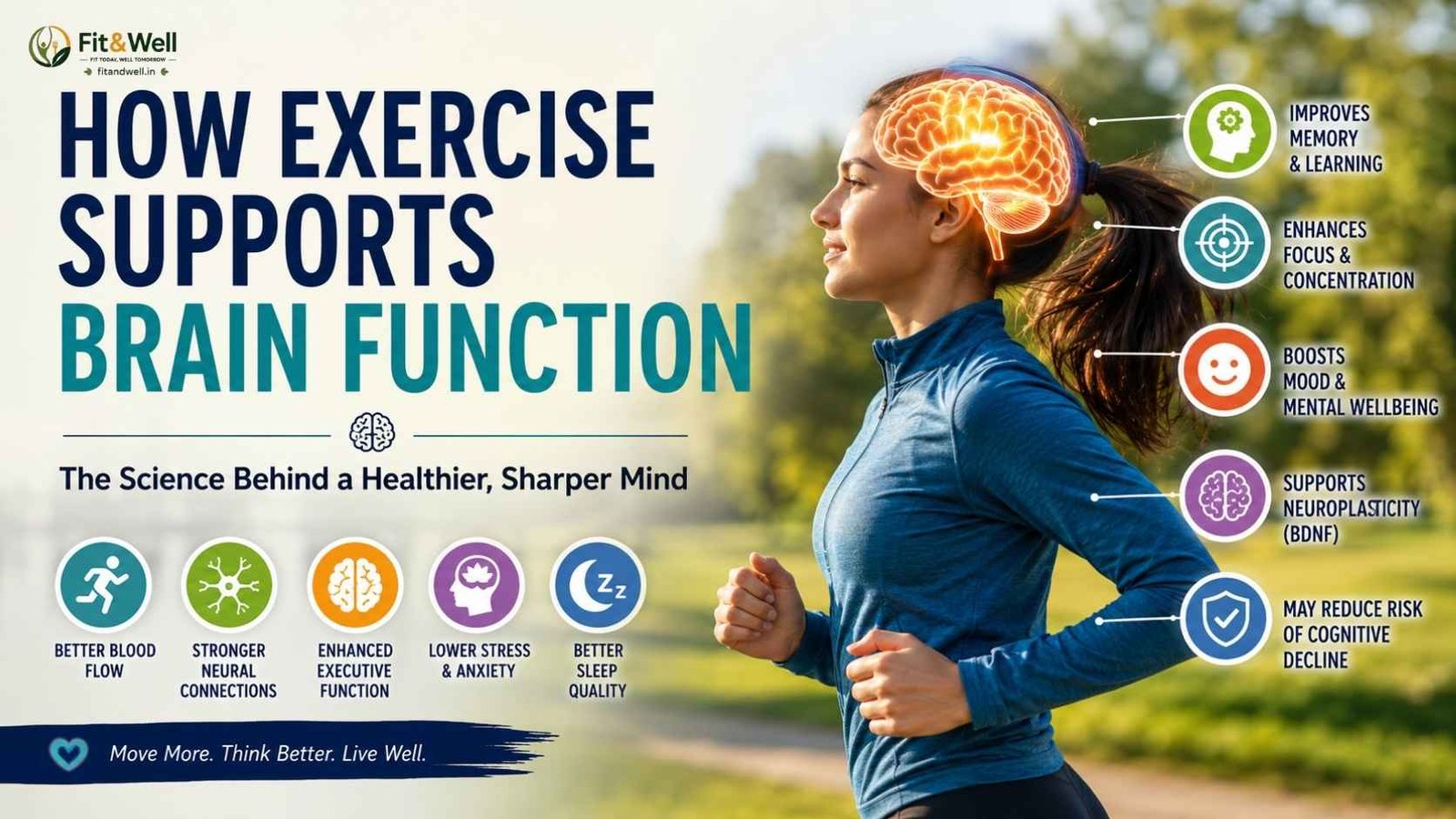
For decades, physical movement was primarily viewed through the lens of cardiovascular health and body composition. However, modern neurobiology has revealed a far more profound truth about how Exercise Supports Brain Function.
The fundamental truth is that your muscles are an endocrine organ for your brain.
Every time you go for a brisk walk, lift weights, or go for a swim, your body releases a complex cascade of neurochemicals, triggers structural remodelling in key memory centres, and enhances metabolic efficiency. Physical activity is one of the most effective, science-backed interventions available for optimising cognitive performance and safeguarding long-term brain health.
For decades, exercise has been recognised as one of the most effective ways to improve physical health. However, research over the last two decades has revealed something equally remarkable: regular physical activity is one of the most powerful lifestyle habits for maintaining a healthy brain.
Whether you enjoy walking, cycling, swimming, resistance training or yoga, moving your body benefits far more than your muscles and heart. Exercise influences how your brain functions, adapts and ages. It improves memory, sharpens concentration, supports emotional wellbeing and may even reduce the risk of cognitive decline later in life.
According to the World Health Organisation, regular physical activity enhances brain health, cognitive function and overall wellbeing across all age groups. Yet despite these well-established benefits, around 31% of adults worldwide and 80% of adolescents still fail to meet the recommended levels of physical activity.
Understanding how exercise benefits the brain helps explain why health professionals consistently recommend staying active—not only for physical fitness but also for long-term cognitive health.
Key Research Finding: In a pivotal randomised controlled trial published in the Proceedings of the National Academy of Sciences, researchers demonstrated that 1 year of moderate aerobic exercise increased anterior hippocampal volume by 2%, effectively reversing age-related tissue loss by 1 to 2 years.
Why Brain Health Matters
The brain is the body’s control centre. It regulates every thought, memory, movement, emotion and decision while coordinating billions of nerve cells through an intricate network of electrical and chemical signals.
Although it accounts for only a small proportion of total body weight, the brain consumes an extraordinary amount of energy. To function efficiently, it requires a continuous supply of oxygen, glucose and nutrients delivered through healthy blood circulation.
Throughout life, the brain constantly changes.
- During childhood, it rapidly develops new neural pathways.
- During adulthood, it continues adapting through learning and experience.
- During older age, natural biological changes can gradually affect memory, attention and processing speed.
While ageing cannot be stopped, numerous lifestyle factors influence how well the brain continues to function. Among these, regular physical activity has emerged as one of the strongest evidence-based strategies for maintaining cognitive health.
The Brain’s Ability to Adapt
For many years, scientists believed the adult brain was relatively fixed and incapable of significant change.
Modern neuroscience has overturned that assumption.
Today, researchers know that the brain possesses an extraordinary ability known as neuroplasticity.
Neuroplasticity refers to the brain’s ability to:
- Form new neural connections
- Strengthen existing pathways
- Reorganise damaged circuits
- Adapt to new experiences
- Improve communication between brain cells
Every time you learn a new language, master a musical instrument or solve a challenging problem, your brain modifies its neural networks.
Exercise is now recognised as one of the most effective ways to support this lifelong adaptability.
How Exercise Supports Brain Function
Exercise does not benefit the brain through a single biological process. Instead, it produces a range of interconnected changes that collectively improve brain health.
Researchers have identified several key mechanisms, including:
- Increased cerebral blood flow
- Improved cardiovascular function
- Greater oxygen and nutrient delivery
- Enhanced neuroplasticity
- Increased production of neurotrophic factors
- Better neurotransmitter regulation
- Reduced chronic inflammation
- Lower oxidative stress
- Improved sleep quality
- Enhanced metabolic health
Together, these changes create an environment that allows neurons to function more efficiently and communicate more effectively.
Improved Blood Flow: Feeding the Brain
Although the brain represents only around 2% of total body weight, it consumes approximately 20% of the body’s oxygen supply.
This remarkable energy demand means healthy circulation is essential for optimal cognitive function.
During physical activity, the heart pumps more efficiently, increasing blood flow throughout the body—including the brain.
Greater cerebral blood flow delivers:
- Oxygen
- Glucose
- Nutrients
- Hormones
- Immune cells
At the same time, it helps remove metabolic waste products produced by active brain cells.
Research suggests that regular aerobic exercise also improves the health and flexibility of blood vessels supplying the brain. Healthier blood vessels contribute to better cerebral circulation and may support cognitive performance throughout life.
More Oxygen Means Better Cognitive Performance
Neurons require a continuous supply of oxygen to produce the energy needed for communication.
When oxygen delivery improves, brain cells are generally better equipped to perform demanding cognitive tasks.
Researchers have observed improvements in:
- Attention
- Mental clarity
- Reaction time
- Information processing
- Decision-making
Many people experience these effects after a brisk walk or moderate workout.
Scientific evidence indicates that even a single session of moderate physical activity can temporarily improve executive function, working memory and attention.
These immediate benefits demonstrate how rapidly the brain responds to movement.
Exercise Encourages Neuroplasticity
Learning depends on the brain’s ability to build and strengthen neural connections.
Exercise supports this process by encouraging biological changes that promote communication between neurons.
Repeated physical activity appears to:
- Strengthen existing neural pathways
- Improve synaptic efficiency
- Support learning
- Reinforce memory formation
- Increase the brain’s adaptability
This is one reason physically active individuals often perform better in tasks involving learning and problem-solving.
Brain-Derived Neurotrophic Factor (BDNF): Supporting Brain Cell Health
One of the most studied biological mechanisms linking exercise and brain function involves Brain-Derived Neurotrophic Factor (BDNF).
BDNF is a naturally occurring protein that supports:
- Neuron survival
- Synaptic communication
- Learning
- Memory formation
- Neuroplasticity
Although it is sometimes described as “brain fertiliser”, this phrase is simply a metaphor. BDNF does not literally fertilise the brain. Instead, it helps maintain healthy neurons and supports communication between them.
Research indicates that aerobic exercise—particularly moderate-intensity activities such as brisk walking, running and cycling—can increase BDNF production. However, responses vary depending on factors such as age, exercise intensity, overall health and the timing of measurements.
Scientists continue to investigate exactly how BDNF contributes to long-term improvements in cognition, but it is widely regarded as one of the key biological pathways influenced by regular exercise.
While this article focuses on brain health, regular walking also supports overall fitness. If your goal is to lose weight, read our comprehensive guide on walking-for-weight-loss.
Stronger Connections Between Brain Cells
The human brain contains billions of neurons connected through trillions of synapses.
Every thought, memory and movement depends on signals passing efficiently across these microscopic connections.
Exercise appears to strengthen synaptic communication by improving the health and efficiency of these neural networks.
Better communication between neurons supports:
- Faster learning
- Improved recall
- Greater cognitive flexibility
- Enhanced problem-solving
- More efficient information processing
Over time, these improvements contribute to healthier overall brain function.
The Hippocampus: A Critical Memory Centre
Among the many brain regions affected by exercise, the hippocampus has received particular attention from researchers.
Located deep within the temporal lobe, the hippocampus plays an essential role in:
- Forming new memories
- Learning new information
- Spatial navigation
- Consolidating long-term memories
Natural ageing is associated with gradual changes in the hippocampus, and reduced hippocampal volume has been linked with memory impairment and dementia.
Research suggests that regular physical activity may help preserve hippocampal structure and function.
Although scientists continue to investigate the precise biological mechanisms involved, maintaining an active lifestyle is consistently associated with better memory performance and healthier cognitive ageing.
Exercise Improves Executive Function
Executive function refers to the collection of mental skills responsible for organising, planning and regulating behaviour.
These skills include:
- Decision-making
- Planning
- Attention control
- Working memory
- Task switching
- Self-control
A comprehensive umbrella review published in the British Journal of Sports Medicine analysed numerous systematic reviews and meta-analyses. It concluded that exercise improves overall cognition, memory and executive function across children, adults and older adults.
Notably, the review found that even light- to moderate-intensity exercise can produce measurable cognitive benefits, reinforcing the message that every movement counts.
Better Mood Supports Better Thinking
Exercise affects not only the structure of the brain but also the chemical messengers that influence mood and cognition.
Physical activity stimulates the release of neurotransmitters including:
- Dopamine
- Serotonin
- Noradrenaline
These neurotransmitters help regulate:
- Motivation
- Mood
- Attention
- Learning
- Emotional wellbeing
Regular exercise has also been associated with lower levels of anxiety and depressive symptoms. Because mental wellbeing strongly influences concentration, memory and decision-making, these emotional benefits indirectly support cognitive performance.
The World Health Organisation recognises improved mental wellbeing as one of the major health benefits of regular physical activity.
Less Inflammation, Better Brain Health
Inflammation is a normal part of the body’s immune response.
However, chronic low-grade inflammation has been linked with numerous long-term health conditions, including cardiovascular disease, type 2 diabetes and cognitive decline.
Regular physical activity helps regulate inflammatory processes throughout the body.
Scientists believe this healthier inflammatory environment contributes to improved brain function by protecting neurons and supporting efficient communication between brain cells.
Although research continues to explore these biological pathways, reduced chronic inflammation is considered one of several mechanisms through which exercise supports healthy brain ageing.
What’s Next?
Exercise Strengthens Memory
Memory is not a single process but a collection of systems that allow us to store, retain and retrieve information. Some memories last only a few seconds, while others remain for decades. These processes rely heavily on healthy communication between neurons, particularly within the hippocampus and surrounding brain regions.
Research consistently shows that physically active individuals tend to perform better on memory-related tasks than those who are largely sedentary. Regular exercise has been associated with improvements in:
- Short-term memory
- Working memory
- Episodic memory
- Spatial memory
- Long-term memory retention
Scientists believe these improvements result from a combination of increased cerebral blood flow, enhanced neuroplasticity and the production of growth factors such as Brain-Derived Neurotrophic Factor (BDNF). Together, these changes create a healthier environment for learning and memory formation.
Importantly, memory benefits have been observed across different age groups, from school-aged children to older adults, although the magnitude of improvement varies between individuals.
Exercise Across Every Stage of Life
One of the strongest findings in exercise science is that brain benefits are not limited to a particular age group. Physical activity supports cognitive function throughout life, although the specific advantages differ depending on age and individual circumstances.
Children and Adolescents
Childhood is a period of rapid brain development. During these years, neural connections are constantly forming and being refined as children acquire new knowledge and skills.
Research suggests that regular physical activity may support:
- Attention and concentration
- Academic performance
- Executive function
- Working memory
- Behavioural regulation
Exercise also encourages healthy sleep patterns, which are essential for learning and memory consolidation.
The World Health Organisation recommends that children and adolescents aged 5–17 years engage in an average of at least 60 minutes of moderate- to vigorous-intensity physical activity each day, with activities that strengthen muscles and bones included at least three days per week.
Adults
For adults, physical activity helps maintain cognitive performance while supporting mental wellbeing and reducing several risk factors associated with brain disease.
Regular exercise has been linked with improvements in:
- Mental clarity
- Productivity
- Concentration
- Stress management
- Emotional resilience
People who maintain an active lifestyle also tend to experience better sleep quality, which plays an important role in memory formation and emotional regulation.
Older Adults
Ageing naturally brings changes in cognitive function. Processing speed may slow, multitasking can become more difficult and certain forms of memory may decline.
Although these changes are common, they are not identical for everyone.
Research indicates that maintaining regular physical activity throughout later life is associated with healthier cognitive ageing.
Exercise may help older adults maintain:
- Executive function
- Processing speed
- Balance
- Coordination
- Independence
- Overall quality of life
Importantly, physical activity also reduces the risk of falls by improving muscle strength and balance, offering both physical and cognitive benefits.
Can Exercise Reduce the Risk of Dementia?
This is one of the most frequently asked questions in neuroscience.
The short answer is possibly—but with important qualifications.
Current evidence does not support the claim that exercise can prevent Alzheimer’s disease or other forms of dementia.
However, a growing body of research suggests that regular physical activity is associated with a lower risk of cognitive decline and may help delay the onset of dementia in some individuals.
The exact reasons remain under investigation, but researchers believe exercise contributes through several pathways, including:
- Improved cardiovascular health
- Better blood flow to the brain
- Reduced inflammation
- Improved glucose metabolism
- Enhanced neuroplasticity
- Better management of conditions such as hypertension, obesity and type 2 diabetes, which are recognised risk factors for dementia
The National Institute on Aging, part of the US National Institutes of Health (NIH), notes that while exercise cannot currently be recommended as a guaranteed method of preventing dementia, maintaining an active lifestyle is considered an important component of healthy ageing.
Which Types of Exercise Benefit the Brain Most?
There is no single “best” exercise for brain health.
Instead, evidence suggests that a variety of physical activities can provide meaningful cognitive benefits.
Aerobic Exercise
Aerobic activities have been studied more extensively than any other form of exercise.
Examples include:
- Brisk walking
- Running
- Cycling
- Swimming
- Dancing
- Hiking
These activities improve cardiovascular fitness and increase blood flow throughout the body, including the brain.
Much of the available evidence supporting improvements in memory and executive function comes from studies involving aerobic exercise.
Resistance Training
Strength training offers benefits beyond building muscle.
Research indicates that resistance exercise may also support:
- Executive function
- Working memory
- Attention
- Overall cognitive health
Examples include:
- Free weights
- Resistance bands
- Bodyweight exercises
- Weight machines
The WHO recommends performing muscle-strengthening activities that target all major muscle groups at least 2 days per week.
Balance and Mind–Body Activities
Exercises such as yoga and tai chi combine movement with balance, breathing and mindfulness.
Although research is still developing, these activities appear to support:
- Stress reduction
- Emotional wellbeing
- Balance
- Attention
- Flexibility
Some studies also suggest modest cognitive benefits, particularly among older adults.
High-Intensity Interval Training (HIIT)
HIIT alternates short bursts of vigorous activity with periods of recovery.
Although early findings are promising, researchers continue to investigate its long-term effects on brain health.
Current evidence suggests that moderate-intensity exercise remains an effective and accessible option for most people.
How Much Exercise Is Recommended?
The World Health Organisation recommends that adults should aim for either:
- 150–300 minutes of moderate-intensity aerobic activity each week, or
- 75–150 minutes of vigorous-intensity aerobic activity each week,
along with muscle-strengthening activities involving major muscle groups on at least two days per week.
Importantly, the WHO also emphasises that some physical activity is better than none.
Even replacing periods of prolonged sitting with light movement can provide measurable health benefits.
Common Myths About Exercise and Brain Health
Myth 1: Only intense exercise benefits the brain
Fact: Moderate physical activity such as brisk walking consistently demonstrates cognitive benefits. Vigorous exercise is not essential for improving brain health.
Myth 2: Exercise creates new brain cells overnight
Fact: Exercise supports processes involved in neuroplasticity and may influence adult neurogenesis in specific brain regions, but scientists are still investigating the extent to which new neurons are generated in adult humans.
Myth 3: Exercise prevents Alzheimer’s disease
Fact: Current evidence suggests exercise may reduce the risk of cognitive decline and support healthy ageing, but it cannot currently be described as a proven method for preventing Alzheimer’s disease.
Myth 4: You’re too old to benefit
Fact: Research consistently shows that older adults continue to experience physical, cognitive and emotional benefits from regular physical activity.
Practical Tips for Supporting Brain Health Through Exercise
You do not need to become a marathon runner to experience meaningful cognitive benefits.
Simple habits can make a difference over time.
Walk More
Aim for a brisk walk most days of the week.
Reduce Sitting Time
Stand, stretch or take short walking breaks throughout the day.
Include Strength Training
Perform resistance exercises at least twice each week.
Stay Consistent
Long-term consistency is more important than occasional intense workouts.
Choose Activities You Enjoy
Enjoyable exercise is easier to maintain and more likely to become a lifelong habit.
Prioritise Recovery
Adequate sleep, hydration and balanced nutrition complement the cognitive benefits of exercise.
Key Takeaways
- Exercise benefits far more than physical fitness—it also supports brain health throughout life.
- Regular physical activity improves blood flow, neuroplasticity and communication between brain cells.
- Exercise enhances memory, executive function, attention and emotional wellbeing.
- Moderate-intensity exercise is sufficient to produce measurable cognitive benefits.
- Aerobic exercise, resistance training and mind–body activities all contribute to healthy brain function.
- Exercise is associated with a lower risk of cognitive decline, although it cannot be described as a proven method of preventing dementia.
- Consistency matters more than intensity, and even small increases in daily movement can improve overall health.
To explore the precise timelines and neural mechanisms of these structural changes further, check out The Real Reason Exercise Boosts Your Brain Power by Dr Tracey Marks. This video provides a clear, evidence-backed overview of how physical movement transforms neural circuitry and supports lifelong cognitive resilience.
Frequently Asked Questions
Does walking improve brain function?
Yes. Research suggests that regular brisk walking supports blood flow to the brain, improves cardiovascular health and may enhance memory, attention and executive function.
How quickly does exercise affect the brain?
Some cognitive improvements, particularly in attention and executive function, may occur after a single session of moderate exercise. Long-term structural and functional changes require consistent physical activity over weeks, months and years.
Is aerobic exercise better than strength training for brain health?
Aerobic exercise has been studied more extensively, but current evidence suggests both aerobic and resistance training contribute to cognitive health. Combining different forms of exercise is likely to provide the greatest overall benefits.
How much exercise should I do for brain health?
The WHO recommends 150–300 minutes of moderate-intensity aerobic activity or 75–150 minutes of vigorous-intensity activity each week, together with muscle-strengthening exercises on at least two days.
Can exercise improve memory at any age?
Yes. Research has found memory benefits in children, adults and older adults, although the extent of improvement depends on factors such as age, health status and exercise habits.
Conclusion
The scientific evidence supporting exercise as a powerful tool for brain health has never been stronger. Regular physical activity does far more than strengthen muscles or improve cardiovascular fitness—it helps create an environment in which the brain can function more efficiently, adapt to new challenges and remain resilient throughout life.
By improving cerebral blood flow, promoting neuroplasticity, supporting healthy neurotransmitter activity and reducing chronic inflammation, exercise contributes to better memory, sharper thinking and improved emotional wellbeing. These benefits have been observed across the lifespan, from childhood through older adulthood, making physical activity one of the most accessible strategies for supporting lifelong cognitive health.
While exercise is not a cure for neurological disorders and cannot guarantee protection against dementia, it remains one of the most evidence-based lifestyle habits for maintaining brain function and promoting healthy ageing.
Whether you choose to walk, cycle, swim, lift weights or practise yoga, the most important step is to move regularly. Every session contributes to a healthier body—and a healthier brain.