
The standard advice splashed across fitness blogs is simple: “Walk 10,000 steps a day, create a calorie deficit, and watch the weight melt away.”
However, generic recommendations ignore biological reality. The precise amount of walking needed to trigger sustainable weight loss depends entirely on an individual’s current body mass, dietary intake, walking velocity, and metabolic adaptations.
1. The Real Science of Step Counts: Demystifying the 10,000-Step Myth
The target of 10,000 steps a day did not originate from a clinical research laboratory. It was created as a marketing gimmick by a Japanese pedometer company in 1965 to sell a device named Manpo-kei (which translates to “10,000-step meter”).
Medical research tells a far more nuanced, non-linear story. A landmark study published in The Lancet Public Health Meta-Analysis on Daily Steps evaluated health data from tens of thousands of adults across international cohorts to determine the real mathematical relationship between daily steps and health outcomes.
The Curvilinear Relationship
The study confirmed that the relationship between daily steps and health benefits is a curve (curvilinear), not a straight line. The sharpest decline in premature mortality risk occurs when an individual transitions from being completely sedentary ($\sim 2,000$ steps per day) to moderately active ($\sim 5,000$ to $7,000$ steps per day).
The statistics show a clear plateau based on age:
-
Adults aged 60 and older: The relative risk reduction for mortality and cardiovascular events flattens out significantly between 6,000 and 8,000 steps per day.
-
Adults younger than 60: The relative health benefits continue to accumulate slightly longer, eventually levelling off between 8,000 and 10,000 steps per day.
Clinical Insight: For weight loss and general longevity, moving from 2,000 steps to 5,000 steps daily yields a far greater biological return than pushing from 10,000 steps to 13,000 steps.
2. Brisk Walking vs. Casual Walking: Which Burns More Calories?
To accurately assess walking for weight loss, we must look at metabolic metrics. The energy expenditure of any physical activity is calculated using Metabolic Equivalents (METs). One MET represents the energy cost of sitting quietly at rest (roughly $1 \text{ kcal/kg/hour}$). While individual metabolic efficiency, age, and body composition cause minor variations, the Official Adult Compendium of Physical Activities maps walking speeds to highly reliable baseline MET values.
These values dictate exactly how many calories are burned under standard physiological conditions:
-
Casual Strolling (< 3.2 km/h / 2.0 mph) = 2.0 METs
-
Moderate Pace (4.0 km/h / 2.5 mph) = 3.0 METs
-
Brisk Exercise Pace (5.6 km/h / 3.5 mph) = 4.3 METs
-
Very Brisk / Power Walking (6.4 km/h / 4.0 mph) = 5.0 METs
Let’s try to understand the formula
Formula:
Calories Burned (kcal) = MET × Body Weight (kg) × Duration (hours)
Example Calculation
Suppose:
- Walking intensity (MET): 4.3 (brisk walking at about 6 km/h)
- Body weight: 70 kg
- Walking time: 1 hour
Calculation:
Calories Burned = 4.3 × 70 × 1
= 301 kcal
Result: A 70 kg person walking briskly for 1 hour burns approximately 301 calories.
Another Example
Suppose:
- Walking intensity (MET): 3.5 (moderate walking at about 5 km/h)
- Body weight: 80 kg
- Walking time: 45 minutes (0.75 hours)
Calculation:
Calories Burned = 3.5 × 80 × 0.75
= 210 kcalNote: These values are estimates. Actual calorie burn varies with age, sex, fitness level, terrain, walking efficiency, and environmental conditions. The MET values used are based on the Compendium of Physical Activities, a widely accepted reference in exercise science.
Calories Burned per Hour Across Different Weights & Speeds
| Walking Speed & Intensity | MET Value | 60 kg (132 lbs) Person | 80 kg (176 lbs) Person | 100 kg (220 lbs) Person |
| Casual Stroll (3.2 km/h) | 2.0 METs | ~120 kcal/hr | ~160 kcal/hr | ~200 kcal /hr |
| Moderate Pace (4.0 km/h) | 3.0 METs | ~180 kcal/hr | ~240 kcal/hr | ~300 kcal/hr |
| Brisk Walking (5.6 km/h) | 4.3 METs | ~258 kcal /hr | ~344 kcal / hr | ~430 kcal/hr |
| Power Walking (6.4 km/h) | 5.0 METs | ~300 kcal/hr | ~400 kcal/hr | ~500 kcal/hr |
3. The Weight Loss Reality: Walking vs. Diet Balance
A critical point where most generic fitness articles mislead readers is the promise of extreme weight loss from walking alone.
To lose approximately 1 kilogram of body fat, the body must achieve a cumulative energy deficit of about 7,700 kcal. If an 80 kg individual adds one hour of brisk walking each day, burning approximately 344 kcal per session, while making no changes to their diet, it would take around 22 days of consistent daily walking to create this calorie deficit and lose about 1 kg of body fat.
Walking is a powerful tool for increasing daily energy expenditure and supporting weight loss. However, sustainable weight management is most effective when regular physical activity is combined with a balanced, calorie-controlled diet. In simple terms, walking provides the momentum, but nutrition determines the direction of long-term success.
The Diet + Walking Matrix
This matrix details the realistic weight loss expectations when walking is combined with strategic nutritional changes.
| Dietary Strategy | Caloric Deficit | Walking Added (Brisk) | Real Weight Loss Reality |
| No Calorie Deficit (Eating at or above maintenance) | 0 kcal | 45 minutes daily | Minimal to zero. Increased movement often naturally triggers increased appetite, leading to accidental calorie compensation. |
| Moderate Deficit (Controlled whole-food portions) | 300–500 kcal | 30–45 minutes daily | Sustainable Fat Loss: Approx. 0.5 kg (1 lb) per week. This aligns seamlessly with the safe physical activity pacing benchmarks highlighted in the World Health Organisation Guidelines on Physical Activity. |
| Large Deficit (Aggressive nutritional tracking) | 500–750 kcal | 20–30 minutes daily | Rapid Fat Loss: Approx. 0.7–1 kg per week. Walking here serves primarily to protect cardiovascular health and preserve metabolic function. |
4. Maximising Efficiency: Incline Walking and Zone 2 Cardio
If time constraints prevent you from walking for 90 minutes a day, you can alter the intensity parameter by incorporating incline walking.
According to the Compendium of Physical Activities, moving from flat ground to a 6% to 10% grade incline at a moderate-to-brisk pace elevates the metabolic demand of the activity to anywhere between 7.0 and 8.8 METs. This simple structural adjustment dramatically alters your energy expenditure:
The Science of Zone 2 Fat Burning
Brisk walking up an incline is one of the most effective ways to keep your heart rate sustained in Zone 2 (60% to 70% of your maximum heart rate). In Zone 2, your muscle cells primarily rely on fat oxidation (burning fatty acids) to generate energy rather than depleting muscle glycogen (carbohydrates).
Furthermore, incline walking achieves this elevated metabolic rate with minimal joint impact, avoiding the wear and tear on knees and ankles frequently caused by running or jogging.
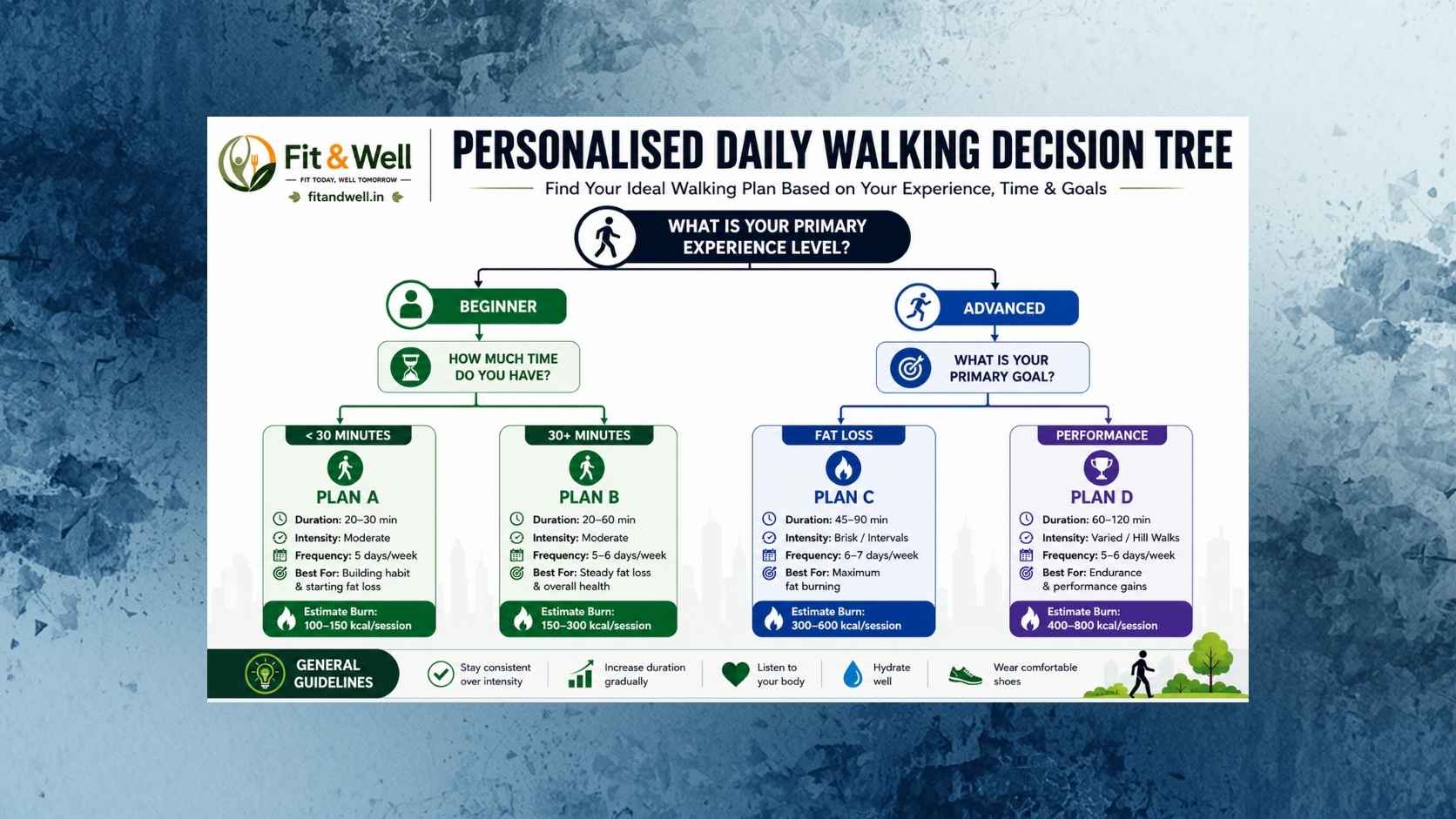
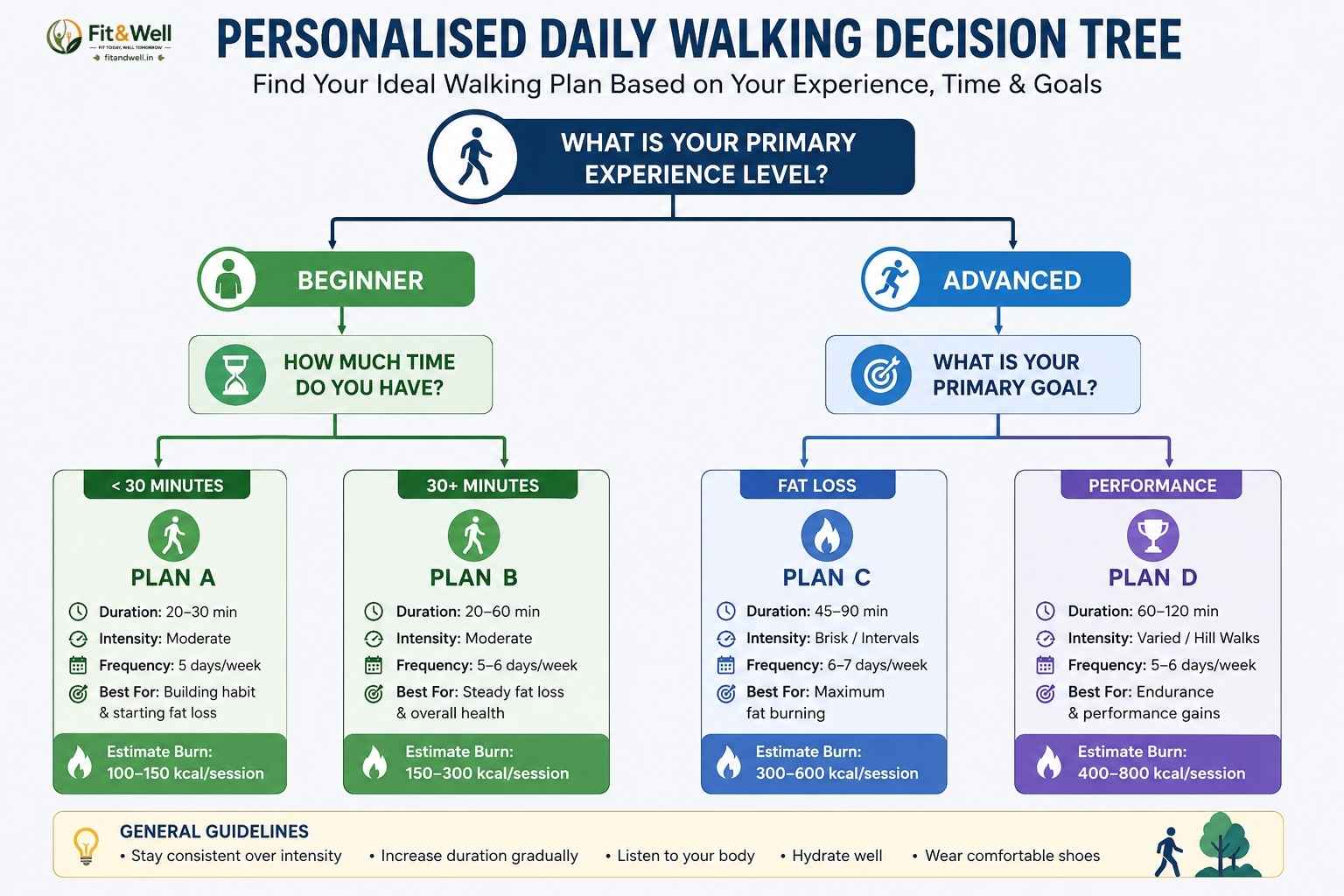
5. Personalised Daily Walking Decision Tree
To determine exactly how much walking is optimal for your personal circumstances, utilise this decision framework:
-
Plan A (Time-Optimised Fat Loss): 20–30 minutes of daily Incline Walking on a treadmill (5% to 8% grade) or a hilly outdoor path. Focuses on maximum calorie burn per minute.
-
Plan B (Standard Fat Loss Accelerator): 45–60 minutes of daily Brisk Walking on flat ground, combined with a verified moderate calorie deficit.
-
Plan C (Younger Adult Health Longevity): Strive for 8,000 to 10,000 total daily steps. Focus on accumulating these naturally throughout the day.
-
Plan D (Senior Adult Health Longevity): Strive for 6,000 to 8,000 total daily steps. Prioritise a steady, comfortable pace to support balance, joint health, and cardiovascular function.
6. Myth vs. Fact in Metabolic Health
Myth: Walking directly targets and burns abdominal fat (belly fat) first.
Fact: Spot reduction of fat is a biological impossibility. When walking creates a calorie deficit, the body breaks down systemic fat stores from across the entire body via lipolysis. Where fat is lost first is determined entirely by your individual genetics and hormonal profile, not the specific type of exercise performed.
Myth: Walking on a treadmill is significantly less effective than walking outside.
Fact: From a purely metabolic and caloric perspective, walking at a set speed on a flat treadmill requires nearly identical energy expenditure to walking on flat outdoor concrete. While outdoor walking provides cognitive benefits, varied terrain, and fresh air, a treadmill is an excellent, mathematically sound alternative for maintaining consistency during poor weather.
7. Troubleshooting: Why You Might Stop Losing Weight
If your daily step counts are high but your weight has plateaued for more than two consecutive weeks, you are likely encountering one of three common metabolic hurdles:
-
Appetite Compensation: Unconscious overeating frequently follows an increase in physical activity. Consuming an extra handful of nuts, a sports drink, or a larger dinner portion can instantly offset the 300 calories burned during your walk.
-
The “Sitting Disease” Compensation: Sometimes, after going for a long morning walk, individuals tend to sit significantly more during the rest of the day due to fatigue. This drop in baseline NEAT (Non-Exercise Activity Thermogenesis) lowers your overall daily calorie expenditure.
-
Biomechanical Adaptation: As you perform the same walk at the same speed over several months, your body becomes highly efficient at that movement. Your muscles adapt, meaning you actually burn slightly fewer calories to cover the same distance than you did on Day 1.
Strategic Success Checklists
The Daily Progress Checklist
-
[ ] Dietary Tracking Calibrated: Ensure your calorie intake remains at a calculated, deliberate deficit.
-
[ ] Continuous Walking Block Cleared: Complete at least one dedicated 30-minute block of brisk walking to train cardiovascular endurance.
-
[ ] Proper Footwear Utilised: Wear shoes that avoid compressing your toes to prevent blisters and unnatural changes to your stride.
-
[ ] NEAT Maintenance Checked: Avoid long, unbroken stretches of sitting still at your desk during non-walking hours.
The Overcoming Plateaus Checklist
-
[ ] Introduce Progressive Overload: Increase your walking speed by 0.5 km/h or add a 2% incline to increase physical demand.
-
[ ] Audit Liquid Calorie Intake: Check for hidden calories in commercial fruit juices, milk teas, and sweet coffees.
-
[ ] Incorporate Basic Strength Training: Perform two short sessions of bodyweight exercises (like squats or lunges) per week to preserve lean muscle tissue while losing fat weight.
Take the Next Step in Your Fitness Journey
Achieving sustainable weight loss requires matching evidence-based science with practical execution. If you want to cut through the confusing noise of the fitness industry, access precision fitness calculators, and get customised guidance tailored to your specific body composition goals, explore the expert resources available at Fitandwell, mapping out your personalised pathway to a healthier, sustainable lifestyle today.