


Last updated: 30/08/2026
Yoga will not stop menopause or replace hormone therapy, but a regular practice combining postures, breathing and relaxation is one of the better-tested non-drug options for the mood, sleep and stress side of the transition. The evidence for hot flashes specifically is weaker and more mixed than the evidence for anxiety, low mood and sleep quality. Women with osteoporosis or osteopenia need a modified practice, since some standard poses carry a genuine, documented fracture risk for a fragile spine.
Indian women reach menopause earlier than the global average, and yoga sits at an unusual intersection here: it is one of the few interventions with both large international meta-analyses behind it and a body of dedicated Indian trials, run in Indian clinics, on Indian women. This guide covers what the pooled trial data actually shows, where it falls short, what a safe practice looks like, and who should be careful.
What Is Happening to the Body During Perimenopause?
Perimenopause is the transition leading up to a woman’s final period, marked by fluctuating and eventually declining oestrogen and progesterone, irregular cycles, and symptoms like hot flashes, night sweats, sleep disruption and mood changes. Menopause itself is defined as twelve consecutive months without a period.
Age at menopause in India runs meaningfully earlier than in the West. A systematic review pooling 10 Indian house-to-house survey studies from 2009–2020 reported an average age at natural menopause in India of 46.6 years, compared with a global average closer to 51.
A separate PAN-India survey by the Indian Menopause Society, covering all four regions of the country, arrived at a near-identical figure of 46.2 years. Urban women (46.8 years) reached menopause slightly later than rural women (44.9 years).
That five-year gap matters practically. It means Indian women spend more of their working, parenting and caregiving years managing menopausal symptoms than their Western counterparts typically do, which is part of why a dedicated, non-drug option like yoga is worth examining closely.
Can Yoga Actually Help With Menopause Symptoms? What the Research Shows
Yes, with real caveats about which symptoms and how much. The picture has shifted as more trials have accumulated, and it is worth walking through that shift honestly rather than quoting only the most flattering number.
The first major meta-analysis on this question, published by Holger Cramer and colleagues in 2012, pooled five randomised controlled trials with 582 participants. It found moderate evidence that yoga helped psychological symptoms in the short term, but no evidence of benefit for total menopausal symptoms, somatic symptoms, vasomotor symptoms or urogenital symptoms.
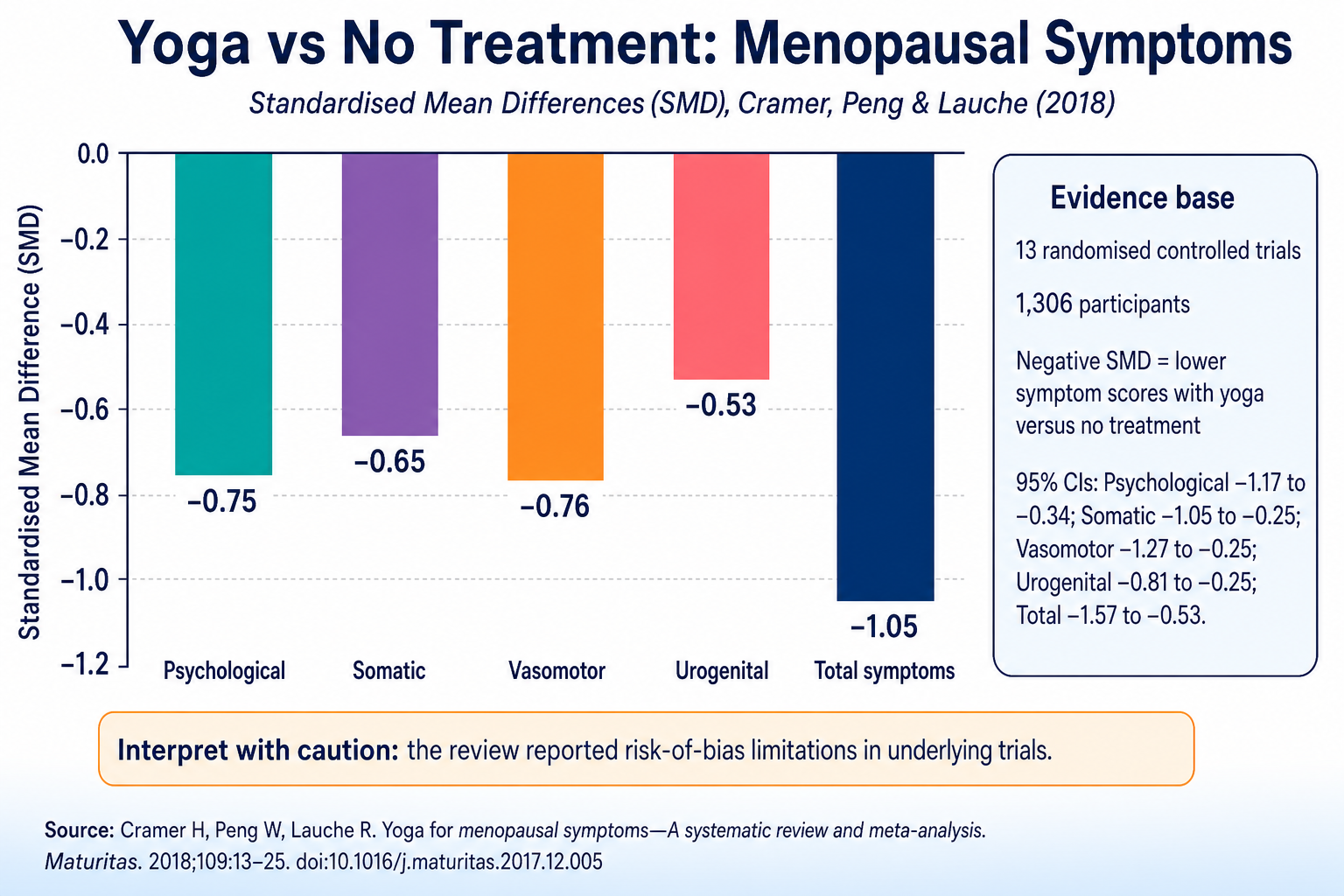
By 2018, the same research group had thirteen RCTs and 1,306 participants to work with, and the picture looked considerably stronger. Compared with no treatment, yoga reduced total menopausal symptoms, psychological symptoms, somatic symptoms, vasomotor symptoms and urogenital symptoms, all with statistically significant effects.
Compared with active exercise controls, though, only the effect on vasomotor symptoms held up. The authors’ own conclusion was measured: yoga appeared effective and safe, with benefits broadly comparable to other forms of exercise, and no serious adverse events were reported across the trials.
A more recent 2024–2025 meta-analysis in the International Journal of Nursing Studies, led by Hongjuan Wang, searched nine databases through August 2024 and again reported that yoga was likely to improve total menopausal symptoms, sleep quality, anxiety, depressive symptoms, body mass index, and both systolic and diastolic blood pressure compared with control groups.
Two things temper the enthusiasm in that string of positive results. First, an independent overview of seventeen systematic reviews, published in BMC Women’s Health in 2024, applied formal quality ratings (AMSTAR-2) to the underlying evidence. It found reasonably good evidence for yoga improving physical, urogenital and total menopausal symptoms, but rated the evidence specifically for vasomotor and psychological symptoms as inconclusive once study quality was accounted for.
Second, the Cramer team itself flagged a limitation in its own data: results were robust against selection bias but not against detection and attrition bias, a standard problem in trials where participants obviously know whether they are doing yoga.
Put plainly: yoga is one of the better-supported non-drug options for menopause, several independent research groups keep finding broadly similar things, and it carries essentially no risk of serious harm. It is not a guaranteed fix for any single symptom, and the trials themselves are usually small, short (commonly 8 to 16 weeks) and hard to blind.
Hot Flashes and Night Sweats: The Weakest Link in the Evidence
If there is one symptom where people overstate what yoga can do, it is vasomotor symptoms, the medical term for hot flashes and night sweats.
Hot flashes affect the majority of women during the menopause transition and are driven by falling oestrogen, narrowing the brain’s thermoneutral zone, so that small rises in core body temperature trigger a disproportionate cooling response: flushing, sweating and a racing heart. The American Heart Association notes that frequent hot flashes and night sweats are themselves linked to worse cardiovascular risk factors, which is one more reason they are worth taking seriously rather than dismissing as a nuisance.
On yoga specifically, the Cramer 2018 meta-analysis found yoga did outperform no treatment on vasomotor symptoms, and even edged out exercise controls on this one outcome. But the 2024 overview of reviews mentioned above rated the vasomotor evidence “inconclusive” once weaker or high-risk-of-bias studies were down-weighted.
That gap between two reviews looking at overlapping trials is itself informative. It suggests any effect on hot flashes specifically is real but modest, rather than the more dramatic reductions sometimes implied in popular coverage.
The honest summary: yoga is a reasonable thing to try for hot flashes, particularly since it will likely help sleep and mood at the same time, but it should not be the only strategy if vasomotor symptoms are severe. Hormone therapy remains the most effective treatment where it is medically appropriate, and that decision belongs with a gynaecologist, not a yoga teacher.
Sleep, Anxiety and Low Mood: Where the Evidence Is Strongest
This is the part of the menopause-yoga story that gets the least attention and is arguably the most useful for day-to-day quality of life.
A 2025 systematic review and meta-analysis in Frontiers in Public Health, covering eighteen randomised trials and 1,572 perimenopausal and postmenopausal women, looked specifically at mind-body therapies (yoga, mindfulness, qigong, art therapy, music therapy, dance therapy and reiki) against usual care. The pooled results showed moderate-to-large improvements: sleep quality improved with a standardised mean difference of −0.86, depression fell with an SMD of −0.79, and anxiety fell with an SMD of −1.13.
The review also found that expressive approaches like mindfulness, music and dance therapy produced somewhat larger psychological benefits than yoga specifically, while yoga and qigong stood out for more consistent sleep benefits.
This lines up with what the very first Cramer review found back in 2012: even when the evidence for physical symptoms was thin, the case for yoga easing psychological distress during menopause was already the strongest signal in the data. If disrupted sleep and a short fuse are the symptoms bothering you most, this is where a regular practice is most likely to help.
A slow, floor-based practice such as Yoga Nidra is a particularly good fit here, since it was designed specifically to calm the nervous system before sleep rather than to build strength or flexibility, and it requires no prior yoga experience.
What Indian Research Specifically Shows
Most of the large meta-analyses above pool trials from Europe, the Americas and East Asia. Indian women have not been an afterthought in this research, though; some of the earliest and most rigorous trials on yoga for menopause were actually run in India.
The landmark study is a randomised controlled trial by Ritu Chattha and colleagues at the Swami Vivekananda Yoga Research Foundation in Bangalore, published in the journal Menopause in 2008. One hundred and twenty perimenopausal women aged 40 to 55 were randomly assigned to either an integrated yoga programme or a matched programme of supervised physical exercise, both for one hour a day, five days a week, over eight weeks.
The yoga programme combined surya namaskara with twelve postures, pranayama breathing practices, and cyclic meditation. Using the Greene Climacteric Scale, the yoga group showed significantly greater improvement across psychological, somatic and vasomotor symptom scores than the exercise group, along with lower perceived stress.
That trial matters for two reasons. It is one of the few studies to compare yoga head-to-head against an active exercise control rather than doing nothing, and it used a genuinely comprehensive yoga protocol rather than a handful of poses, which is closer to what a real practitioner would actually do.
A smaller pilot study from Manipal, Karnataka, followed thirty perimenopausal women from women’s self-help groups through a twelve-week, 45-minute-a-day yoga programme. Alongside a highly significant improvement in climacteric symptoms (psychological, somatic and vasomotor domains all improved, p<0.001), the women also saw a significant drop in waist-hip ratio and BMI, and a marginal reduction in blood pressure. The study’s authors noted this was a small, uncontrolled pilot and called for larger trials, a caveat worth repeating here rather than smoothing over.
Taken together with the international meta-analyses, this Indian-specific evidence adds real weight to the case for yoga during the menopause transition here, rather than simply importing findings from trials run on very different populations.
Yoga, Blood Pressure and Heart Risk After Menopause
Cardiovascular risk rises sharply through the menopause transition, and this is one of the more under-discussed parts of menopause care. Falling oestrogen is linked to a less favourable cholesterol profile, more abdominal fat, stiffer arteries and a higher rate of metabolic syndrome, and the American Heart Association has called perimenopause a “window of opportunity” for starting cardiovascular prevention, since these changes accelerate specifically around the transition rather than simply tracking chronological age.
This is one area where yoga has genuinely strong supporting data, independent of the menopause-specific trials. A 2025 systematic review and meta-analysis of 30 randomised controlled trials with 2,283 participants found yoga lowered systolic blood pressure by an average of 7.95 mmHg and diastolic blood pressure by 4.93 mmHg compared with waitlist controls, alongside a drop in resting heart rate. The certainty of that evidence was rated very low, and the authors called for larger, higher-quality trials.
Even so, the direction of effect has been consistent across several independent reviews of yoga and blood pressure, including the Manipal pilot study above, where blood pressure fell after twelve weeks of yoga in perimenopausal women specifically. For a fuller breakdown of blood pressure targets and management in India, see our guide to hypertension management.
Yoga, Weight Gain and Metabolic Health at Menopause
Weight gain and a shift in fat distribution towards the abdomen are common around menopause, driven by hormonal change as much as by any drop in activity, and this shift itself raises metabolic risk independent of the number on the scale.
The evidence on yoga and weight during menopause specifically is thinner than the evidence for mood or blood pressure, but what exists is consistent in direction. The 2024–2025 International Journal of Nursing Studies meta-analysis found yoga groups had a lower BMI than control groups, and the small Manipal pilot study recorded a significant drop in both BMI and waist-hip ratio after twelve weeks.
Neither finding should be read as “yoga burns fat” in the way a cardio session does. A slow-paced asana practice is not a high-calorie-burn activity, and its likely mechanism here runs through better sleep, lower cortisol and reduced stress-eating rather than direct energy expenditure.
For a broader look at safe, sustainable weight management, see our guide to 12 yoga asanas for weight loss and our overview of obesity, its causes and its health risks.
Bone Health: What Yoga Can and Cannot Do, and a Genuine Safety Caution
This is the part of the menopause-and-yoga conversation that gets skipped most often, and it deserves more attention than it usually receives.
Oestrogen protects bone, so bone loss accelerates in the years around menopause, raising the risk of osteopenia and, eventually, osteoporosis and fracture. This is exactly the population many general “yoga for menopause” articles are written for, and exactly the population that needs to modify a standard practice.
A landmark 1984 trial by Mehrsheed Sinaki and Beth Mikkelsen followed 59 postmenopausal women with spinal osteoporosis assigned to spinal extension exercises, spinal flexion exercises, a combination, or no exercise, and tracked new vertebral compression fractures over one to six years. New fractures occurred in 16% of the extension-only group, compared with 89% of the flexion-only group.
That is a striking gap, though it is worth noting this was a small trial (nine women in the flexion group) in women who already had diagnosed osteoporosis, not a general population of healthy exercisers. The finding is a caution for a specific group, not a blanket warning against forward bends for everyone.
Sinaki followed up with a case series in 2013 describing three healthy, pain-free people with low bone mass who developed new pain or fractures after starting yoga involving deep spinal flexion. A second case series, led by Jad Sfeir with Sinaki as a co-author, described a further nine people (eight women, median age 66) who developed vertebral compression fractures one month to six years after starting yoga poses built around spinal flexion.
The common thread across both reports was strenuous forward-folding and twisting postures under load. The conclusion in both papers was not that yoga is unsafe, but that it needs to be matched to bone density: patients with osteopenia or osteoporosis benefit from avoiding extreme spinal flexion, and physicians should factor this into how they discuss yoga as exercise.
What this means practically for a menopausal or postmenopausal woman:
- If you have not had a bone density (DEXA) scan and you are past your late 40s, this is a reasonable time to ask your doctor whether one is appropriate, particularly if you have risk factors such as a slight build, family history of osteoporosis, or early menopause.
- If you already have osteopenia or osteoporosis, avoid deep forward folds, aggressive spinal twists and any pose that loads a rounded spine (a full seated forward fold, deep twists like Ardha Matsyendrasana taken to end range, or “wheel” backbends attempted without preparation). Gentle backward extension and neutral-spine strengthening work are generally considered safer.
- A qualified yoga teacher who knows your bone density status can modify almost every pose in a sequence; this is a conversation worth having explicitly before a class, not something to assume the teacher already knows.
- None of this is a reason to avoid yoga altogether. The same body of research shows regular yoga practice improves balance, which is itself a meaningful protective factor against falls and the fractures that follow them.
What a Menopause-Friendly Yoga Practice Actually Looks Like
Based on what the Chattha 2008 protocol and other trials actually used, a sensible practice for perimenopause and menopause combines three elements rather than posture work alone: postures (asana), breathing practices (pranayama) and a relaxation or meditation component.
Most trials that showed benefit ran sessions three to five times a week, for 45 minutes to an hour, over eight weeks or longer. Shorter or less frequent practice may still help but has less trial evidence behind it.
If you are entirely new to yoga, our complete beginner’s guide covers foundational poses and how to build a routine from nothing. A reasonable structure to adapt specifically for the menopause transition looks like this:
- Gentle warm-up and standing poses (10 minutes): simple sun salutations at a comfortable pace, Tadasana (mountain pose), Trikonasana (triangle pose). Avoid rushing into deep backbends cold.
- Balance work (5 minutes): Vrikshasana (tree pose) and similar single-leg balances, which the research on falls and bone health suggests are genuinely worth prioritising, not just a nice-to-have.
- Breathing practice (10 to 15 minutes): slow diaphragmatic breathing, Anulom Vilom (alternate nostril breathing) and Bhramari (humming bee breath), all of which have separate evidence for calming the nervous system and, in Bhramari’s case, releasing nasal nitric oxide, a natural vasodilator.
- Relaxation or meditation (10 to 20 minutes): Savasana with guided body awareness, or a full Yoga Nidra session in the evening if sleep is the main concern.
If bone density is a known concern, skip or heavily modify any deep forward fold or aggressive twist, and mention this to whoever is leading the class.
Who Should Be Cautious, or Talk to a Doctor First
- Anyone with diagnosed osteopenia or osteoporosis, as covered above.
- Anyone with a recent fracture, significant joint replacement, or uncontrolled high blood pressure, who should get individual clearance before starting a new physical routine.
- Women considering hormone therapy for severe symptoms: yoga is a reasonable complementary practice but is not shown to be a substitute for hormone therapy where hormone therapy is medically indicated, and that decision should sit with a gynaecologist familiar with your full history.
- Anyone whose mood symptoms go beyond ordinary irritability, such as persistent low mood, loss of interest, or thoughts of self-harm: these deserve a conversation with a doctor rather than being managed through yoga alone. Our guide to anxiety symptoms, causes and treatment covers when to seek professional support.
Frequently Asked Questions
Can yoga replace hormone replacement therapy (HRT) for menopause symptoms?
No. The trial evidence shows yoga helping with psychological symptoms, sleep and, to a lesser extent, hot flashes and blood pressure, but none of the reviewed meta-analyses claims effects anywhere near the size seen with hormone therapy for vasomotor symptoms specifically. Yoga is best understood as a complementary practice, and the decision to start or avoid HRT should be made with a gynaecologist based on your individual risk profile.
How soon can I expect to notice a difference?
Most of the trials showing benefit ran for eight to sixteen weeks with regular practice (typically three to five sessions a week). Some women notice better sleep and calmer mood within the first few weeks, but the formal trial evidence is built around consistent practice over two months or more, not a single class.
Is hot yoga or power yoga safe during menopause?
There is no dedicated trial evidence either way for vigorous, heated yoga styles specifically in menopausal women. Given that hot flashes are a heat-regulation problem, and that vigorous flexion-heavy sequences carry more risk for anyone with reduced bone density, a gentler, traditional hatha-style practice with a qualified teacher is the better-supported starting point, especially if bone density is unknown.
Does age at menopause affect how well yoga works?
No dedicated Indian trial has directly tested this, but since Indian women reach menopause roughly five years earlier than the global average, they also spend more years living with perimenopausal and postmenopausal symptoms, which is a practical reason to start a sustainable practice earlier rather than waiting for symptoms to become severe.
Can perimenopausal women safely do the same poses as before menopause?
Mostly, yes, provided bone density has not been affected, and there are no other joint issues. The caution in this article is specifically about deep spinal flexion in women with confirmed osteopenia or osteoporosis, not a blanket restriction on perimenopausal women in general.
Will yoga help with vaginal dryness and other urogenital symptoms?
The Cramer 2018 meta-analysis found a modest but statistically significant improvement in urogenital symptoms with yoga compared with no treatment, though the 2024 overview of reviews rated this evidence stronger than the vasomotor evidence but still limited. Local vaginal moisturisers or, where appropriate, vaginal oestrogen prescribed by a doctor remain the more directly targeted options for this specific symptom.
The Bottom Line on Yoga for Menopause
Yoga is genuinely one of the better-tested non-drug options for the menopause transition, with a body of evidence that has grown from a handful of small, ambiguous trials in 2012 to over a dozen larger studies by 2018 and a fresh meta-analysis as recently as 2024–2025, alongside dedicated Indian trials run specifically on Indian women.
The strongest, most consistent benefits are for sleep, anxiety and low mood. The evidence for hot flashes is real but weaker, and roughly comparable to other forms of structured exercise. The evidence for blood pressure is encouraging and consistent across independent reviews, though rated very low certainty, and it is useful in its own right given how much cardiovascular risk rises after menopause.
The one caution that deserves more airtime than it usually gets: women with reduced bone density need a modified practice that avoids deep spinal flexion under load, based on documented case reports of vertebral fractures linked to standard yoga poses.
That is not a reason to avoid yoga. It is a reason to know your bone density and adapt accordingly, ideally with a teacher who knows your history and a doctor who has seen your scan.
This article is for general information and is not a substitute for personalised medical advice. If you are experiencing severe menopausal symptoms, have osteoporosis or osteopenia, or are considering hormone replacement therapy, speak to a gynaecologist or your doctor before starting or changing an exercise routine.
Sources
- Maninder Ahuja. Age of menopause and determinants of menopause age: A PAN India survey by IMS. Journal of Mid-Life Health, 2016;7(3):126–131.
- Age at menopause in India: A systematic review. Diabetes & Metabolic Syndrome: Clinical Research & Reviews, 2021.
- Holger Cramer, Romy Lauche, Jost Langhorst, Gustav Dobos. Effectiveness of Yoga for Menopausal Symptoms: A Systematic Review and Meta-Analysis of Randomized Controlled Trials. Evidence-Based Complementary and Alternative Medicine, 2012.
- Holger Cramer, Wenbo Peng, Romy Lauche. Yoga for menopausal symptoms—A systematic review and meta-analysis. Maturitas, 2018;109:13–25.
- Hongjuan Wang, Yaqian Liu, Jojo Yan Yan Kwok, Mei Sun. The effectiveness of yoga on menopausal symptoms: A systematic review and meta-analysis of randomized controlled trials. International Journal of Nursing Studies, 2025;161:104928.
- Annemarie Money, Aylish MacKenzie, Gill Norman, Chris Todd. The impact of physical activity and exercise interventions on symptoms for women experiencing menopause: overview of reviews. BMC Women’s Health, 2024.
- Zhixin Fan, Yifan Zhang, Yankai Shu, Yongxu Zhou, Zhongzhi Zuo. Mind–body therapies for sleep disturbances, depression, and anxiety in menopausal women: a systematic review and meta-analysis of randomized controlled trials. Frontiers in Public Health, 2025;13:1686981.
- Ritu Chattha, Nagarathna Raghuram, Padmalatha Venkatram, Nagendra R. Hongasandra. Treating the climacteric symptoms in Indian women with an integrated approach to yoga therapy: a randomized control study. Menopause, 2008;15(5):862–870.
- Alok Kumar, E. Archana, Akshatha Pai, Gayathry Nayak, Revathi P. Shenoy, Anjali Rao. Serum mineral status and climacteric symptoms in perimenopausal women before and after Yoga therapy, an ongoing study. Journal of Mid-Life Health, 2013;4(4):225–229.
- American Heart Association. The connection between menopause and cardiovascular disease risks. AHA News, 2023.
- American Heart Association Scientific Statement. Menopause Transition and Cardiovascular Disease Risk: Implications for Timing of Early Prevention. Circulation, 2020.
- Christoph Geiger, Holger Cramer, Dennis Anheyer, Gustav Dobos, Wiebke Kathrin Kohl-Heckl, Bhabesh Deka, Satish Patil. A systematic review and meta-analysis of yoga for arterial hypertension. PLOS ONE, 2025.
- M. Sinaki, B. A. Mikkelsen. Postmenopausal spinal osteoporosis: flexion versus extension exercises. Archives of Physical Medicine and Rehabilitation, 1984;65(10):593–596.
- Mehrsheed Sinaki. Yoga spinal flexion positions and vertebral compression fracture in osteopenia or osteoporosis of spine: case series. Pain Practice, 2013;13(1):68–75.
- Jad G. Sfeir, Matthew T. Drake, Vikram J. Sonawane, Mehrsheed Sinaki. Vertebral compression fractures associated with yoga: A case series. European Journal of Physical and Rehabilitation Medicine, 2018;54(6):947–951