
Sleep hygiene is the set of daily habits and bedroom conditions that make good sleep more likely: a steady wake time, a dark and cool room, caffeine and alcohol kept away from bedtime. The evidence supports many of the individual habits, but it does not support the biggest claim made for them. The American Academy of Sleep Medicine advises clinicians against using sleep hygiene as a stand-alone treatment for chronic insomnia in adults, because on its own it does not fix a sleep problem that has already taken hold.
That distinction matters more than any single tip. Sleep hygiene is maintenance for sleep that is basically working. Insomnia is a condition, and it has its own treatment.
The evidence at a glance
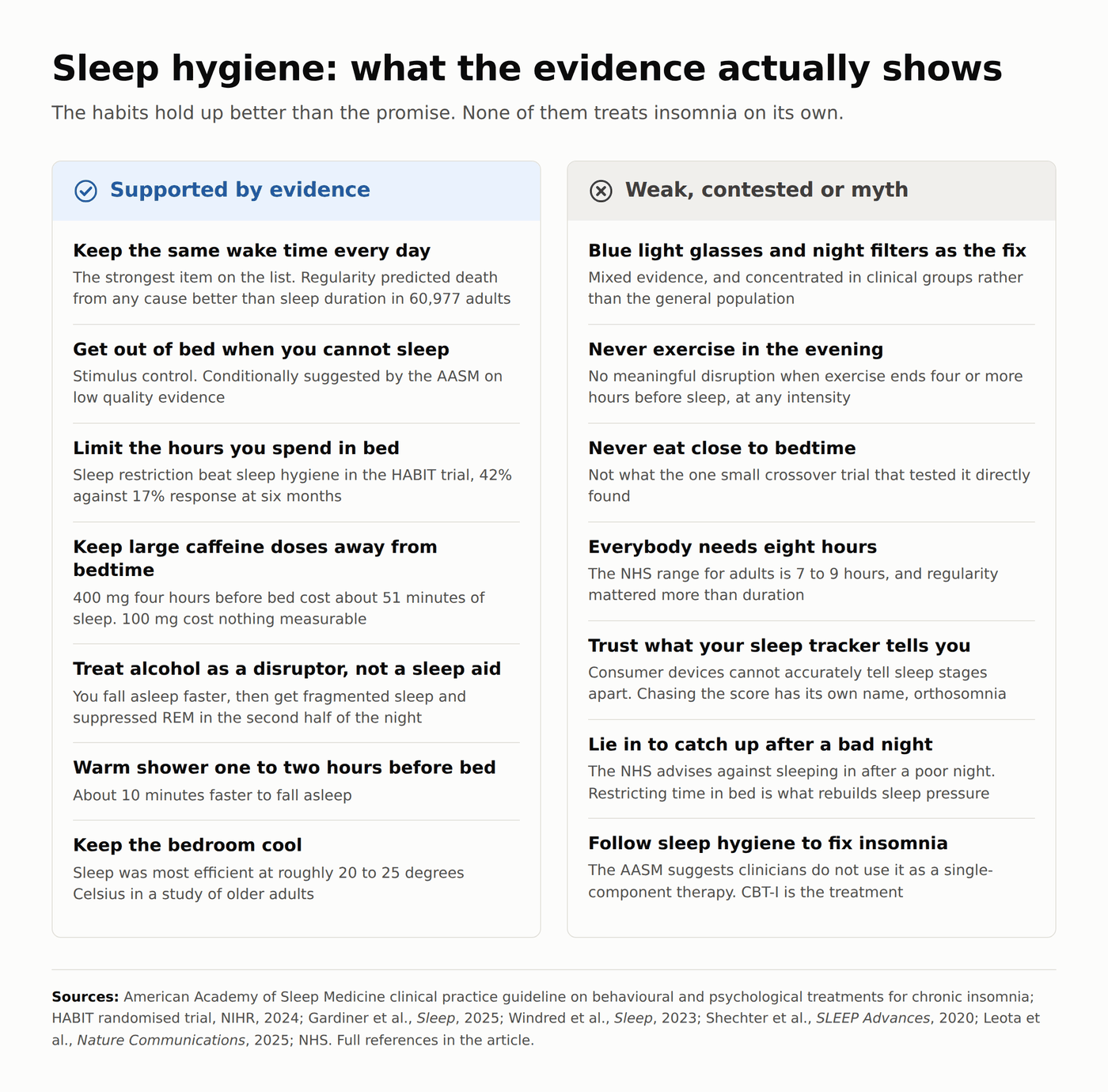
| Common advice | What the evidence actually shows |
|---|---|
| Keep the same wake time every day | The strongest item on the list. Sleep regularity predicted death from any cause better than sleep duration in 60,977 UK Biobank adults |
| Get out of bed when you cannot sleep | Conditionally suggested by the AASM as stimulus control, on low-quality evidence |
| Limit time in bed (sleep restriction) | Conditionally suggested by the AASM. Beat sleep hygiene in the HABIT trial, 42% against 17% response at six months |
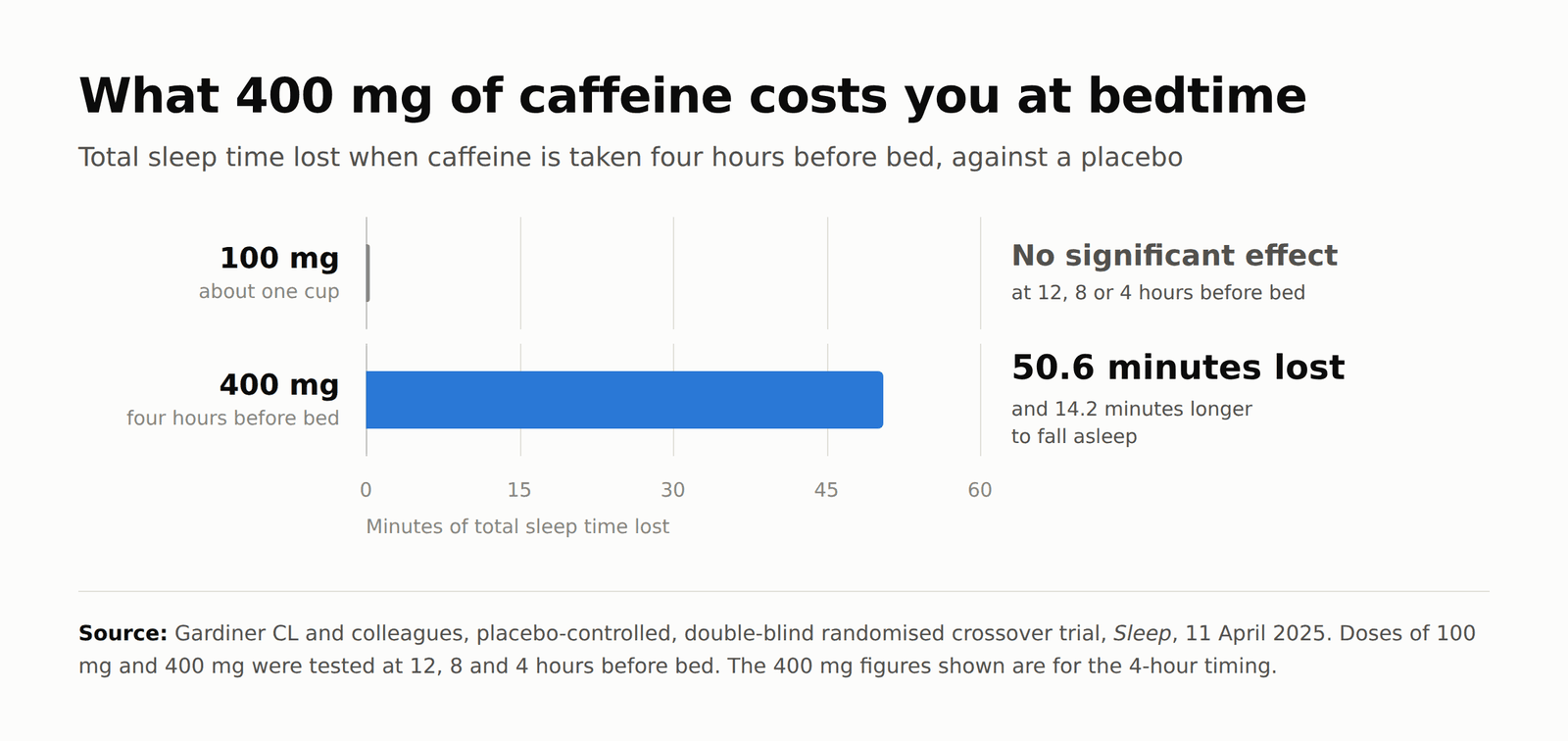
| Avoid large caffeine doses near bedtime | 400 mg four hours before bed cut total sleep by about 51 minutes. 100 mg had no significant effect at any timing tested |
| Avoid alcohol before bed | You fall asleep faster, then get more fragmented sleep and suppressed REM, worst in the second half of the night |
| Warm bath or shower 1 to 2 hours before bed | Around 10 minutes faster to fall asleep |
| Keep the bedroom cool | Sleep was most efficient at roughly 20 to 25 degrees Celsius in a study of older adults |
| Wear blue light glasses or use night filters | Mixed evidence, and concentrated in clinical groups rather than the general population |
| Never exercise in the evening | Not supported. No meaningful disruption when exercise ends four or more hours before sleep |
| Never eat close to bedtime | Not supported by the one small crossover trial that tested it directly |
| Follow sleep hygiene to fix insomnia | Not supported. The AASM suggests against it as a single-component therapy |
What sleep hygiene actually covers
The term is older than most people assume. According to Sleepstation, the phrase was used in this sense as early as 1918, in an article by Ferdinand Eugene Daniel in the American journal Medical Insurance. The modern list has grown long and, in places, contradictory.
The NHS version, last reviewed on 19 March 2024, is representative. It advises going to bed only when you feel sleepy, getting out of bed at the same time every day, relaxing for at least an hour beforehand, and keeping the bedroom dark and quiet. On the other side, it advises against caffeine, alcohol and smoking within six hours of bed, against exercise within four hours, against daytime naps, and against lying in after a bad night.
Some of that is well supported. Some of it is a reasonable rule of thumb that newer research has softened. And one part of it, the belief that following the whole list will cure insomnia, is not supported at all.
The claim that does not hold: sleep hygiene as a treatment
This is the single most important thing to understand about the topic.
The American Academy of Sleep Medicine’s clinical practice guideline on behavioural and psychological treatments for chronic insomnia, published in the February 2021 issue of the Journal of Clinical Sleep Medicine, concluded that “sleep hygiene should not be used as a single-component treatment for chronic insomnia disorder in adults”. Jack Edinger, who led the guideline, put it this way: “Although sleep hygiene practices are often suggested and well-understood by patients, sleep hygiene recommendations do not constitute an effective stand-alone therapy.”
It is worth being precise about the strength of that. In the guideline document, the recommendation reads “we suggest that clinicians do not use sleep hygiene as a single-component therapy for the treatment of chronic insomnia disorder in adults”, and it is graded conditional rather than strong, on low quality evidence. It is a considered steer, not a settled verdict.
The pattern behind it is consistent, though. A systematic review and meta-analysis by Ka-Fai Chung and colleagues, published in Family Practice in 2018, pulled together 15 studies, 12 of which compared sleep hygiene education with cognitive behavioural therapy for insomnia. Sleep hygiene education “was significantly less efficacious than CBT-I, with difference in effect size ranging from medium to large”, and only subjective measures reached significance. The authors were careful to add that “unanswered methodological and implementation issues prevent a firm conclusion to be made on whether SHE has a role in a stepped-care model for insomnia in primary care”.
A larger analysis pointed the same way. Yuki Furukawa and colleagues examined 241 studies covering 31,452 adults and published the results in JAMA Psychiatry in January 2024, asking which parts of CBT-I actually do the work. According to the University of Tokyo’s summary of that analysis, cognitive restructuring, third-wave components, sleep restriction, stimulus control and in-person delivery were the components that mattered, while sleep hygiene education “did not appear to be essential”. More surprisingly, relaxation procedures “could be counterproductive”.
And in the HABIT trial, funded by the UK’s National Institute for Health and Care Research and reported by Simon Kyle, Peter Bower, Ly-Mee Yu and colleagues in 2024, adults with insomnia in primary care were given either brief nurse-delivered sleep restriction therapy or sleep hygiene. At six months, 42% of the sleep restriction group had responded, against 17% of the sleep hygiene group, where responding meant a fall of at least eight points on the Insomnia Severity Index. The trial concluded that “brief nurse-delivered SRT in primary care is clinically effective for insomnia disorder, safe, and likely to be cost-effective”.
So sleep hygiene is not useless. Roughly one person in six improved on it. It is just not the treatment.
What the evidence does support
A regular wake time, above almost everything
Of all the standard advice, the case for consistency is the strongest.
Daniel Windred and colleagues, writing in Sleep in 2023, tracked 60,977 UK Biobank participants over a mean of 6.3 years. They found that “sleep regularity is a stronger predictor of all-cause mortality than sleep duration”. Participants in the highest regularity quintiles had a 20% to 48% lower risk of death from any cause. When regularity and duration were put in the same model, duration added no further predictive value.
This is an association in an older cohort, not proof that fixing your schedule extends your life. But it does reorder the priorities. If you change one thing, change the time you get up, and keep it the same at the weekend.
Getting out of bed when you cannot sleep
The NHS advice to go to bed only when sleepy is the everyday version of stimulus control, which the AASM guideline conditionally suggests as a single-component therapy in its own right, on low-quality evidence. The logic is that lying awake in bed teaches your brain to associate the bed with being awake. Sleep restriction therapy, which deliberately shortens time in bed to rebuild sleep pressure, carries the same conditional wording and the same low evidence grading, and is the component that outperformed sleep hygiene in HABIT.
Both are more demanding than they sound, and sleep restriction in particular should be done with a clinician or a structured programme rather than improvised.
Caffeine, with the dose in mind
Here the evidence has become more specific, and more forgiving, than the blanket rule.
A placebo-controlled, double-blind, randomised crossover trial by Carissa Gardiner and colleagues, published in Sleep on 11 April 2025, gave participants 100 mg or 400 mg of caffeine at 12, 8 or 4 hours before bed. At 400 mg taken four hours before bed, time to fall asleep rose by an estimated 14.2 minutes and total sleep time fell by an estimated 50.6 minutes. At the 100 mg dose, “no significant effects were observed on objective or subjective sleep outcomes”.
An earlier and widely cited study, reported by the AASM in 2013, found that total sleep time “was reduced by more than one hour when caffeine was consumed six hours before bedtime, though participants were often unaware of the disruption”. Lead author Christopher Drake noted something that matters for anyone who thinks caffeine does not affect them: “People tend to be less likely to detect the disruptive effects of caffeine on sleep when taken in the afternoon.”
The honest summary is that the dose does a lot of the work, and that not noticing an effect is not evidence there isn’t one. If you sleep badly, the amount is worth counting, not just the clock.
Alcohol is a sleep disruptor, not a sleep aid
A narrative review by Jean-Philippe Chaput, published in Nutrients in 2026, describes the mechanism clearly. “Acute intake reliably reduces sleep onset latency in the short term, but this is followed by increased wake after sleep onset, reduced sleep efficiency, REM suppression with later rebound, and greater sleep fragmentation.” As the alcohol is metabolised, “initial sedative effects wane and are replaced by sympathetic activation, increased arousability, and sleep fragmentation”. The review adds that alcohol “disrupts sleep architecture, suppresses rapid eye movement sleep, increases sleep fragmentation, and impairs breathing during sleep, particularly in the second half of the night”.
That is why the nightcap feels like it works. You fall asleep faster, then pay for it at 3am.
A warm shower one to two hours before bed
This one is easy to do and holds up reasonably well. A review led by Shahab Haghayegh at UT Austin, published in Sleep Medicine Reviews, analysed 5,322 studies and found that a warm bath or shower at 104 to 109 degrees Fahrenheit, roughly 40 to 43 degrees Celsius, taken one to two hours before bed, could “hasten the speed of falling asleep by an average of 10 minutes”.
Ten minutes is a modest gain. It is also more than most bedtime routines can claim.
A cool room, which is harder in India than the guidance admits
Amir Baniassadi and colleagues at Hebrew SeniorLife followed 50 older adults across nearly 11,000 person-nights and reported in Science of the Total Environment that “sleep can be most efficient and restful for older adults when nighttime bedroom ambient temperature ranges between 68 to 77 degrees Fahrenheit”, about 20 to 25 degrees Celsius. They recorded “a 5-10% drop in sleep efficiency as the nighttime ambient temperature increases from 77 to 86 degrees Fahrenheit”, which is 25 to 30 degrees Celsius.
A much larger study by Anni Li and colleagues in Nature Communications in 2025, covering 214,445 people in 336 Chinese cities and more than 23 million days of sleep monitoring, found that “for each 10 °C increase in ambient temperature, the odds of sleep insufficiency increased by 20.1%” and total sleep duration fell by 9.67 minutes. That study was conducted in mainland China, so the exact numbers should not be transplanted to Indian conditions, but the direction is not in doubt.
For most Indian bedrooms through the summer, 25 degrees is an aspiration rather than a setting. A fan, cross ventilation, cotton bedding and a cooler shower before bed are the practical levers when air conditioning is not an option.
Morning light
Timed light exposure is the tool clinicians use to move a body clock. Stanford Health Care describes bright light therapy as “appropriately timed exposure to light” used “to gradually shift sleeping patterns to what we consider normal”. The timing depends on the direction you need to shift. For delayed sleep phase syndrome, where sleep keeps drifting later, Stanford specifies that “the light must be delivered to the retina as soon after spontaneous awakening as possible to achieve the desired effect”, for 30 to 90 minutes. For advanced sleep phase syndrome, where sleep keeps drifting earlier, evening light is used instead.
That is a clinical protocol for a diagnosed circadian problem, not a claim that fifteen minutes on your balcony will fix your sleep. But it is the reason morning daylight sits on almost every sleep hygiene list, and it costs nothing to get some.
What is weaker than you have been told
Blue light is not the whole story. Ari Shechter and colleagues reviewed 12 studies of interventions to cut short-wavelength light at night for SLEEP Advances in 2020. They concluded that “there is some, albeit mixed, evidence that this approach can improve sleep, particularly in individuals with insomnia, bipolar disorder, delayed sleep phase syndrome, or attention-deficit hyperactive disorder”. Note where the benefit sits: in clinical groups, not in the general population. Effects on objective measures such as sleep efficiency and total sleep time were modest, while effects on self-reported sleep quality were larger. Amber glasses are not a fix for a phone you cannot put down.
The screen consensus is about children, not you. A National Sleep Foundation expert panel chaired by Lauren Hale reviewed 574 peer-reviewed studies and published its consensus statement in Sleep Health. It agreed that “in general, screen use impairs sleep health among children and adolescents”, that content matters, and that “behavioural strategies and interventions may attenuate the negative effects of screen use on sleep health”. Those consensus statements are specific to children and adolescents. The panel looked at adults too, and did not issue the same statement for them.
Evening exercise is mostly fine. The NHS advises against exercise within four hours of bed. A study of 14,689 physically active people across 4,084,354 person-nights, published by Josh Leota and colleagues in Nature Communications in 2025, gives a more precise picture: maximal rather than light exercise ending two hours before habitual sleep onset was associated with sleep onset 36 minutes later, but exercise finishing four or more hours before sleep showed no meaningful disruption at any intensity. If a 7 pm gym session is the only one you will actually do, do it. Save the maximal effort sessions for earlier. A brisk daily walk does not carry this problem at all, and simply breaking up long periods of sitting helps build the daytime activity that sleep pressure depends on.
Late dinner is not automatically ruinous. Daisy Duan and colleagues ran a randomised laboratory crossover trial in 20 healthy volunteers of mean age 26, published in Nature and Science of Sleep in 2021, comparing dinner five hours before bed with dinner one hour before. Conventional sleep staging was similar between the two visits, though the late dinner was “associated with deeper sleep in the beginning of the night and lighter sleep in the latter part of the night”. Twenty young healthy people is a small sample, and this says nothing about reflux, which is a separate reason to leave a gap. But the blanket claim that eating late destroys sleep is not what this trial found.
Eight hours is a target, not a requirement. The NHS puts adult need at 7 to 9 hours, which is a range, and the Windred data suggest regularity matters more than hitting a number.
Your tracker is not a diagnosis. Kelly Glazer Baron and colleagues at Rush University described a pattern they named orthosomnia in the Journal of Clinical Sleep Medicine in 2017, based on three patient cases, including “a 39-year-old man who developed anxiety trying to achieve eight hours nightly”. Of consumer devices, Baron said: “They don’t do a good job of estimating sleep accurately.” They “are unable to accurately discriminate stages of sleep”. Use a tracker for trends over weeks. Do not let a bad sleep score set the tone for your day.
Sleep problems in India, and where hygiene runs out
Indian prevalence data is thin. A 2023 preprint review, which has not been peer reviewed, pooled 100 studies covering 67,844 people and estimated insomnia prevalence at 25.7%, with a confidence interval running from 16.3% to 38.0% and near-total statistical heterogeneity. That range is too wide to plan around. Its authors made the more useful point themselves, that “the need to develop standardised protocols to study prevalence of various sleep disorders on a national level remains pivotal”.
What is clear is that the one hygiene lever with the most data behind it, a cool bedroom, is the hardest to pull here. Where air conditioning is not an option, a fan, cross-ventilation, light cotton bedding and a warm shower earlier in the evening are the tools left.
It is also worth ruling out the things that masquerade as bad sleep habits. Persistent unrefreshing tiredness can have a medical cause, and hypothyroidism in India lists persistent fatigue among its symptoms. If low mood or anxiety is part of the picture, that needs its own assessment, and India’s mental health treatment gap is a large part of why so many people never get one. The daytime cost of poor sleep often shows up as brain fog long before anyone calls it a sleep disorder.
For the wind-down hour the NHS recommends, a structured practice is easier to keep than a vague intention. Yoga nidra and simple meditation for anxiety both give the hour a shape. Be aware that the evidence here pulls in two directions. The AASM guideline suggests clinicians may use relaxation therapy as a single-component therapy for chronic insomnia, again conditionally and on low-quality evidence, while the University of Tokyo’s summary of Furukawa’s component analysis reports that relaxation procedures “could be counterproductive”. As a way to stop working an hour before bed, it is a reasonable habit. As a treatment for chronic insomnia, it is contested.
When to stop tinkering and see a doctor
The NHS advises seeing a GP if changing your sleep habits has not helped, if trouble sleeping has persisted for months, or if it is significantly affecting your daily functioning. That is the right threshold, and it is the point at which more sleep hygiene stops being the answer.
The treatment to ask for is cognitive behavioural therapy for insomnia. The AASM guideline contains “one strong recommendation”, and CBT-I is it. The therapy typically runs to four to eight sessions and combines cognitive strategies with sleep education and behavioural techniques such as stimulus control and sleep restriction. Edinger’s summary is blunt: “The multicomponent treatment, cognitive behavioural therapy for insomnia, is the most supported therapy.” The NHS offers CBT face to face and through online programmes, and prescribes sleeping pills only “for a few days, or weeks at the most”.
If you snore heavily, if someone has seen you stop breathing in your sleep, or if you wake unrefreshed despite getting enough hours in bed, raise these with your doctor as separate questions rather than treating them as a hygiene problem.
Frequently asked questions
Does sleep hygiene cure insomnia?
No. The American Academy of Sleep Medicine suggests clinicians do not use sleep hygiene as a single-component therapy for chronic insomnia in adults, a conditional recommendation based on low-quality evidence. Cognitive behavioural therapy for insomnia carries the guideline’s one strong recommendation, and in the HABIT trial sleep restriction therapy produced a 42% response rate at six months against 17% for sleep hygiene.
Is sleep hygiene therefore useless?
No. It is preventive maintenance rather than treatment. The individual habits, especially a regular wake time, are worth keeping, and sleep hygiene still produced a 17% response rate in HABIT. It simply is not enough on its own once insomnia is established.
How late can I drink coffee?
It depends more on how much than how late. In a 2025 randomised crossover trial in Sleep, 100 mg of caffeine had no significant effect on sleep at any of the timings tested, while 400 mg taken four hours before bed cut total sleep time by around 51 minutes. The NHS advises avoiding caffeine within six hours of bed, which is a safe default if you are a heavy drinker of it or you sleep badly.
Does a nightcap help me sleep?
It helps you fall asleep and worsens the rest of the night. Alcohol reduces sleep onset latency, then increases wakefulness after sleep onset, suppresses REM sleep with a later rebound, and fragments sleep, particularly in the second half of the night.
Is exercising at night bad for sleep?
Not usually. In a 2025 Nature Communications analysis of more than four million person-nights, exercise ending four or more hours before sleep showed no meaningful disruption at any intensity. Maximal-intensity exercise ending two hours before bed was associated with falling asleep about 36 minutes later.
Do blue light filters and amber glasses work?
The evidence is mixed. A 2020 review of 12 studies in SLEEP Advances found some evidence of benefit, particularly in people with insomnia, bipolar disorder, delayed sleep phase syndrome or ADHD, with modest effects on objective sleep measures and larger effects on self-reported sleep quality. They are not a substitute for putting the device down.
What temperature should my bedroom be?
Research in older adults found sleep was most efficient between about 20 and 25 degrees Celsius, with sleep efficiency falling 5% to 10% as the room warmed from 25 to 30 degrees. In Indian summer conditions, a fan, cross ventilation and light cotton bedding are the realistic tools.
This article is for general information and is not a substitute for advice from your own doctor. If your sleep has been disturbed for months, or you are considering starting or stopping any treatment, speak to a qualified clinician.
Sources
- American Academy of Sleep Medicine. Behavioral and psychological treatments for chronic insomnia disorder in adults: an American Academy of Sleep Medicine clinical practice guideline, guideline document dated 12 May 2020. The final guideline, led by Jack Edinger, was published in the Journal of Clinical Sleep Medicine, February 2021.
- American Academy of Sleep Medicine. New guideline supports behavioral, psychological treatments for insomnia.
- Chung KF, Lee CT, Yeung WF, Chan MS, Chung EWY, Lin WL. Sleep hygiene education as a treatment of insomnia: a systematic review and meta-analysis. Family Practice, 2018;35(4):365.
- University of Tokyo. Streamlining cognitive behavioral therapy for chronic insomnia, on Furukawa Y, et al. JAMA Psychiatry, January 2024.
- Kyle SD, Bower P, Yu LM, et al. Nurse-delivered sleep restriction therapy to improve insomnia disorder in primary care: the HABIT RCT. NIHR Health Technology Assessment, 2024.
- Windred DP, Burns AC, Lane JM, Saxena R, Rutter MK, Cain SW, Phillips AJK. Sleep regularity is a stronger predictor of mortality risk than sleep duration: a prospective cohort study. Sleep, 2023;47(1).
- Gardiner CL, Weakley J, Burke LM, et al. Dose and timing effects of caffeine on subsequent sleep: a randomized clinical crossover trial. Sleep, 11 April 2025;48(4).
- American Academy of Sleep Medicine. Late afternoon and early evening caffeine can disrupt sleep at night, 14 November 2013.
- Chaput JP. Alcohol, wine, and sleep in adults: insights from a narrative review. Nutrients, 2026;18(4):585.
- University of Texas at Austin. Take a warm bath 1-2 hours before bedtime to get better sleep, researchers find, 19 July 2019, on Haghayegh S, et al. Sleep Medicine Reviews.
- Hebrew SeniorLife. Sleep can be most restful for older adults when nighttime temperature range is between 68 to 77 °F, on Baniassadi A, et al. Science of The Total Environment.
- Li A, Luo H, Zhu Y, et al. Climate warming may undermine sleep duration and quality in repeated-measure study of 23 million records. Nature Communications, 2025.
- Shechter A, Quispe KA, Mizhquiri Barbecho JS, Slater C, Falzon L. Interventions to reduce short-wavelength (“blue”) light exposure at night and their effects on sleep: a systematic review and meta-analysis. SLEEP Advances, 2020;1(1).
- Stony Brook University. Expert panel says screen use impairs sleep health of children and adolescents, on Hale L, et al. National Sleep Foundation consensus statement, Sleep Health.
- Leota J, Presby DM, Le F, et al. Dose-response relationship between evening exercise and sleep. Nature Communications, 2025.
- Duan D, Gu C, Polotsky VY, Jun JC, Pham LV. Effects of dinner timing on sleep stage distribution and EEG power spectrum in healthy volunteers. Nature and Science of Sleep, 2021;13:601-612.
- NHS. Insomnia. Page last reviewed 19 March 2024.
- Stanford Health Care. Bright light therapy.