
Yoga on its own is not an efficient way to burn calories, and no asana targets fat in a particular part of your body. What yoga does do, and the research here is reasonably good, is lower blood pressure, reduce emotional and binge eating, and build lower body strength and balance. It also appears to be something people stick with, though that evidence is weaker. Used alongside a calorie deficit and some brisk walking, it earns its place in a weight loss plan. Used instead of them, it will disappoint you.
That is the short version, and the rest of this article shows the working: the measured energy cost of a yoga session, what the trials actually found, which asanas are worth learning, and which popular claims do not survive contact with the evidence.
How many calories does yoga actually burn?
Less than most people assume.
Hagins and colleagues, writing in BMC Complementary and Alternative Medicine in 2007, put 20 practitioners through a 56-minute beginner hatha yoga session and measured their oxygen consumption directly. Across the whole session, the average was 2.5 METs and 3.2 kcal per minute, at 49.4% of maximum heart rate. Over that 56-minute session, that comes to under 200 kcal. The authors’ conclusion was blunt: metabolic costs “represent low levels of physical activity … and do not meet recommendations for levels of physical activity for improving or maintaining health or cardiovascular fitness”.
Two caveats travel with that number. The sample was 90% female, young, healthy and of normal weight, and everyone in it was an intermediate to advanced practitioner. The authors say so themselves, and note the findings do not generalise to people with adverse health conditions or at either extreme of BMI.
A 2025 study in Scientific Reports found the same thing in a different population. Twenty-six adults with a mean age of 70 did a 75-minute hatha session with heart rate monitors. The most intensive phase reached 60% of maximum heart rate and 31% of heart rate reserve, and only four of the 26 held moderate intensity for a full 30 minutes. The session, the author wrote, “did not reach the threshold for moderate-intensity exercise”. Maximum heart rate there was estimated from age rather than measured, and oxygen consumption was not measured at all, both of which the author lists as limitations.
The reference tables agree. The 2024 Adult Compendium of Physical Activities, the standard catalogue of energy costs used by exercise researchers, lists hatha yoga at 2.3 METs and general yoga at 2.3. Vinyasa is 2.7, hot yoga 3.0, Surya Namaskar 3.5 and power yoga 4.0. Ordinary brisk walking, at 3.5 to 3.9 mph, is 4.8.
So a brisk walk is a harder workout than almost every style of yoga on that list. The one exception in the Compendium is high-intensity hatha, at 8.0 METs, which is a specific vigorous format and not what most classes deliver.
This is not an argument against yoga. It is an argument against expecting the calorie burn to do the work.
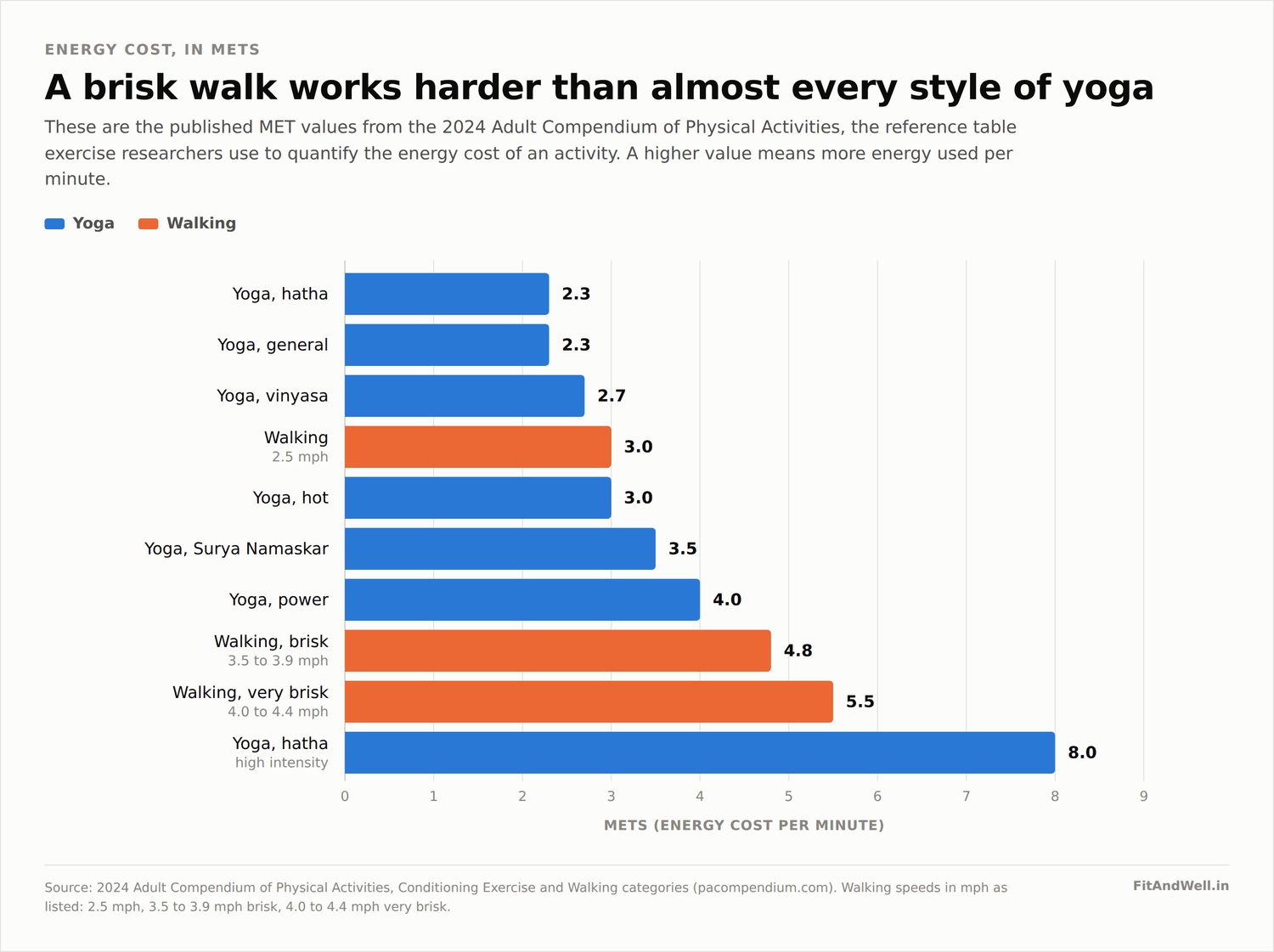
Style comparison at a glance
| Activity | METs |
|---|---|
| Yoga, hatha | 2.3 |
| Yoga, general | 2.3 |
| Yoga, vinyasa | 2.7 |
| Walking, 2.5 mph | 3.0 |
| Yoga, hot | 3.0 |
| Yoga, Surya Namaskar | 3.5 |
| Yoga, power | 4.0 |
| Walking, brisk (3.5 to 3.9 mph) | 4.8 |
| Walking, very brisk (4.0 to 4.4 mph) | 5.5 |
| Yoga, hatha, high intensity | 8.0 |
Source: 2024 Adult Compendium of Physical Activities.
What the trials show about yoga and body weight
Here the honest answer is that the evidence is thinner than the internet suggests, and a lot of it does not separate yoga from the diet that came with it.
The largest recent synthesis is a systematic review and meta-analysis published in PLOS Global Public Health in April 2026. It identified 30 randomised controlled trials in 2,689 adults with overweight or obesity, of which 23 trials and 2,313 participants went into the pooled analyses. Those pooled results showed yoga lowered systolic blood pressure by 4.35 mmHg (95% CI -6.10 to -2.60) and diastolic by 2.06 mmHg (95% CI -2.97 to -1.15), and reduced insulin resistance as measured by HOMA-IR by 0.87 (95% CI -1.64 to -0.10). Its authors concluded the evidence supports “the inclusion of yoga in clinical guidelines for the treatment of individuals with overweight or obesity”.
Triglycerides and HDL moved in the right direction too, by 0.26 mmol/L and 0.06 mmol/L, but the authors were careful to describe these as “modest effects below the minimal clinically important differences on lipid profiles”. LDL and total cholesterol did not change significantly.
Note what is missing from that list. The review did not pool body weight, BMI, waist circumference or body fat at all. It is a cardiometabolic review, and the headline benefits it found are blood pressure benefits, not weight benefits.
Two limitations are worth carrying with you, because this review is quoted a lot. Several of the included trials conducted among Asian participants were judged to be at high risk of bias, particularly over randomisation, missing outcome data and outcome measurement. And people with conditions such as type 2 diabetes, kidney disease and coronary artery disease were excluded, which the authors note reduces how well the results transfer to clinical practice.
A 2022 randomised trial in PLOS ONE tested yoga specifically as a weight maintenance tool. Sixty women with overweight or obesity completed a three-month behavioural weight loss programme, then were randomised to 12 weeks of Iyengar yoga twice a week or to matched cooking and nutrition classes. At six months, the two groups did not differ on weight loss. Only in a post-hoc subgroup, the women who had already lost 5% or more during the first programme, did yoga come out ahead, at 9.0 kg versus 6.7 kg. The authors called this “preliminary support”, and the trial was small, all-female and predominantly non-Hispanic White.
An Indian trial published in Medical Science Monitor in 2014 is often quoted as proof that yoga reduces weight. Read it carefully and it shows something more interesting. Telles and colleagues gave 68 overweight and obese adults 90 minutes daily of either supervised yoga or supervised walking for 15 days, with both groups on an identical diet of roughly 1,650 kcal a day. Both groups lost BMI, waist and hip circumference. Both also lost lean mass. There was no control group, dropout was around 33%, and the study ran for a fortnight with no follow-up. What it demonstrates is that a controlled diet plus 90 minutes of daily movement reduces weight, whichever of those two movements you pick.
Harvard’s Nutrition Source, reviewing the literature in April 2023, summarises it this way: a significant reduction in BMI “was found only in studies including overweight or obese participants practising yoga compared with usual care or no specific treatment”. The same page adds the necessary caveat, that “most of the studies are of low quality so it is hard to make definitive conclusions”.
And a 2022 review in Diseases put the position plainly: there is “not sufficient evidence to recommend that yoga interventions alone can lower energy expenditure”, and the small number of randomised trials “provides weak evidence”.
The context that matters more than the yoga
Weight loss is driven mostly by energy intake, and exercise of any kind is a modest contributor on its own. The International Agency for Research on Cancer’s 2017 monograph Energy Balance and Obesity reports that 120 to 240 minutes a week of aerobic exercise produced a weighted mean weight difference of just -1.6 kg over six-month programmes, and concluded that “isolated aerobic exercise is not an effective weight-loss therapy but may be effective in conjunction with diets”. Adding exercise to a diet bought an extra 1.1 kg over the diet alone.
That is for aerobic exercise, which is harder than yoga. If two to four hours a week of aerobic work moves the scale by about a kilo and a half in six months, a gentle hatha class is not going to do more.
Where physical activity earns its keep is afterwards. The same monograph reports that physical activity is “widely endorsed as being indispensable for long-term weight maintenance”, with more than 250 minutes a week associated with better maintenance. Keeping weight off is the part most people fail at, and it may be where yoga fits best, because it is an activity people carry on with.
Four things yoga does do for weight control
It reduces emotional and binge eating. This is the strongest mechanistic case. In a 2016 randomised trial of 52 women published in the Journal of Consulting and Clinical Psychology, eight weeks of heated hatha yoga reduced binge eating frequency (p = .040, d = .62) and eating to cope with negative feelings (p = .038, d = .54). Among women who started with high cortisol reactivity to stress, the yoga group also reduced that reactivity (p = .042, d = .85). The trial used a waitlist control, only 37% met the prescribed dose, and it did not report weight change as a finding. Still, the direction is consistent with what a 2022 review suggested: that yoga inside a weight management programme “may help reduce energy intake and improve eating habits”.
It builds lower body strength, balance and flexibility. A 2019 meta-analysis of 22 randomised trials in the International Journal of Behavioral Nutrition and Physical Activity found yoga improved lower limb strength against inactive controls (ES 0.45) and, notably, against active controls too (ES 0.49). Balance improved by ES 0.7 and lower body flexibility by ES 0.5 against inactive controls. Harvard’s review notes yoga helped older adults improve “lower body endurance and strength (e.g., ability to rise from a chair)”. That matters for weight control because strength and mobility are what let you keep walking, climbing stairs and training as you get older.
It lowers blood pressure. The 4.35 mmHg systolic reduction across 23 pooled trials is a real clinical benefit in its own right, and it arrives whether or not the scale moves. If you carry extra weight and have raised blood pressure, yoga treats one of those two directly.
People stick with it. In a six-month trial of 135 older adults, yoga class attendance was 77% with home practice on 64% of days, against 69% and 54% for a conventional exercise class. Dropout was 14% in yoga and 19% in exercise. The difference did not reach statistical significance, so this is a hint rather than a finding. But an exercise you actually do beats a better exercise you abandon.
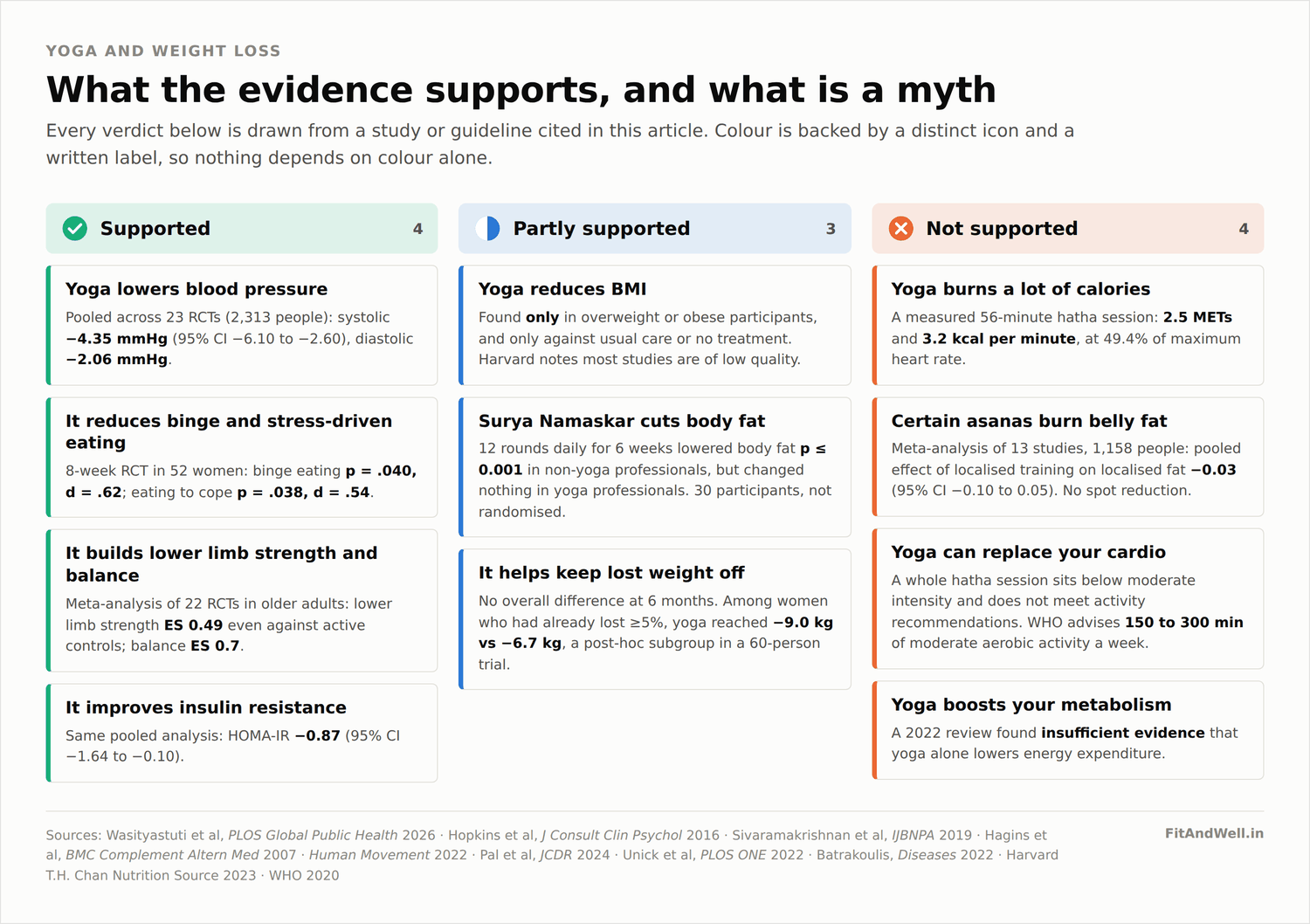
Five claims about yoga and weight loss that do not hold up
“These asanas burn belly fat.” They do not, and nothing else does either. A 2022 systematic review and meta-analysis in Human Movement pooled 13 studies and 1,158 participants across 37 comparisons of trained versus untrained limbs. The pooled effect size was -0.03 (95% CI -0.10 to 0.05, p = 0.508), with low heterogeneity and no publication bias. Its conclusion: “Localised muscle training had no effect on localised adipose tissue depots, i.e., there was no spot reduction.” Dr Nick Fuller of the University of Sydney puts it in plain terms: “exercising a specific part of the body did not reduce fat in that part of the body.” Where you lose fat is largely decided for you, and genes account for around 60% of where fat sits in the first place.
“Yoga boosts your metabolism.” No verifiable source supports this. The measured data point the other way: a yoga session is a low-intensity activity, and the 2022 Diseases review concluded there is “not sufficient evidence to recommend that yoga interventions alone can lower energy expenditure”.
“Hot yoga burns more because you sweat more.” Sweat is thermoregulation, not fat loss. The Compendium rates hot yoga at 3.0 METs, below brisk walking. Harvard’s review also warns that the heat in Bikram-style classes “may increase dehydration or even heat stroke”.
“Yoga can replace your cardio and strength work.” The World Health Organisation’s 2020 guidelines advise adults to do 150 to 300 minutes of moderate aerobic activity a week, or 75 to 150 minutes of vigorous, plus muscle-strengthening work on two or more days. Both are strong recommendations. A hatha class of the kind that was measured, at 2.5 METs and below the moderate threshold, does not cover the aerobic half. It has good evidence behind it for lower limb strength, which is part of the second half but not the whole of it, since WHO asks for work involving all the major muscle groups. Treat yoga as one component rather than the whole prescription.
“Yoga detoxifies and flushes out toxins.” We found no qualifying source for this at all, so we have left it out rather than hedge it. Your liver and kidneys handle that job.
The asanas worth learning, and the cautions that come with them
Rather than invent a list, the sensible starting point is the Common Yoga Protocol published by the Ministry of AYUSH, Government of India. It is a 45-minute sequence, with provision for a further 15 minutes of institutional practices. It has one great advantage over a typical “top 10 asanas” article: it publishes the conditions under which each pose should be avoided.
| Asana | Group | Cautions given in the Common Yoga Protocol |
|---|---|---|
| Tadasana | Standing | Avoid lifting the heels if you have vertigo |
| Vrikshasana | Standing | Avoid with vertigo |
| Pada-Hastasana | Standing | Avoid with cardiac disorders, hernia, ulcers or vertigo |
| Ardha Chakrasana | Standing | Hypertensive patients should bend with care; avoid with a tendency to vertigo |
| Trikonasana | Standing | Avoid with slipped disc or sciatica |
| Bhadrasana | Sitting | General rules apply; check the full protocol |
| Vajrasana | Sitting | General rules apply; check the full protocol |
| Ardha Ushtrasana | Sitting | Avoid with hernia or abdominal injuries, vertigo or arthritis |
| Ushtrasana | Sitting | Those with heart disease or hernia should not practise it |
| Shashankasana | Sitting | General rules apply; check the full protocol |
| Uttana Mandukasana | Sitting | General rules apply; check the full protocol |
| Vakrasana | Sitting | Avoid with acute back pain or spinal disorders, and during menstruation |
| Makarasana | Prone | Avoid during pregnancy |
| Bhujangasana | Prone | Those with hernia or ulcers should not practise it |
| Shalabhasana | Prone | Proceed cautiously with severe lower back pain; avoid with hernia |
| Setubandhasana | Supine | General rules apply; check the full protocol |
| Uttanapadasana | Supine | General rules apply; check the full protocol |
| Ardha Halasana | Supine | General rules apply; check the full protocol |
| Pavanamuktasana | Supine | General rules apply; check the full protocol |
| Shavasana | Supine | General rules apply; check the full protocol |
The cautions in that table are the ones the protocol attaches to specific poses. Its general rules apply to every pose in the sequence, so read the full protocol before you start: practise on an empty or light stomach with bladder and bowels emptied, and if you have chronic disease, pain or cardiac problems, consult a physician or yoga therapist first. Bathing and eating should wait 20 to 30 minutes after practice. The protocol also says a yoga expert should be consulted before practising during pregnancy or menstruation, and that elderly people and those with chronic cervical spondylitis may skip neck bending.
Surya Namaskar: the sequence with the most direct evidence
Of the elements of a standard practice, Surya Namaskar is the one with the most body composition evidence behind it, thin though that evidence is. At 3.5 METs in the Compendium, it sits above hatha, vinyasa and hot yoga, though below power yoga at 4.0. It was also the component of the 2007 hatha session that came closest to useful intensity. Those authors noted that sun salutation postures exceeding the minimum bout of 10 minutes “may contribute some portion of sufficiently intense physical activity … in unfit or sedentary individuals”.
A 2024 quasi-experimental study at the Morarji Desai National Institute of Yoga in New Delhi, published in the Journal of Clinical and Diagnostic Research, had participants perform 12 rounds of Surya Namaskar, totalling 24 minutes a day, five days a week for six weeks. Among non-yoga professionals, body fat percentage and total body fat fell (p ≤ 0.001), and weight and BMI fell (p ≤ 0.05). Among people who were already yoga professionals, nothing changed significantly.
Treat that finding with the caution its own authors ask for. There were 30 people split into three groups of ten, no diet restriction, and it was not a randomised, blinded trial. But the pattern it suggests is a useful one: the change showed up in the people who were not already yoga practitioners, and not in those who were.
A realistic weekly plan
If weight loss is the goal, structure the week so each element does the job it is actually good at.
- A calorie deficit is the engine. Nothing in the exercise literature substitutes for it. India’s 2025 revised obesity guideline recommends “a minimum of 60 min of daily physical activity per day … for weight loss and management”, which is more than most people expect.
- Brisk walking, or another moderate aerobic activity, meets the WHO minimum. Aim at 150 to 300 minutes a week. At 4.8 METs, brisk walking does roughly twice the metabolic work per minute of a hatha class.
- Surya Namaskar most days, working up gradually. Twelve rounds took 24 minutes in the Indian study. Start well below that if you are new.
- A full 45-minute Common Yoga Protocol session two or three times a week, for the strength, balance, flexibility and blood pressure benefits, and for the stress and eating-behaviour effects that may matter most over a year.
- Two days of muscle-strengthening work, as WHO advises. Yoga contributes here, and the meta-analytic evidence for lower limb strength is real, but do not assume it covers everything.
If you already have high blood pressure, a heart condition, a hernia, disc disease, or you are pregnant, take the contraindications above seriously and speak to your doctor or a qualified yoga therapist before starting.
Is yoga safe?
Mostly, yes, and more so than its reputation for gentleness might lead you to check. A survey of 1,702 German practitioners published in BMC Complementary and Alternative Medicine in 2019 found 21.4% reported at least one acute adverse effect and 10.2% a chronic one. Recruitment was by snowball sampling, so the response rate cannot be determined, and the sample is not representative of the general population. Hand, shoulder and head stands accounted for 29.4% of reported problems, forward and backward bends 23.8%, and sitting positions 11.9%. Full recovery was reached in 76.9% of acute and 51.6% of chronic cases.
Risk was higher for people practising alone through self-study without supervision, and for people with pre-existing chronic illness. The authors’ overall verdict, based on a rate of 0.60 injuries per 1,000 practice hours, was that “yoga appears to be as safe or safer when compared to other exercise types”.
The practical reading: learn from a qualified teacher rather than a video, and leave inversions alone. Harvard’s review also notes that inverted poses have been associated with headache and worsening glaucoma.
Why this matters more in India
According to the National Family Health Survey-5 (2019-21), quoted by the Ministry of Health and Family Welfare in August 2025, 24% of women and 23% of men in India are overweight or obese.
The bigger issue is where the weight sits. India’s revised obesity definition, published in Diabetes & Metabolic Syndrome in 2025 by Misra and colleagues, sets abdominal obesity at a waist circumference of 90 cm or more in men and 80 cm or more in women, and a waist-to-height ratio above 0.5. Normal BMI for Asian Indians is defined as 18.5 to 22.99. The guideline also introduces two stages: Stage 1 is raised adiposity “without impacting organ functions or causing functional limitations in day-to-day activities”, while Stage 2 affects organ function and brings co-morbid disease.
That framing is useful for anyone weighing up yoga. If you are at Stage 1, the goal is to stop the progression, and blood pressure, insulin resistance and eating behaviour are all legitimate targets. Yoga has decent evidence on all three. What it does not have is evidence that it will move the number on the scale by itself.
Measure your waist as well as your weight. It is the measurement the Indian guideline leans on, and it is the one a tape measure at home can give you honestly.
Frequently asked questions
Can you lose weight with yoga alone? Not to any meaningful degree without also changing what you eat. Yoga is a low-intensity activity: a measured 56-minute hatha session came to 2.5 METs and 3.2 kcal a minute. Even proper aerobic exercise, done for two to four hours a week without dietary change, produced a weighted mean difference of only -1.6 kg over six months in the IARC’s review.
How much yoga do you need to do to see a benefit? The 2026 meta-analysis found the cardiometabolic benefits were strongest when the programme ran at least 12 weeks, at least three times a week, with sessions of at least 60 minutes. That is at least 180 minutes a week, which the authors noted is above the 150-minute minimum for moderate-to-vigorous activity.
Which yoga is best for weight loss? On energy cost, the 2024 Adult Compendium puts power yoga highest among the mainstream styles at 4.0 METs, then Surya Namaskar at 3.5, hot yoga at 3.0 and vinyasa at 2.7. Hatha and general yoga sit at 2.3. High-intensity hatha is listed at 8.0, but that is a specific vigorous format rather than a typical class. Of those, Surya Namaskar is the one with direct body composition evidence attached to it, from a small Indian study.
Does yoga reduce belly fat specifically? No. A 2022 meta-analysis of 13 studies and 1,158 participants found no effect of localised training on localised fat, with a pooled effect size of -0.03 (95% CI -0.10 to 0.05). Fat loss is systemic, and around 60% of where you carry fat is genetic.
Is yoga better than walking for weight loss? On energy cost, no. Brisk walking is 4.8 METs against 2.3 for hatha yoga. In the one Indian trial that compared them head to head, over 15 days with a controlled diet, both groups lost BMI, waist and hip circumference, and both also lost lean mass. That trial had no control group and a 33% dropout rate, so it cannot separate the exercise from the diet.
Can yoga help me keep weight off after I have lost it? Possibly, and this may be its strongest role. The IARC monograph reports that physical activity is “widely endorsed as being indispensable for long-term weight maintenance”, with more than 250 minutes a week associated with better maintenance. In the 2022 PLOS ONE trial, women who had already lost 5% or more went on to lose more with yoga (9.0 kg versus 6.7 kg at six months), though that was a post-hoc subgroup finding in a small trial.
Does yoga help with stress eating? This is one of the stronger lines of evidence in the whole area. An eight-week randomised trial in 52 women found yoga reduced binge eating frequency (p = .040, d = .62) and eating to cope with negative feelings (p = .038, d = .54), with reduced cortisol reactivity among those who started as high reactors. It was a small trial with a waitlist control, and only 37% met the prescribed dose.
How many calories does an hour of yoga burn? The only directly measured figure we can stand behind is 3.2 kcal a minute, from a 56-minute beginner hatha session in which oxygen consumption was measured. That works out to under 200 kcal for the session. Figures you see quoted for vinyasa, power or hot yoga are typically estimates from MET tables rather than measurements.
Is yoga safe if I have high blood pressure? Yoga lowers blood pressure on average by 4.35 mmHg systolic in the 2026 meta-analysis. But individual poses carry cautions. The Common Yoga Protocol says hypertensive patients should bend with care in Ardha Chakrasana, and people with cardiac disorders should avoid Pada-Hastasana, while those with heart disease should not practise Ushtrasana. Speak to your doctor before you start.
Should I worry about getting injured? The risk is real but modest. In a survey of 1,702 German practitioners, 21.4% reported at least one acute adverse effect, most often from hand, shoulder and head stands. Unsupervised self-study and pre-existing chronic illness both raised the risk. That survey used snowball recruitment and is not representative of the general population. On an hourly basis, at 0.60 injuries per 1,000 practice hours, the authors judged yoga “as safe or safer” than other forms of exercise.
This article is for general information and is not a substitute for advice from your own doctor. If you have a diagnosed condition, are pregnant, or are starting exercise after a long gap, speak to a clinician or a qualified yoga therapist before you begin.
Sources
- Hagins M, Moore W, Rundle A. Does practicing hatha yoga satisfy recommendations for intensity of physical activity which improves and maintains health and cardiovascular fitness? BMC Complementary and Alternative Medicine, 2007.
- Grabara M. Intensity of Hatha yoga training for older adults. Scientific Reports, 15 April 2025.
- 2024 Adult Compendium of Physical Activities: Conditioning Exercise. Compendium of Physical Activities.
- 2024 Adult Compendium of Physical Activities: Walking. Compendium of Physical Activities.
- Wasityastuti W, Pramaningtyas MD, Wibowo RA, et al. Impact of yoga on cardiometabolic health in adults with overweight or obesity: a systematic review and meta-analysis of randomized controlled trials. PLOS Global Public Health, 22 April 2026.
- Unick JL, Dunsiger SI, Bock BC, et al. A preliminary investigation of yoga as an intervention approach for improving long-term weight loss: a randomized trial. PLOS ONE, 4 February 2022.
- Telles S, Sharma SK, Yadav A, Singh N, Balkrishna A. A comparative controlled trial comparing the effects of yoga and walking for overweight and obese adults. Medical Science Monitor, 2014.
- Physical activity, sedentary behaviour, and obesity. In: Energy Balance and Obesity. International Agency for Research on Cancer, 2017.
- Recommendations. In: WHO Guidelines on Physical Activity and Sedentary Behaviour. World Health Organization, 2020.
- A proposed model to test the hypothesis of exercise-induced localized fat reduction (spot reduction), including a systematic review with meta-analysis. Human Movement, 2022;23(3):1-14.
- Fuller N. Spot reduction: why targeting weight loss to a specific area is a myth. University of Sydney, 7 November 2023.
- Yoga. The Nutrition Source, Harvard T.H. Chan School of Public Health, last reviewed April 2023.
- Cramer H, Quinker D, Schumann D, Wardle J, Dobos G, Lauche R. Adverse effects of yoga: a national cross-sectional survey. BMC Complementary and Alternative Medicine, 2019.
- Steps taken to Reduce Obesity. Press Information Bureau, Ministry of Health and Family Welfare, Government of India, 12 August 2025.
- Misra A, Vikram NK, Ghosh A, et al. Revised definition of obesity in Asian Indians living in India. Diabetes & Metabolic Syndrome: Clinical Research & Reviews, 2025;19:102989.
- Common Yoga Protocol. Ministry of Ayurveda, Yoga & Naturopathy, Unani, Siddha and Homoeopathy (AYUSH), Government of India.
- Pal R, Rao S, Deo G, Basavaraddi IV, Sharma N, Madaan L. Impacts of the Surya Namaskar on body composition and physiological parameters among yoga and non yoga professionals: a quasi-experimental study. Journal of Clinical and Diagnostic Research, February 2024;18(2):CC11-CC15.
- Sivaramakrishnan D, et al. The effects of yoga compared to active and inactive controls on physical function and health related quality of life in older adults: systematic review and meta-analysis of randomised controlled trials. International Journal of Behavioral Nutrition and Physical Activity, 2019.
- Hopkins LB, Medina JL, Baird SO, Rosenfield D, Powers MB, Smits JAJ. Heated hatha yoga to target cortisol reactivity to stress and affective eating in women at risk for obesity-related illnesses: a randomized controlled trial. Journal of Consulting and Clinical Psychology, 2016.
- Flegal KE, Kishiyama S, Zajdel D, Haas M, Oken BS. Adherence to yoga and exercise interventions in a 6-month clinical trial. BMC Complementary and Alternative Medicine, 2007.
- Batrakoulis A. Psychophysiological adaptations to yoga practice in overweight and obese individuals: a topical review. Diseases, 2022.