

A lipoprotein(a) test measures an inherited cholesterol-carrying particle linked to heart attack, stroke and aortic valve disease. About one in four Indians and other South Asians carry a level at or above 50 mg/dL, the point at which risk climbs, yet Indian laboratories sell Lp(a) as a separate test that has to be ordered by name. In March 2026, the American College of Cardiology and the American Heart Association began recommending that every adult have it measured at least once.
That last point is the change worth knowing about. For years, Lp(a) was a test ordered only for people who already looked unusual: a heart attack at 38, a family full of early cardiac deaths, severe cholesterol with no obvious cause. The 2026 guidance moves it into the category of things you check once and then know for life.
What Lp(a) actually is
Lp(a) is a particle made of the same apolipoprotein B core found in LDL cholesterol, with an extra protein called apolipoprotein(a) attached to it. The Cleveland Clinic Journal of Medicine describes it as ‘a lipoprotein particle comprising the LDL-like component apolipoprotein B covalently bound to a protein called apolipoprotein(a)’.
What makes it different from the rest of your lipid panel is where the number comes from. The 2022 European Atherosclerosis Society consensus statement puts it plainly: Lp(a) concentration is ‘predominantly (>90%) determined by genetic variability at the LPA locus’. A repeat polymorphism in that gene explains somewhere between 30% and 70% of the variation between individuals.
So your Lp(a) is not really a lifestyle number. It is closer to a blood group: something you were dealt, that you can find out, and that changes your calculation about everything else.
The range between people is enormous. The European Atherosclerosis Society notes concentrations running from under 0.1 mg/dL to over 300 mg/dL. Two people with identical LDL cholesterol can sit at opposite ends of that spread.
Why this matters more in India
Indians do not have the highest Lp(a) levels in the world. People of African descent do. But Indians sit well above white European and Chinese populations, and the consequences appear to be worse.
The figures are consistent across two independent reviews. Population median Lp(a) rises in sequence across Chinese individuals at 16 nmol/L, white individuals at 19 nmol/L, South Asians at 31 nmol/L and Black individuals at 75 nmol/L.
The clinical picture for South Asians is the part that should give any Indian reader pause. A 2019 review in the Indian Heart Journal by Enas A. Enas and colleagues concluded that ‘South Asians have the second highest Lp(a) levels and the highest risk of AMI from the elevated levels, more than double the risk observed in people of European descent’. The same review found that approximately 25% of Indians and other South Asians have elevated Lp(a) at or above 50 mg/dL, which it described as ‘a risk factor of great importance, similar to or surpassing diabetes’.
Set that against the other well-known Indian pattern. Enas and colleagues note that Indians ‘develop acute myocardial infarction (AMI) about 10 years earlier’ than other populations, with heart attack rates in young Indians three to five times higher. Crucially, they add that established risk factors ‘do not fully account for the excessive burden of CAD in young Indians’.
Lp(a) is one of the candidates for that missing piece. A high level carries a twofold to threefold risk of coronary artery disease, comparable to diabetes.
One important qualification. The extra burden in South Asians looks to be driven mainly by how common high levels are, rather than by each unit of Lp(a) doing more damage in Indian bodies. The National Lipid Association’s 2024 update reports that the risk attributable to elevated Lp(a) ‘was similar for White, South Asian, and Black individuals’, with hazard ratios of 1.11, 1.20 and 1.07 respectively per 50 nmol/L increase. The molecule behaves much the same in everyone. More of us are carrying a lot of it.
Indian evidence directly testing this is thinner than the international evidence, and it is worth being honest about that. A 2022 case-control study in PLOS ONE of 928 people in Kerala found Lp(a) was not significantly associated with coronary disease across all ages (odds ratio 1.22, 95% CI 0.87 to 1.72). In participants under 50, however, it was strongly associated, with an odds ratio of 3.52 (95% CI 1.63 to 7.57). The authors themselves flag the study’s limits: it was retrospective, confined to Kerala, hospital-based and unbalanced between cases and controls. It is a signal, not a settled fact, and it points in the same direction as the wider literature: Lp(a) seems to matter most in the young.
What changed in March 2026
On 13 March 2026, the ACC and AHA released an updated dyslipidaemia guideline. Its position on Lp(a) is short and consequential: ‘Lp(a) should be measured at least once in adulthood.’
The reason a single test suffices is the genetics. The AHA statement accompanying the guideline explains that Lp(a) levels ‘are largely genetically determined and remain relatively stable over a lifetime’ and that ‘repeat testing is generally not needed’. The AHA’s guidance for clinicians makes the same point: ‘a single measurement is usually sufficient to establish a lifetime baseline’.
This was not a lone position. The National Lipid Association’s 2024 focused update had already called for ‘measurement of Lp(a) levels at least once in every adult for cardiovascular risk assessment’. The European Atherosclerosis Society recommended ‘testing Lp(a) concentration at least once in adults’ back in 2022. The 2026 guideline brought a mainstream American guideline into line with where lipid specialists had already arrived.
How to read your Lp(a) result
Two units are in circulation, which causes real confusion on lab reports: mg/dL and nmol/L. The National Lipid Association’s position is that results should be reported in nmol/L using WHO- and IFCC-calibrated assays.
Do not convert between the two yourself. The Cleveland Clinic Journal of Medicine notes that using a fixed conversion factor of two to two and a half times the mg/dL figure ‘is now discouraged owing to significant variability’. If your report gives mg/dL, read it against mg/dL thresholds.
| Band | nmol/L | mg/dL | What it means |
|---|---|---|---|
| Desirable | Below 75 | About below 30 | No added risk from Lp(a) |
| Grey zone | 75 to under 125 | About 30 to under 50 | Intermediate. Worth a repeat measurement |
| High | 125 or above | 50 or above | Treated as high risk |
| Very high | 300 to 400 | Not quoted in mg/dL | Risk comparable to inherited high cholesterol |
A word on the phrase ‘Lp(a) normal range’, which is what most people type into a search box and what many Indian lab reports print in the margin. Cleveland Clinic gives it as ‘less than 30 milligrams per deciliter (mg/dL)’, and grades the rest as borderline risk from 14 to 30 mg/dL, high risk above 31 to below 50, and highest risk above 50. It is worth knowing that clinicians increasingly avoid ‘normal’ here. Lp(a) is not a value your body is supposed to hold steady within a healthy window. It is a fixed inherited level, and the bands describe how much risk it adds, not whether something has gone wrong.
The 125 nmol/L or 50 mg/dL line is the one the major bodies now converge on. The National Lipid Association states that people ‘with Lp(a) levels ≥125 nmol/L (50 mg/dL) should be considered high risk’. Ann Marie Navar, a member of the 2026 guideline writing committee, described that threshold as one that ‘represents a meaningful inflexion point, above which cardiovascular risk increases substantially’.
The grey zone deserves attention rather than relief. The National Lipid Association specifically recommends repeat measurement between 75 and 125 nmol/L, because ‘a substantial percentage of individuals with intermediate-risk Lp(a) levels may move into the high-risk category’.
What the number does to your risk
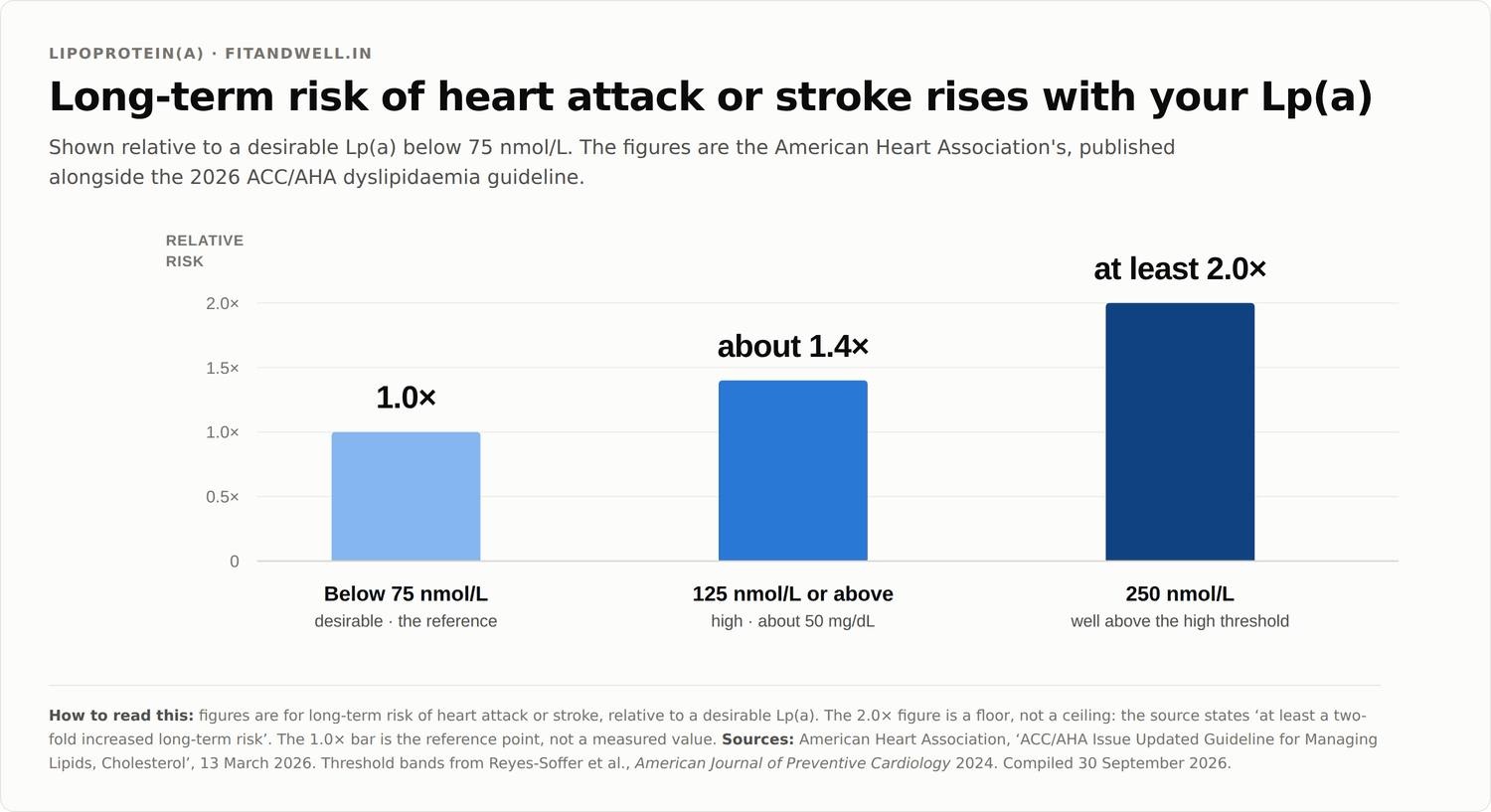
The AHA put numbers on this alongside the 2026 guideline. An Lp(a) of 125 nmol/L or more ‘is associated with about a 1.4-fold increased long-term risk of heart attack or stroke’. At 250 nmol/L, the risk is ‘at least a two-fold increased long-term risk’.
A 1.4-fold increase is not a verdict. What makes it worth knowing is that it sits on top of whatever your LDL cholesterol, blood pressure and blood sugar are doing, and that it has been doing so since childhood without appearing on any report you have seen.
It is also not uniform across every outcome. The European Atherosclerosis Society found that levels above the 75th percentile raised the risk of aortic valve stenosis and myocardial infarction, levels above the 90th percentile were linked to heart failure, and the risk of cardiovascular death and ischaemic stroke rose only at very high levels above the 95th percentile. Lp(a) is a heart attack and aortic valve risk first, and a stroke risk mainly at the extremes.
That valve point is underappreciated. The European Atherosclerosis Society describes Lp(a) as ‘a new risk factor for aortic valve stenosis’, associated with ‘both microcalcification and macrocalcification of the aortic valve’.
Who should get tested for Lipoprotein(a) test first
The 2026 guidance says all adults, once. In a health system where people are paying out of pocket, some people should move up the queue. Based on the indications the National Lipid Association and Cleveland Clinic set out, that means you, if any of these apply:
- A parent, sibling or child who had premature heart disease, a stroke or a cardiac death
- Your own heart attack or stroke, especially if it happened early or without the usual risk factors
- A known family history of raised Lp(a)
- Very high LDL cholesterol, or suspected familial hypercholesterolaemia
- Calcific aortic valve disease, or cardiovascular disease that keeps recurring despite optimal treatment
- An intermediate calculated risk score, where you and your doctor are genuinely undecided about starting a statin
If your Lp(a) comes back high, the result is not only about you. Because the level is inherited, a 2024 review in the American Journal of Preventive Cardiology notes that ‘cascade screening of first-degree family members is another warranted and actionable response’. The European Atherosclerosis Society adds that cascade testing has ‘potential value in familial hypercholesterolaemia’.
What lowers Lp(a), and what does not
This is where most articles go wrong, so it is worth being blunt about the evidence in both directions.
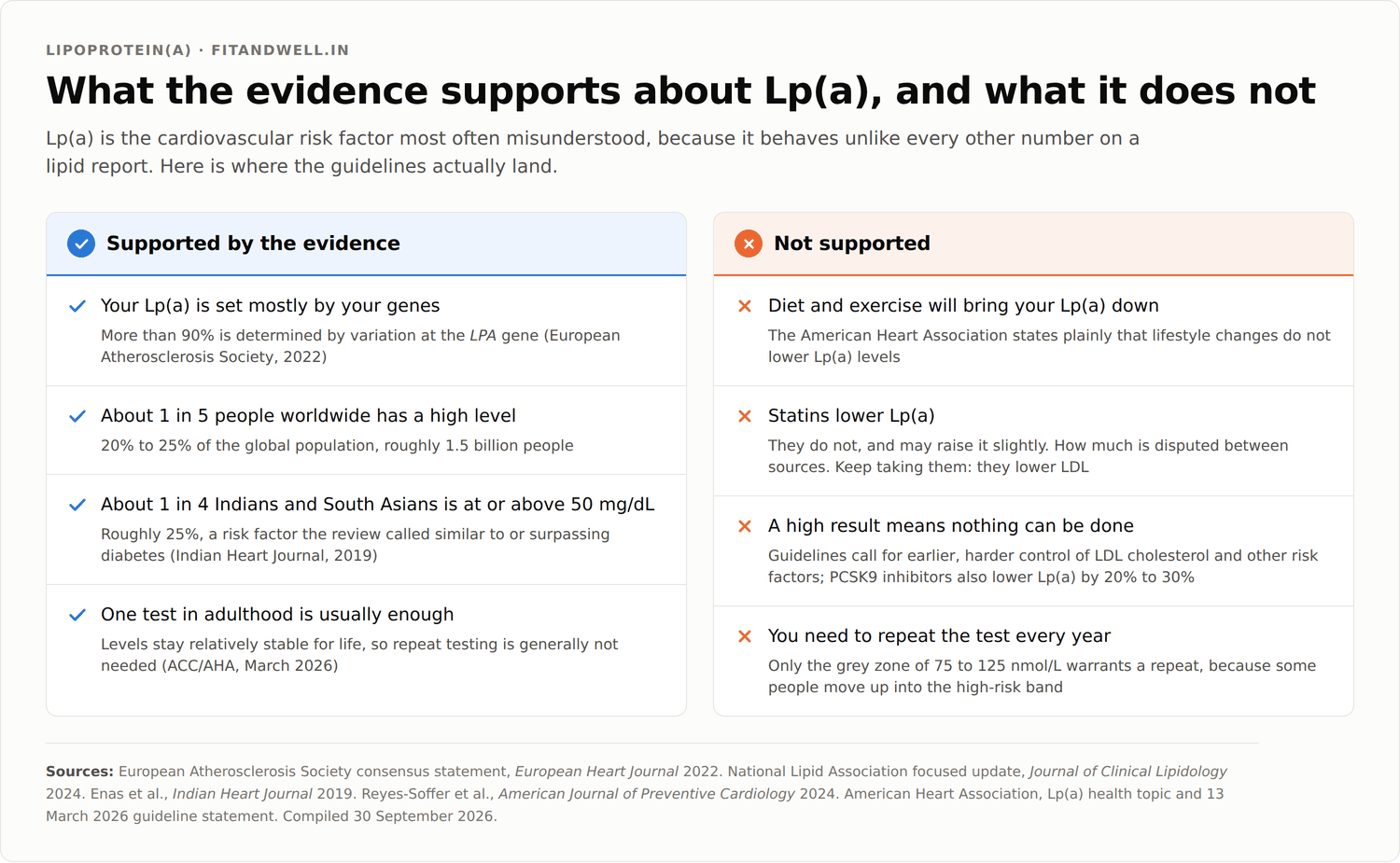
Diet and exercise do not lower it. The American Heart Association states that ‘lifestyle changes don’t lower Lp(a) levels’. That is the whole finding, and it is worth holding on to the next time a supplement is marketed to you on the promise of moving this particular number.
Statins do not lower it either, and may nudge it up. The National Lipid Association’s 2024 update says flatly that ‘statins do not lower Lp(a) and may slightly increase Lp(a)’. How much they raise it is genuinely disputed: the National Lipid Association puts the average effect at about a 1.1 mg/dL increase, while the American Journal of Preventive Cardiology review reports statins increasing Lp(a) by 9% to 20%. The Cleveland Clinic Journal of Medicine describes the effect as slight or neutral. None of this is a reason to stop a statin. Statins are prescribed to lower LDL cholesterol, and the guidelines quoted here treat reducing LDL cholesterol as the main response to a high Lp(a).
Some drugs do lower it, modestly. PCSK9 inhibitors reduce Lp(a) by roughly 20% to 30%. Niacin reduces it by about 20% to 25%, but the Cleveland Clinic Journal of Medicine notes that ‘its routine use is discouraged’, and the National Lipid Association does not recommend it for this purpose. Lipoprotein apheresis, a filtering procedure reserved for very high-risk patients, drops apoB-containing lipoproteins including Lp(a) by 70% to 75% acutely, though across repeated treatments the time-averaged reduction works out at 30% to 35%.
Drugs that lower it dramatically are in late-stage trials, not in pharmacies. The American Journal of Preventive Cardiology review lists pelacarsen reducing Lp(a) by up to 80% in the Phase 3 Lp(a)HORIZON trial, olpasiran by 70% to 97% in Phase 3, lepodisiran by a median 97% at the highest dose, zerlasiran by up to 98%, and muvalaplin, an oral drug, by up to 65% in the Phase 2 KRAKEN trial. These are impressive reductions. What none of them has yet published is proof that lowering Lp(a) prevents heart attacks, which is the question the outcome trials exist to answer.
So what do you actually do with a high result?
Treat it as information that changes the urgency of everything else, which is precisely what the guidelines say.
The National Lipid Association’s advice is ‘early, more-intensive risk factor management, including lifestyle modification and lipid-lowering drug therapy in high-risk individuals, primarily to reduce low-density lipoprotein cholesterol (LDL-C) levels’. It adds that for people with elevated Lp(a), ‘treatment of conventional risk factors to guideline-based goals becomes particularly important’. The AHA’s clinician guidance agrees: the best approach ‘is to lower overall ASCVD risk’, by targeting LDL-C with lifestyle changes, statins and other lipid-lowering therapy.
In practice, that means a harder push on the things that do respond: LDL cholesterol, blood pressure, blood sugar, smoking, weight and the long stretches of sitting that quietly undermine all of them. If weight is part of your picture, the evidence-backed strategies matter more for you than for someone with a normal Lp(a), not less, because you have less margin.
Two further points from the guidelines. For people who already have cardiovascular disease alongside high Lp(a), PCSK9 inhibitors may be added to help reach LDL-C targets. And the National Lipid Association recommends a risk and benefit discussion about aspirin in primary prevention patients with elevated Lp(a), for use as a risk-lowering rather than a lipid-lowering agent. Note that the National Lipid Association frames this as a discussion to have, weighing risk against benefit, rather than something to start on your own.
What an Lp(a) test costs in India, and how to ask for it
Indian laboratories sell and price Lp(a) as a standalone test, separate from the lipid profile, so you have to ask for it by name. Order it as ‘Lipoprotein (a)’ or ‘Lp(a)’.
Prices vary widely. Dr Lal PathLabs lists the test at ₹990. A price aggregator covering Delhi laboratories, checked on 30 September 2026, showed a range from ₹300 at the low end to ₹2,760 at the high end, with an average around ₹890 and Thyrocare listed at ₹670 with an online discount.
No special preparation is needed. Dr Lal PathLabs states ‘no special preparation required’ for its Lp(a) test, which takes a serum sample. If you are having a lipid profile done anyway, adding Lp(a) to the same draw saves a second visit.
One practical request worth making: ask the laboratory to report in nmol/L if they can, and to state which units they used. Given that fixed conversions are discouraged, a report that does not say clearly which unit it used is a report you cannot interpret.
Frequently asked questions
Is Lp(a) included in a normal lipid profile?
No. A standard lipid profile measures total cholesterol, LDL, HDL and triglycerides. Indian laboratories list and price Lp(a) separately, so it has to be ordered by name.
How often should I repeat the Lp(a) test?
Usually never. Because levels are largely genetic and stable, the AHA statement accompanying the 2026 guideline says ‘repeat testing is generally not needed’. The main exception is a grey-zone result between 75 and 125 nmol/L, where the National Lipid Association suggests repeating it, since some people in that band move up into the high-risk category.
The picture is not completely fixed, though. The Cleveland Clinic Journal of Medicine notes that ’emerging data suggest a person’s lipoprotein(a) level may vary from measurement to measurement in specific circumstances’. If a result sits close to a threshold and a treatment decision hangs on it, that is worth raising with your doctor.
Can I lower my Lp(a) with diet, exercise or supplements?
No. The American Heart Association is explicit that ‘lifestyle changes don’t lower Lp(a) levels’. Lifestyle changes remain worth making, because they lower your overall cardiovascular risk, which is the actual goal when Lp(a) is high.
Does a high Lp(a) mean I will definitely have a heart attack?
No. An Lp(a) of 125 nmol/L or above is associated with roughly a 1.4-fold increase in long-term risk of heart attack or stroke, rising to at least two-fold at 250 nmol/L. That is a meaningful increase in probability, not a verdict, and the rest of your risk profile remains largely in your hands.
At what age should I get tested?
The 2026 guidance is once in adulthood. NPR’s report on the guideline adds that the test ‘typically needs to be done only once, ideally early in adulthood’, since the result does not change and knowing it early gives you decades to act on the rest of your risk. If you have a family history of early heart disease, there is no reason to wait.
Should my children be tested?
If your Lp(a) is high, discuss it with your doctor. Cascade screening of first-degree relatives is described in the 2024 American Journal of Preventive Cardiology review as ‘warranted and actionable’, and Cleveland Clinic notes that ‘the amount of lipoprotein (a) you have as a child will most likely be the level you have for years to come’.
Does Lp(a) affect anything other than the heart?
Yes. The European Atherosclerosis Society identifies Lp(a) as a risk factor for aortic valve stenosis, linked to calcification of the valve, and found raised risk of ischaemic stroke at very high levels.
Are the new Lp(a)-lowering drugs available in India?
No drug is yet approved anywhere specifically to lower Lp(a). Pelacarsen, olpasiran, lepodisiran, zerlasiran and muvalaplin were all still in Phase 2 or Phase 3 trials as of the 2024 review cited here, and none has yet shown that lowering Lp(a) prevents cardiovascular events. PCSK9 inhibitors lower Lp(a) by 20% to 30% as a secondary effect, but they are prescribed to lower LDL cholesterol, not Lp(a). Ask your cardiologist what is available to you locally.
The bottom line
Lp(a) is the rare cardiovascular risk factor where one blood test, once in your life, tells you something permanent and useful. For Indians the case is stronger than for most populations: about a quarter of us are above the risk threshold, we have heart attacks about a decade earlier than other populations, and conventional risk factors do not fully explain why.
The honest limitation is that there is still no approved drug that lowers Lp(a) and has been proven to prevent heart attacks. What a high result buys you is not a prescription but a reason to be more serious, and earlier, about the risks that do respond to treatment. For a risk factor you have carried since childhood without knowing, that is not a small thing.
If your result is high, or if you are unsure how it fits with the rest of your numbers, take the report to your doctor rather than acting on it alone. Decisions about statins, aspirin and further cardiac testing depend on your whole risk picture, not on one value.
Sources
- Kronenberg F, et al. Lipoprotein(a) in atherosclerotic cardiovascular disease and aortic stenosis: a European Atherosclerosis Society consensus statement. European Heart Journal, 2022;43(39):3925-3946.
- Koschinsky ML, et al. A focused update to the 2019 NLA scientific statement on use of lipoprotein(a) in clinical practice. Journal of Clinical Lipidology, 2024.
- Enas EA, Varkey B, Dharmarajan TS, Pare G, Bahl VK. Lipoprotein(a): An underrecognized genetic risk factor for malignant coronary artery disease in young Indians. Indian Heart Journal, 2019;71(3):184-198.
- Reyes-Soffer G, Yeang C, Michos ED, et al. High lipoprotein(a): Actionable strategies for risk assessment and mitigation. American Journal of Preventive Cardiology, 2024;18:100651.
- Al-Dalakta A, Cho LS, Sarraju A. Lipoprotein(a) in clinical practice: What clinicians need to know. Cleveland Clinic Journal of Medicine, 2025;92(11):679-685.
- Joseph J, Menon JC, Sebastien PK, Sudhakar A, John D, Menon GR. Association of lipoprotein (a) with coronary artery disease in a South Asian population: A case-control study. PLOS ONE, 2022.
- American Heart Association. ACC/AHA Issue Updated Guideline for Managing Lipids, Cholesterol. 13 March 2026.
- American Heart Association. 2026 Guideline on the Management of Dyslipidemia. Professional Heart Daily, 13 March 2026.
- American Heart Association. Lipoprotein(a). AHA health topics.
- American Heart Association. Clinicians’ Guide to Frequently Asked Questions About Lipoprotein(a) Testing.
- Cleveland Clinic. Who Needs a Test for Lipoprotein (a)? Last reviewed 31 August 2023.
- Family Heart Foundation. New 2026 Dyslipidemia Guidelines Recommend Lipoprotein(a) Testing and Earlier Detection of Inherited Risk. 17 March 2026.
- National Lipid Association. Use of Lipoprotein(a) in clinical practice: guideline summary.
- Expert Insights: Lp(a) and ApoB in the 2026 Dyslipidemia Guidelines. HCPLive, 23 March 2026.
- Dr Lal PathLabs. LIPOPROTEIN (a); Lp(a) test. Prices checked 30 September 2026.
- Medifee. Lipoprotein A / LP(a) Test in Delhi (with Cost). Prices checked 30 September 2026.
- A cholesterol test you’ve never heard of is now recommended to prevent heart disease. NPR, 13 March 2026.
This article is for information and is not a substitute for advice from your own doctor.