
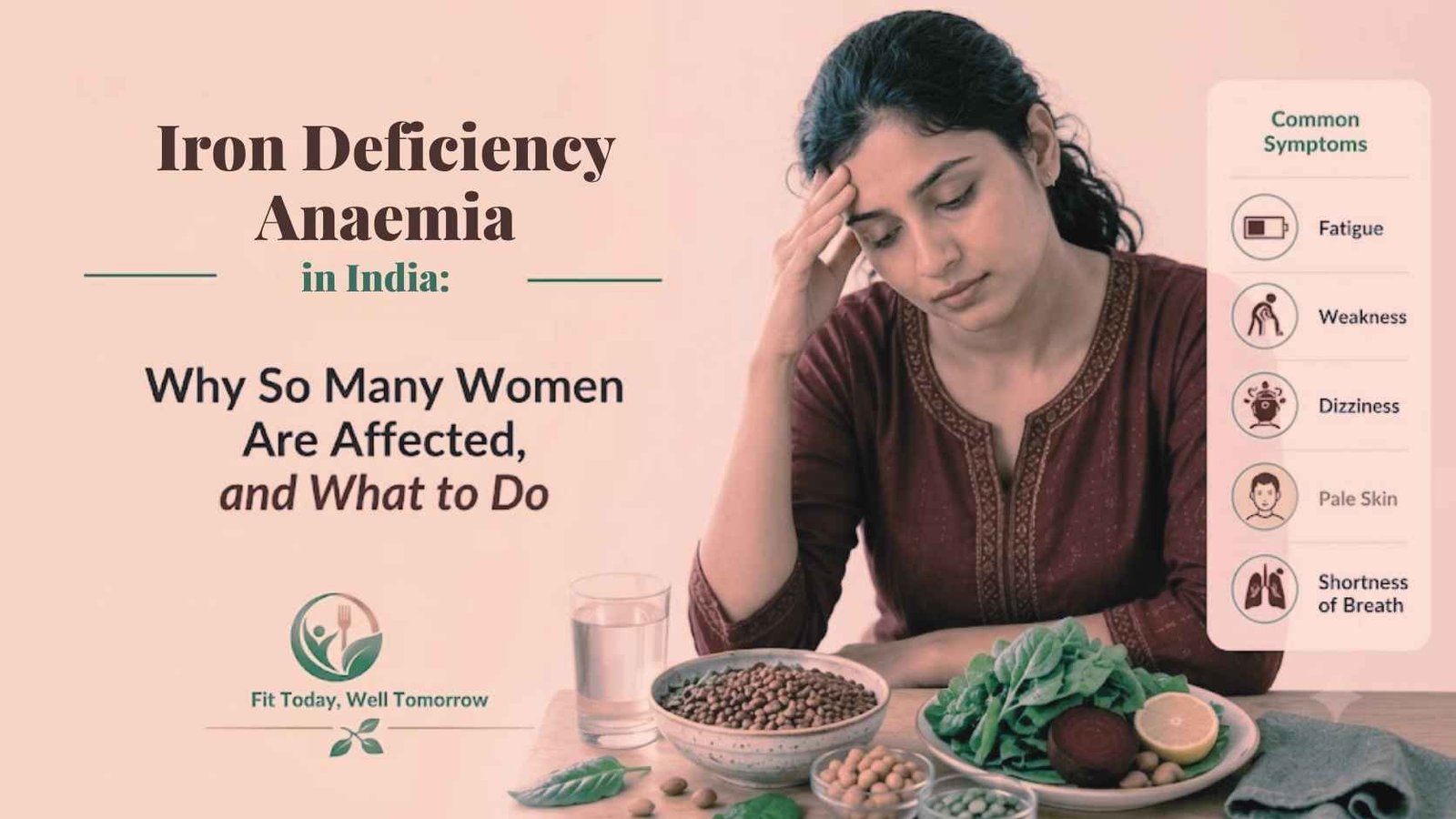
Iron deficiency anaemia happens when the body doesn’t have enough iron to make adequate haemoglobin, the protein in red blood cells that carries oxygen. In India, it is extremely common, especially among women: government survey data puts anaemia in well over half of women aged 15 to 49, and iron deficiency is its single biggest driver.
The condition is treatable and, in most cases, straightforward to diagnose with a simple blood test. The harder part is that its symptoms- tiredness, breathlessness, poor concentration- are so easy to write off as an ordinary busy life that many women live with it for years before anyone checks their blood count.
This guide covers what iron deficiency anaemia actually is, how big the problem really is in India, why women carry such a disproportionate share of it, how it’s diagnosed and treated, what a sensible Indian diet looks like, and what India’s government is doing about it at population scale.
Medical note: this article is for health education. It does not replace diagnosis or treatment from a qualified doctor. Iron supplements should not be started long-term, especially at high doses, without a blood test confirming the diagnosis, since unnecessary iron overload carries its own risks.
Anaemia is common, but feeling exhausted all the time should never be dismissed as normal.
What Is Iron Deficiency Anaemia?
Iron is the raw material the body uses to build haemoglobin. Without enough of it, the bone marrow cannot make healthy red blood cells, and the blood’s capacity to carry oxygen to tissues and organs falls.
Iron deficiency develops in stages. First, the body’s iron stores, measured by a protein called ferritin, are used up. At this stage, haemoglobin can still be normal, but a person can already feel some of the effects of low iron. This is called iron deficiency without anaemia, and it’s more common and more often missed than most people realise.
If the shortfall continues, haemoglobin production eventually falls too, and true anaemia sets in. The red blood cells that are made tend to be smaller and paler than normal, a pattern doctors call microcytic, hypochromic anaemia, which is usually visible on a routine blood count even before more detailed iron tests are done.
Iron deficiency anaemia is the most common cause of anaemia worldwide and in India, but it isn’t the only one. Vitamin B12 and folate deficiency, chronic disease, and inherited blood disorders can all cause anaemia too, and a proper diagnosis needs to identify which one is actually at play rather than assuming iron is always the answer.
Our guide to vitamin B12 deficiency covers the other major nutritional anaemia common in India, which frequently overlaps with iron deficiency in the same person.
How Common Is Iron Deficiency Anaemia in India?
India carries one of the largest anaemia burdens in the world, and women bear the brunt of it. According to the National Family Health Survey’s fifth round (NFHS-5, 2019 to 2021), 57.0% of non-pregnant women aged 15 to 49 were anaemic, along with 52.2% of pregnant women in the same age group and 59.1% of adolescent girls aged 15 to 19.
Men fare considerably better: 25.0% of men aged 15 to 49 and 31.1% of adolescent boys were anaemic over the same period (Ministry of Health and Family Welfare, India’s Fight Against Anaemia).
The regional spread is wide. Ladakh recorded anaemia in 92.8% of all women in NFHS-5, while Kerala, at the other end, came in at 36.3%. Even Kerala’s figure means more than a third of women are affected.
Wealth reduces the problem but doesn’t come close to solving it. Among the richest fifth of Indian households, over half of women aged 15 to 49 are still anaemic, a pattern that points to causes beyond simple food access, including diet composition, menstrual health and healthcare-seeking behaviour (Data For India, Anaemia in India).
Perhaps the most sobering part of the picture is the trend line. Anaemia prevalence among Indian women and children rose between NFHS-4 (2015 to 2016) and NFHS-5 (2019 to 2021), even as several other nutrition indicators improved over the same period.
The number of Indian states with anaemia prevalence above 60% doubled, from five states to eleven, across those two survey rounds (Anaemia in India and Its Prevalence and Multifactorial Aetiology: A Narrative Review, Nutrients, 2024).
Most of this is mild to moderate anaemia rather than severe. Fewer than 3% of Indian women and children fall into the severely anaemic category, which is a genuinely reassuring detail buried inside an otherwise alarming set of numbers: this is overwhelmingly a problem that responds well to straightforward treatment once it’s identified, not a crisis of critically ill patients.
Is all of this iron deficiency anaemia specifically?
Not entirely, and it’s worth being honest about that rather than treating ‘anaemia’ and ‘iron deficiency’ as interchangeable, which popular coverage in India often does.
Iron deficiency is the leading cause of anaemia in Indian women and children, but it isn’t the only one. The same 2024 narrative review found that iron deficiency accounted for only around 36.5% of anaemia cases in children aged one to four, and an even smaller 15.6% to 21.3% in older children and adolescents in some Indian studies, with vitamin B12 and folate deficiency responsible for roughly a quarter of anaemia cases in older age groups.
Hookworm infestation, other chronic infections, and haemoglobin disorders such as thalassaemia trait also contribute in specific populations and regions (Nutrients, 2024).
This matters practically. Someone who takes iron tablets for months without an improvement in their blood count may not have iron deficiency anaemia at all, or may have iron deficiency alongside a second, untreated cause. A blood test that goes beyond haemoglobin alone, checking ferritin and, where relevant, B12 and folate, is what actually tells the difference.
Why Are Indian Women So Disproportionately Affected?
Several factors compound in Indian women in a way they typically don’t in men, which is why the gap in anaemia rates between the sexes is as wide as it is.
Menstruation is the most direct driver. Regular monthly blood loss represents an ongoing iron drain that men simply don’t have, and women with heavy periods, whether from fibroids, adenomyosis, or PCOS, lose considerably more iron than average and are at correspondingly higher risk.
Pregnancy and repeated childbearing multiply the demand for iron further, since the growing fetus and placenta both draw on the mother’s iron stores. Early marriage, closely spaced pregnancies, and multiple pregnancies, all more common in parts of rural India, compound this over a woman’s reproductive years rather than giving iron stores time to recover between pregnancies.
Diet composition plays a large and underappreciated role. The typical Indian diet, especially outside affluent urban households, is predominantly vegetarian and cereal-based, meaning most dietary iron comes in the non-heme form found in plants rather than the far more absorbable heme iron found in meat and fish.
Non-heme iron absorption is also more easily blocked by phytates in lentils, grains and legumes, and by the tannins in tea, a beverage most Indian households drink multiple times a day, often around meals.
This dietary reality is reflected directly in India’s own nutrient guidelines. The Indian Council of Medical Research’s National Institute of Nutrition sets the recommended dietary allowance for iron at 29 mg a day for adult women, compared with 19 mg a day for adult men, a considerably wider gap than in Western dietary guidelines, precisely because the ICMR-NIN accounts for the lower bioavailability of iron in a typical Indian, largely plant-based diet (ICMR-NIN, Nutrient Requirements for Indians, 2020).
Survey data on actual intake shows many households falling short even of older, lower targets, with median household iron intake around 12 mg a day against a recommended level, a real-world gap on top of an already demanding requirement (Nutrients, 2024).
Social and household eating patterns add a further, less visible layer. In many Indian households, women and girls still eat last and get a smaller share of protein- and iron-dense foods such as eggs, meat, fish and pulses, a pattern well documented in nutrition research even though it rarely appears in official statistics as a named ’cause’.
Worm infestation and gastrointestinal blood loss remain relevant in specific populations, particularly among adolescent girls and women in areas with poor sanitation, where hookworm causes chronic, low-grade intestinal bleeding that depletes iron over months or years, sometimes without any obvious digestive symptoms (Intestinal parasitic infestations and anaemia among urban female school children, Tamil Nadu, PMC, 2018).
None of these factors acts entirely alone. A young woman who menstruates heavily, eats a largely vegetarian diet low in vitamin C-rich foods at the same meal, and lives in a household where she isn’t prioritised for iron-dense food, is dealing with three compounding risk factors at once, not one.
Symptoms of Iron Deficiency Anaemia
Iron deficiency anaemia usually develops slowly, which means the body has time to partly adapt, and that’s exactly why it’s so often missed. Many women describe feeling ‘just tired’ for months, or attribute breathlessness on the stairs to being unfit or overweight, before a blood test reveals what’s actually going on.
Common symptoms include:
- Persistent fatigue and low energy, out of proportion to activity or sleep
- Pale skin, and pale inner eyelids or nail beds
- Breathlessness, even with mild exertion such as climbing stairs
- Dizziness or lightheadedness
- Headaches
- A rapid or noticeable heartbeat (palpitations)
- Cold hands and feet
- Poor concentration and reduced mental sharpness, sometimes called brain fog
- Reduced exercise tolerance and physical work capacity
- Hair thinning or increased hair fall
- Brittle nails, and in more advanced cases, spoon-shaped nails (koilonychia)
- Soreness or unusual smoothness of the tongue
- Cracks at the corners of the mouth (angular stomatitis)
Fatigue and poor concentration overlap heavily with other common conditions, including vitamin D deficiency, thyroid disorders, and simple sleep deprivation, so symptoms alone can’t confirm the diagnosis. Our guide to the causes and treatment of brain fog is a useful companion read if poor concentration is the dominant complaint.
Our guide on what actually helps when you can’t stop feeling tired is a useful next step if fatigue persists after a normal iron test, since it walks through the other common causes worth ruling out.
Two symptoms doctors say are underused in diagnosis
Two specific symptoms deserve more attention than they usually get, both in patient self-assessment and, according to recent research, in clinical history-taking itself.
Pagophagia, an intense craving to chew ice, and restless legs syndrome, an uncomfortable urge to move the legs, particularly at night, are both strongly associated with iron deficiency, sometimes appearing before anaemia becomes obvious on a standard blood count.
A 2022 study in the American Journal of Haematology concluded that both symptoms are highly associated with iron deficiency. It recommended that they be routinely asked about when evaluating anaemia, since patients rarely volunteer them unprompted (Auerbach and Adamson, Pagophagia and restless legs syndrome are highly associated with iron deficiency, American Journal of Haematology, 2022).
In the Indian context, cravings for non-food items such as ice, raw rice, chalk or clay, sometimes locally recognised as ‘mitti khana’, constitute a form of pica that warrants a ferritin test rather than dismissal, particularly in pregnant women and adolescent girls.
Iron Deficiency Without Anaemia: The Stage Before the Blood Count Changes
It’s entirely possible to be iron deficient with a completely normal haemoglobin level. This is called iron deficiency without anaemia, and it happens because the body depletes its stored iron, reflected in a falling ferritin level, well before haemoglobin production is affected enough to show up as anaemia on a standard complete blood count.
Someone in this stage can still experience real symptoms: fatigue, reduced exercise capacity, hair loss, restless legs, and poor concentration have all been linked to low ferritin even when haemoglobin looks entirely normal.
Because routine blood work in India often checks haemoglobin alone rather than ferritin, this stage is easy to miss unless a doctor specifically thinks to test for it, which is worth requesting directly if fatigue or hair loss persists despite a ‘normal’ blood count.
This is also the stage at which correcting the problem through diet, or a shorter course of supplementation, tends to be easiest, before more depleted iron stores require a longer treatment course to rebuild.
Who Is Most at Risk?
- Women with heavy or prolonged menstrual periods
- Pregnant women, particularly with closely spaced or multiple pregnancies
- Adolescent girls, due to the combined demands of growth, menstruation onset and often inadequate diets
- Vegetarians and vegans, given the lower bioavailability of non-heme iron
- People with coeliac disease, inflammatory bowel disease, or a history of bariatric surgery, all of which impair iron absorption
- Frequent blood donors
- Endurance athletes, through a combination of increased iron turnover and, in some cases, gut blood loss
- Anyone with unexplained or unmonitored gastrointestinal bleeding, including from ulcers or, in men and postmenopausal women particularly, colorectal conditions that need to be actively ruled out
- People with PCOS, where heavy or irregular menstrual bleeding patterns commonly increase iron losses; our guide to PCOS symptoms, causes and treatment covers this overlap in more depth
Unexplained iron deficiency anaemia in men, or in women past menopause, is treated differently in clinical practice from iron deficiency anaemia in a menstruating woman. Since there’s no obvious ongoing source of blood loss to explain it, international guidelines recommend actively investigating the digestive tract.
Recurrent blood loss, most often from the gut, is behind the large majority of iron deficiency anaemia cases once menstrual blood loss is no longer a factor (Evaluation and Management of Iron Deficiency Anaemia, American Family Physician, 2025). This isn’t a reason for alarm in a young menstruating woman with an obvious explanation, but it is a reason not to skip that investigation in men or older women.
How Is Iron Deficiency Anaemia Diagnosed?
Diagnosis rests on a small number of blood tests, all inexpensive and widely available across India.
Haemoglobin (Hb) is the starting point, usually as part of a complete blood count. The World Health Organisation’s standard cutoffs for anaemia are haemoglobin below 12 g/dL in non-pregnant women, below 11 g/dL in pregnant women, and below 13 g/dL in men, though some national guidelines apply slightly different thresholds by age and trimester.
Serum ferritin reflects the body’s stored iron and is the single most useful test for confirming that low haemoglobin is actually caused by iron deficiency rather than something else.
The World Health Organization’s most recent guidance sets iron deficiency at a ferritin level below 15 µg/L in apparently healthy people aged five and over, with higher thresholds, up to around 70 µg/L, applied when there’s evidence of infection or inflammation, since ferritin itself rises as part of the body’s inflammatory response and can mask a genuine deficiency underneath (WHO, New thresholds for the use of ferritin concentrations to assess iron status, 2020).
Clinical practice in individual patients often uses a somewhat higher ferritin cutoff than the population-screening threshold used in public health surveys. A 2025 clinical review in American Family Physician uses a ferritin level below 45 ng/mL (equivalent to µg/L) as diagnostic in someone without inflammation, rising to below 100 ng/mL when inflammation is present, reflecting the fact that a ‘normal’ ferritin by strict population standards can still coexist with genuine iron deficiency in a specific patient being investigated for symptoms (American Family Physician, 2025).
This is a reasonable source of confusion for patients comparing their own lab report against numbers they’ve read online, and it’s worth asking a doctor directly which threshold is being applied to a specific result.
Transferrin saturation (TSAT), which measures what proportion of the blood’s iron-carrying protein is actually occupied by iron, is sometimes used alongside ferritin, particularly when ferritin sits in a borderline or inflammation-affected range.
Further investigation, including tests for coeliac disease, H. pylori infection, or in some cases endoscopy, is reserved for people without an obvious explanation for their iron deficiency, particularly men, postmenopausal women, and anyone with digestive symptoms alongside the anaemia.
Iron Deficiency Anaemia and Pregnancy in India
Pregnancy is where iron deficiency anaemia carries some of its most serious consequences, and where India’s clinical guidelines apply the most structured, tiered approach to treatment.
Indian government guidance sets specific haemoglobin bands to guide treatment during pregnancy. Haemoglobin of 11 g/dL or above is considered normal and managed with a single daily prophylactic iron-folic acid tablet, while 9.1 to 10.9 g/dL is classified as mild anaemia, treated with a therapeutic, twice-daily iron-folic acid dose for 100 days.
A haemoglobin of 7.1 to 9 g/dL is moderate anaemia, which may need intravenous iron sucrose alongside oral treatment during the second and third trimesters, and below 7 g/dL is severe anaemia, referred for possible blood transfusion at a specialised centre (National Health Portal, Government of India, Anaemia During Pregnancy).
The reason for this tiered urgency is that untreated iron deficiency anaemia in pregnancy carries genuine risks for both mother and baby.
A 2024 narrative review found consistent evidence linking maternal iron deficiency anaemia with a higher risk of low birth weight, preterm birth, postpartum haemorrhage, stillbirth and neonatal death, alongside a higher risk of postnatal depression and cognitive difficulty for the mother during pregnancy itself (Iron Deficiency Anaemia in Pregnancy: A Narrative Review, Diagnostics, 2024).
For the baby, the same review linked maternal iron deficiency anaemia with an increased risk of intrauterine growth restriction and, in children affected in the womb, longer-term associations with poorer fine motor skills, language development, cognitive function and memory, effects that may not be fully reversible even after the child’s own iron status is later corrected. That’s a genuinely serious finding, and it’s the clearest argument for treating maternal anaemia early rather than waiting.
It’s also worth being honest about the nuance the same review raises: several studies found comparable, or even somewhat lower, complication rates in mild anaemia specifically, suggesting the relationship between severity and risk isn’t perfectly linear, and that mild, promptly treated anaemia is a considerably different clinical picture from untreated, severe anaemia carried through to delivery.
Should pregnant women with anaemia get IV iron instead of tablets?
This is a genuinely active question in obstetric research, and two large trials conducted specifically in India give a useful, if mixed, answer.
A 2025 randomised trial across four sites in India compared twice-daily oral iron against a single infusion of one of two intravenous iron formulations in more than 4,000 pregnant women with moderate iron deficiency anaemia.
A 2025 trial found some benefits from intravenous iron during pregnancy. Ferric carboxymaltose slightly lowered the risk of low birth weight compared with oral iron. Both intravenous treatments also made it more likely that women would recover from anaemia without needing additional rescue treatment. However, neither treatment showed a clear advantage in simply bringing haemoglobin back into the non-anaemic range (Derman et al., Single-dose intravenous iron vs oral iron for treatment of maternal iron deficiency anaemia, American Journal of Obstetrics & Gynaecology, 2025).
An earlier, large Indian government-funded trial reached a more cautious conclusion.
Comparing intravenous iron sucrose against standard oral iron in over 2,000 pregnant women with moderate to severe anaemia across four Indian medical colleges, the trial was stopped early for futility, finding no meaningful difference between the two approaches in preventing serious pregnancy complications such as postpartum haemorrhage or the need for blood transfusion (Neogi et al., Safety and effectiveness of intravenous iron sucrose versus standard oral iron therapy in pregnant women with moderate-to-severe anaemia in India, The Lancet Global Health, 2019).
A 2024 Cochrane review pooling 13 trials, the majority conducted in India and Africa, sits between these two findings. It concluded that intravenous iron likely produces a slightly higher haemoglobin level than oral iron, both during pregnancy and around birth, and likely reduces the overall rate of anaemia.
But it makes little to no meaningful difference to serious outcomes such as postpartum haemorrhage or the need for a blood transfusion, based on moderate to low-certainty evidence (Nicholson et al., Effect and safety of intravenous iron compared to oral iron for treatment of iron deficiency anaemia in pregnancy, Cochrane Database of Systematic Reviews, 2024).
Put together, intravenous iron reliably raises haemoglobin and iron stores faster than tablets, and clearly helps women who can’t tolerate or absorb oral iron. But the evidence doesn’t yet show it reliably prevents the most serious pregnancy complications better than oral iron does when oral iron is actually taken and absorbed.
That’s exactly why Indian guidelines currently reserve routine intravenous iron for moderate to severe anaemia rather than using it as a universal first-line replacement for tablets, while research on exactly which women benefit most continues.
Treatment: Oral Iron and What to Expect
For most people with confirmed iron deficiency anaemia, oral iron tablets remain the standard, effective, first-line treatment. Ferrous sulfate is the most commonly used and least expensive formulation, and international clinical guidance doesn’t find one iron salt clearly superior to another for most people (AGA Clinical Practice Update on Management of Iron Deficiency Anaemia, 2024).
Iron tablets commonly cause gastrointestinal side effects, including nausea, constipation and stomach upset, which is the single biggest reason people stop taking them before their iron stores are actually rebuilt. This is worth naming plainly rather than glossing over, since poor tolerance, not a lack of availability, is one of the most common reasons treatment fails in practice.
Daily or alternate-day dosing: what the evidence actually shows
This is one of the more genuinely unsettled questions in iron deficiency treatment right now, and it’s worth explaining honestly rather than picking a side.
The case for alternate-day dosing comes from a series of Swiss isotope-tracing studies showing that a dose of oral iron triggers a 24-hour rise in a hormone called hepcidin, which blocks absorption of any further iron taken on the same or the next day. Based on this mechanism, giving iron every other day, rather than daily, allows hepcidin to fall back down between doses, and measurably increases the fraction of iron absorbed per dose (Stoffel et al., The Lancet Haematology, 2017).
A larger 180-day follow-up trial from the same research group found that, at an equal total iron dose, alternate-day dosing produced similar ferritin levels to daily dosing but with fewer gastrointestinal side effects, and a lower rate of iron deficiency after six months (von Siebenthal et al., eClinicalMedicine, 2023).
That evidence largely comes from young, iron-deficient but not severely anaemic women in a high-income setting. When the same question was tested specifically in iron-deficient women in a lower-middle-income setting, the result flipped: a 2025 trial found that daily dosing produced significantly greater improvements in blood count measures than alternate-day dosing over two weeks, with no difference in side effects or gut inflammation between the two schedules (John et al., Clinical Nutrition, 2025).
Major clinical guidance has landed on a middle position rather than declaring a single winner. The American Gastroenterological Association’s 2024 best-practice advice recommends giving oral iron once a day at most, noting that every-other-day dosing may be similarly effective and better tolerated for some patients, without stating that alternate-day dosing is universally superior (AGA Clinical Practice Update, 2024).
The honest, practical takeaway: taking iron once daily rather than in multiple split doses through the day is well supported. Whether to space doses out to alternate days on top of that is more of an individual decision to make with a doctor, weighing side-effect tolerance against the pace of correction needed, rather than a settled rule that applies the same way to everyone.
Does adding vitamin C actually help?
This is a genuinely widely repeated piece of advice that turns out to rest on thinner evidence than most people assume, and it’s a good example of where the honest answer is more nuanced than the popular one.
Vitamin C does chemically improve the absorption of non-heme iron in isolated studies, which is the basis for the advice. But whether that translates into a clinically meaningful difference over a full course of treatment is genuinely unclear.
A large, well-designed Chinese equivalence trial in 440 adults with iron deficiency anaemia found that adding vitamin C to iron tablets produced no meaningful difference in haemoglobin recovery compared with iron tablets alone, concluding that routine vitamin C supplementation isn’t essential alongside iron treatment (Li et al., The Efficacy and Safety of Vitamin C for Iron Supplementation in Adult Patients With Iron Deficiency Anemia, JAMA Network Open, 2020).
A separate systematic review and meta-analysis reached a similar overall conclusion, finding a statistically real but clinically small increase in haemoglobin with added vitamin C, one unlikely to matter much in practice (Efficacy of vitamin C with Fe supplementation in patients with iron deficiency anaemia: a systematic review and meta-analysis, PMC, 2025).
Set against that, the American Gastroenterological Association’s 2024 best-practice advice still recommends adding vitamin C to oral iron to improve absorption. An Indian trial in school-age children found that adding vitamin C-rich guava to an iron-containing mungbean dal meal did meaningfully increase children’s haemoglobin and reduce anaemia over seven months, even though it didn’t measurably rebuild their iron stores (Rani et al., Vitamin C-rich guava consumed with mungbean dal reduces anaemia and increases haemoglobin but not iron stores, The Journal of Nutrition, 2024).
Taken together, pairing iron-rich food with a vitamin C source, a squeeze of lemon on dal, a guava or orange alongside a meal, is a reasonable, low-cost habit that does no harm and has some supporting evidence at the dietary level. Relying on a vitamin C tablet specifically to make iron supplementation work is less well supported: the largest, most rigorous trial on that specific question found it made no meaningful difference.
When is intravenous iron needed?
Intravenous iron isn’t the default first treatment for most people, but it has a clear, well-supported role for specific groups. This includes people who can’t tolerate oral iron even after trying a different formulation or dosing schedule, and people whose ferritin doesn’t improve despite a genuine trial of oral iron.
It also includes people with a condition such as coeliac disease or inflammatory bowel disease that impairs how much iron the gut can absorb, and people who’ve had bariatric surgery affecting the part of the gut where iron is absorbed (AGA Clinical Practice Update, 2024).
Modern intravenous iron formulations are considered safe, with true anaphylaxis occurring in fewer than 1% of infusions; most reactions that do occur are milder infusion reactions rather than genuine allergy. It remains a treatment given under medical supervision, typically in a hospital or clinic setting, rather than something to seek out independently ahead of a proper trial of tablets.
Iron-Rich Foods: What a Sensible Indian Diet Looks Like
Diet alone can’t correct an established, symptomatic iron deficiency quickly, and it’s not a substitute for treatment once a doctor has confirmed anaemia. What it can do is meaningfully support iron status day to day and help prevent a recurrence once levels are rebuilt.
Heme iron, found in meat, poultry, fish and eggs, is far more efficiently absorbed than the non-heme iron found in plant foods, and its absorption isn’t affected much by what else is on the plate. For those who eat non-vegetarian food, lean red meat, chicken, and fish are efficient, reliable sources.
Non-heme iron, the only source for vegetarians and vegans, is found in lentils and dals, chickpeas, rajma and other beans, dark leafy greens such as spinach and methi, and iron-fortified foods. Absorption is real but considerably more variable, and depends heavily on what’s eaten alongside it.
Vitamin C-rich foods eaten in the same meal meaningfully improve non-heme iron absorption at the level of a single meal, even where the evidence for vitamin C tablets specifically is thinner, as covered above. Practical, everyday options include a squeeze of lemon over dal or sabzi, tomatoes, amla, guava, orange, or a side of cabbage or capsicum.
Tea and coffee are the most underappreciated iron blockers in the typical Indian diet. The tannins in tea, in particular, meaningfully reduce non-heme iron absorption when drunk with or immediately after a meal, which matters given how routinely tea accompanies meals and snacks across the country.
Leaving a gap of an hour or so between a main meal and a cup of tea or coffee, rather than avoiding either drink altogether, is a realistic, sustainable habit.
Calcium and iron compete for absorption too, so a large glass of milk alongside an iron-rich meal, or an iron supplement taken at the same time as a calcium tablet, is worth spacing out rather than combining.
Millets, increasingly promoted as part of a healthier Indian diet, are a reasonable source of iron among other nutrients, though like other whole grains they also contain phytates that can limit absorption unless soaked, fermented or sprouted before cooking, techniques already common in traditional preparation of ragi and other millets. Our guide to millets as everyday superfoods covers how to work them into a typical week.
For anyone building a vegetarian diet around iron specifically, it’s worth pairing that effort with attention to overall protein intake too, since pulses and legumes are doing double duty as both iron and protein sources in a typical Indian vegetarian thali. Our guide to the best protein sources for vegetarians in India sets out how to build that more fully.
What a day of iron-conscious eating might look like
- Breakfast: vegetable poha or upma with a squeeze of lemon, or eggs on whole-grain toast with a side of tomato.
- Lunch: rajma or chana with rice or roti, a leafy green sabzi such as palak or methi, and a side salad with lemon dressing.
- Evening: tea or coffee, ideally an hour or so away from the main meals rather than immediately alongside them.
- Dinner: dal with a vegetable side, or grilled fish or chicken for those who eat non-vegetarian food, with a fruit such as guava or orange to close the meal.
India’s Public Health Response to Anaemia
Given the scale of the problem, India runs one of the world’s larger nutrition programmes specifically aimed at anaemia, called Anaemia Mukt Bharat (‘Anaemia-Free India’), launched in 2018.
The programme follows a ‘6x6x6’ structure: six target beneficiary groups across the life cycle (children, adolescents, women of reproductive age, and pregnant and lactating women among them), six core interventions, and six institutional mechanisms for delivery.
The six interventions include iron and folic acid supplementation across age groups, deworming, testing for anaemia using point-of-care digital devices, treating non-nutritional causes of anaemia such as malaria and haemoglobin disorders, managing severe anaemia in pregnancy through intravenous iron or transfusion where needed, and behaviour-change communication around diet and supplement adherence (Ministry of Health and Family Welfare, Anaemia Mukt Bharat).
Weekly Iron and Folic Acid Supplementation (WIFS) targets adolescent boys and girls aged 10 to 19, both in and out of school, with a weekly tablet containing 100 mg of elemental iron and 500 micrograms of folic acid, alongside biannual deworming with albendazole, delivered through schools and Anganwadi centres on a fixed weekly day, typically Monday (National Health Mission, Weekly Iron Folic Acid Supplementation).
Rice fortification is a newer, large-scale intervention, adding iron, folic acid and vitamin B12 to rice distributed through India’s public distribution system, mid-day meal scheme and Integrated Child Development Services.
It’s now intended to reach roughly a billion people through these safety-net schemes, including around 200 million women of reproductive age, on the basis that it reaches people who may not otherwise engage with a standalone supplementation programme (NITI Aayog, Rice fortification is an effective way to combat anaemia).
Double-fortified salt, iodised salt with added iron, is a further population-level tool being scaled in some states, on the logic that salt is a near-universal household purchase regardless of income.
Whether these programmes are closing the gap fast enough is a genuinely open question given that NFHS-5 showed prevalence rising rather than falling between survey rounds, and it’s a reasonable thing to stay sceptical about rather than assume solved. What’s clearer is that the scale of the response reflects how seriously the scale of the problem is being taken at a policy level, even as the numbers on the ground haven’t yet caught up.
Common Myths About Iron Deficiency Anaemia, Checked Against the Evidence
‘If you eat spinach every day, you don’t need iron tablets.’ Spinach and other leafy greens are genuinely useful iron sources, but their non-heme iron is poorly absorbed, and a bowl of palak alone won’t correct an established deficiency at the pace tablets can. Diet supports iron status; it doesn’t reliably reverse confirmed anaemia on its own within a useful timeframe.
‘More iron is always better, so it’s fine to take supplements without a test.’ No. Taking iron supplements without a confirmed deficiency risks iron overload over time, which carries its own health risks, including liver and heart strain in people with an underlying tendency to over-absorb iron, such as hereditary haemochromatosis. A ferritin test before starting supplementation, and periodic monitoring during it, matters for exactly this reason.
‘Vitamin C tablets are essential alongside iron tablets.’ As covered in detail above, this is more mixed than commonly presented. The most rigorous trial on the question found no meaningful difference in outcomes with or without added vitamin C tablets specifically, though pairing iron-rich food with a vitamin C-rich food at the same meal remains a reasonable, low-cost habit.
‘Tea and coffee should be avoided completely if you’re anaemic.’ Not necessarily. The issue is timing, not the drinks themselves. Having tea or coffee an hour or so away from meals and iron tablets, rather than eliminating them, addresses the actual mechanism at play.
‘Only very poor people get iron deficiency anaemia.’ Household wealth reduces risk but doesn’t eliminate it. Over half of women in India’s wealthiest households are still anaemic according to NFHS-5, which points to menstrual health, dietary patterns and awareness mattering just as much as raw food access.
‘Anaemia in India is always iron deficiency.’ As covered earlier, this is genuinely not true across the board, particularly in children and adolescents, where B12 and folate deficiency, and non-nutritional causes, account for a meaningful share of cases. A ferritin test, not an assumption, is what tells the two apart.
What Happens If Iron Deficiency Anaemia Is Left Untreated?
Left uncorrected over a long period, iron deficiency anaemia can meaningfully affect quality of life and, in more severe or prolonged cases, physical health more broadly: persistent fatigue and reduced physical work capacity, poor concentration and reduced productivity at school or work, an increased strain on the heart from it working harder to compensate for lower oxygen-carrying capacity, and, in pregnancy specifically, the maternal and fetal risks covered earlier in this guide.
For most people diagnosed and treated promptly, none of this needs to happen. Iron deficiency anaemia is one of the more reliably reversible conditions in general medicine once it’s correctly identified and treated, which makes early testing, rather than living with unexplained tiredness for years, the single most useful step available.
A Simple Iron Deficiency Anaemia Checklist
- Get a ferritin test, not just a haemoglobin check, if fatigue, hair loss or poor concentration persists despite an apparently normal blood count.
- Don’t self-start high-dose iron supplements without a confirmed deficiency; get tested first.
- Take iron tablets once daily rather than split through the day, and discuss with a doctor whether alternate-day dosing suits you better if side effects are a problem.
- Pair iron-rich meals with a vitamin C-rich food, rather than relying on a separate vitamin C tablet.
- Space tea, coffee, calcium and iron apart by an hour or so, rather than taking them together.
- Flag heavy periods to a doctor rather than assuming they’re normal; they’re a common, treatable driver of iron deficiency.
- Get pregnancy anaemia tested and treated early, given the tiered urgency Indian guidelines apply as severity increases.
- Don’t stop iron treatment early just because you feel better; ferritin, not just energy levels, needs to be rebuilt.
- Investigate unexplained iron deficiency in men or postmenopausal women rather than treating it as routine, since it often points to an underlying source of blood loss.
- Revisit fatigue that doesn’t improve on iron treatment; it may be a second, untreated cause rather than a dose problem.
Frequently Asked Questions
What is the main cause of iron deficiency anaemia in Indian women?
A combination of menstrual blood loss, a largely non-heme, plant-based diet with lower iron bioavailability, and the added demands of pregnancy, layered on top of each other across a woman’s reproductive years.
What haemoglobin level counts as anaemia?
By WHO standards, below 12 g/dL in non-pregnant women, below 11 g/dL in pregnant women, and below 13 g/dL in men, though pregnancy-specific Indian guidelines apply slightly different tiers to guide treatment intensity.
Can iron deficiency anaemia be cured with diet alone?
Diet supports iron status and helps prevent recurrence, but an established, symptomatic deficiency is usually corrected faster and more reliably with iron tablets, prescribed after a blood test confirms the diagnosis.
How long does it take for iron tablets to work?
Energy levels often start improving within a few weeks, but rebuilding iron stores, reflected in ferritin, typically takes several months of continued treatment even after haemoglobin itself has normalised.
Is it safe to take iron tablets without a blood test?
Not ideally. Taking iron without confirmed deficiency risks iron overload over time, and it also delays finding the real cause if fatigue turns out to be something else entirely.
Does craving ice mean I’m iron deficient?
It’s a genuinely recognised sign worth mentioning to a doctor. Pagophagia, the medical term for compulsive ice-chewing, is strongly associated with iron deficiency and is under-asked-about in routine consultations.
Can men get iron deficiency anaemia?
Yes, though less often than women, and when they do, it’s taken as a more urgent signal to look for an underlying source of blood loss, since men don’t have menstruation as an obvious explanation.
Is intravenous iron better than tablets?
It works faster and doesn’t depend on gut absorption or tolerating side effects, which makes it valuable for specific situations. Current evidence doesn’t show it’s clearly better than oral iron at preventing serious complications for most people who can tolerate and absorb tablets.
Should I take vitamin C with my iron tablets?
The best current evidence suggests it makes little difference when taken as a separate tablet, though pairing iron-rich meals with vitamin C-rich food remains a reasonable, low-cost habit.
Can iron deficiency anaemia affect a baby during pregnancy?
Yes. It’s linked with a higher risk of low birth weight, preterm birth and, in the longer term, effects on the child’s cognitive and motor development, which is why Indian guidelines treat pregnancy anaemia with escalating urgency as severity increases.
When to See a Doctor
Get a blood test if fatigue, breathlessness, dizziness, hair loss or poor concentration has persisted for several weeks without an obvious explanation, if periods are unusually heavy, if trying to conceive or already pregnant, or if there’s any unexplained blood in stool or unusual paleness noticed by family or friends before it’s noticed personally.
The tests themselves, haemoglobin and ferritin at minimum, are inexpensive, quick, and available at virtually any lab or clinic across India. An abnormal result is, for the great majority of people, the start of a straightforward and effective treatment path rather than a cause for alarm.
The Bottom Line
Iron deficiency anaemia affects a genuinely enormous number of Indian women, well over half of women aged 15 to 49 by the latest national survey data, and it remains one of the most common, and most treatable, health conditions in the country.
It develops through a combination of menstrual blood loss, a diet built around less-absorbable non-heme iron, the added demands of pregnancy, and, for some women, worm infestation or unequal access to iron-rich food within the household.
Not every case of anaemia in India is iron deficiency specifically, which is why a proper blood test, checking ferritin alongside haemoglobin, matters more than assuming iron tablets are always the answer. Diagnosis is simple and cheap; treatment, usually daily oral iron alongside dietary changes, works well for the great majority of people once it’s actually started and continued long enough to rebuild iron stores, not just normalise a single blood count.
Pregnancy raises the stakes considerably, and Indian guidelines reflect that with a genuinely tiered, urgency-based approach to treatment as severity increases. Government programmes, from weekly supplementation for adolescents to rice fortification at population scale, are trying to close this gap nationally, even though the most recent survey data shows prevalence still moving in the wrong direction, a reminder that this remains a live, unfinished public health effort rather than a problem already solved.
For any individual reading this with unexplained tiredness, heavy periods, or a family pattern of ‘everyone’s just a bit anaemic’, the most useful next step isn’t a supplement bought without advice. It’s a simple blood test, and a conversation with a doctor about what it actually shows.
Sources
- Ministry of Health and Family Welfare, Government of India: India’s Fight Against Anemia / Anaemia Mukt Bharat
- National Health Portal, Government of India: Anaemia During Pregnancy (Maternal Anaemia)
- National Health Mission: Weekly Iron Folic Acid Supplementation (WIFS)
- ICMR-National Institute of Nutrition: Nutrient Requirements for Indians, a brief note on RDA 2020
- NITI Aayog: Rice fortification is an effective way to combat anaemia
- Data For India: Anaemia in India, NFHS-5 analysis
- Anaemia in India and Its Prevalence and Multifactorial Aetiology: A Narrative Review, Nutrients (2024)
- Iron Deficiency Anaemia in Pregnancy: A Narrative Review from a Clinical Perspective, Diagnostics (2024)
- World Health Organization: New thresholds for the use of ferritin concentrations to assess iron status (2020)
- Evaluation and Management of Iron Deficiency Anemia, American Family Physician (2025)
- Deloughery et al: AGA Clinical Practice Update on Management of Iron Deficiency Anemia, Clinical Gastroenterology and Hepatology (2024)
- Stoffel et al: Iron absorption from oral iron supplements given on consecutive versus alternate days, The Lancet Haematology (2017)
- von Siebenthal et al: Alternate day versus consecutive day oral iron supplementation in iron-depleted women, eClinicalMedicine (2023)
- John et al: Daily oral iron supplementation produced greater improvements in hematological parameters than alternate day doses, Clinical Nutrition (2025)
- Li et al: The Efficacy and Safety of Vitamin C for Iron Supplementation in Adult Patients With Iron Deficiency Anemia, JAMA Network Open (2020)
- Efficacy of vitamin C with Fe supplementation in patients with iron deficiency anemia: a systematic review and meta-analysis, PMC (2025)
- Rani et al: Vitamin C-rich guava consumed with mungbean dal reduces anemia and increases hemoglobin but not iron stores, The Journal of Nutrition (2024)
- Derman et al: Single-dose intravenous iron vs oral iron for treatment of maternal iron deficiency anemia, a randomized clinical trial across four sites in India, American Journal of Obstetrics & Gynecology (2025)
- Neogi et al: Safety and effectiveness of intravenous iron sucrose versus standard oral iron therapy in pregnant women with moderate-to-severe anaemia in India, The Lancet Global Health (2019)
- Nicholson et al: Effect and safety of intravenous iron compared to oral iron for treatment of iron deficiency anaemia in pregnancy, Cochrane Database of Systematic Reviews (2024)
- Auerbach and Adamson: Pagophagia and restless legs syndrome are highly associated with iron deficiency and should be included in histories evaluating anemia, American Journal of Hematology (2022)
- Intestinal parasitic infestations and anemia among urban female school children in Kancheepuram district, Tamil Nadu, PMC (2018)