
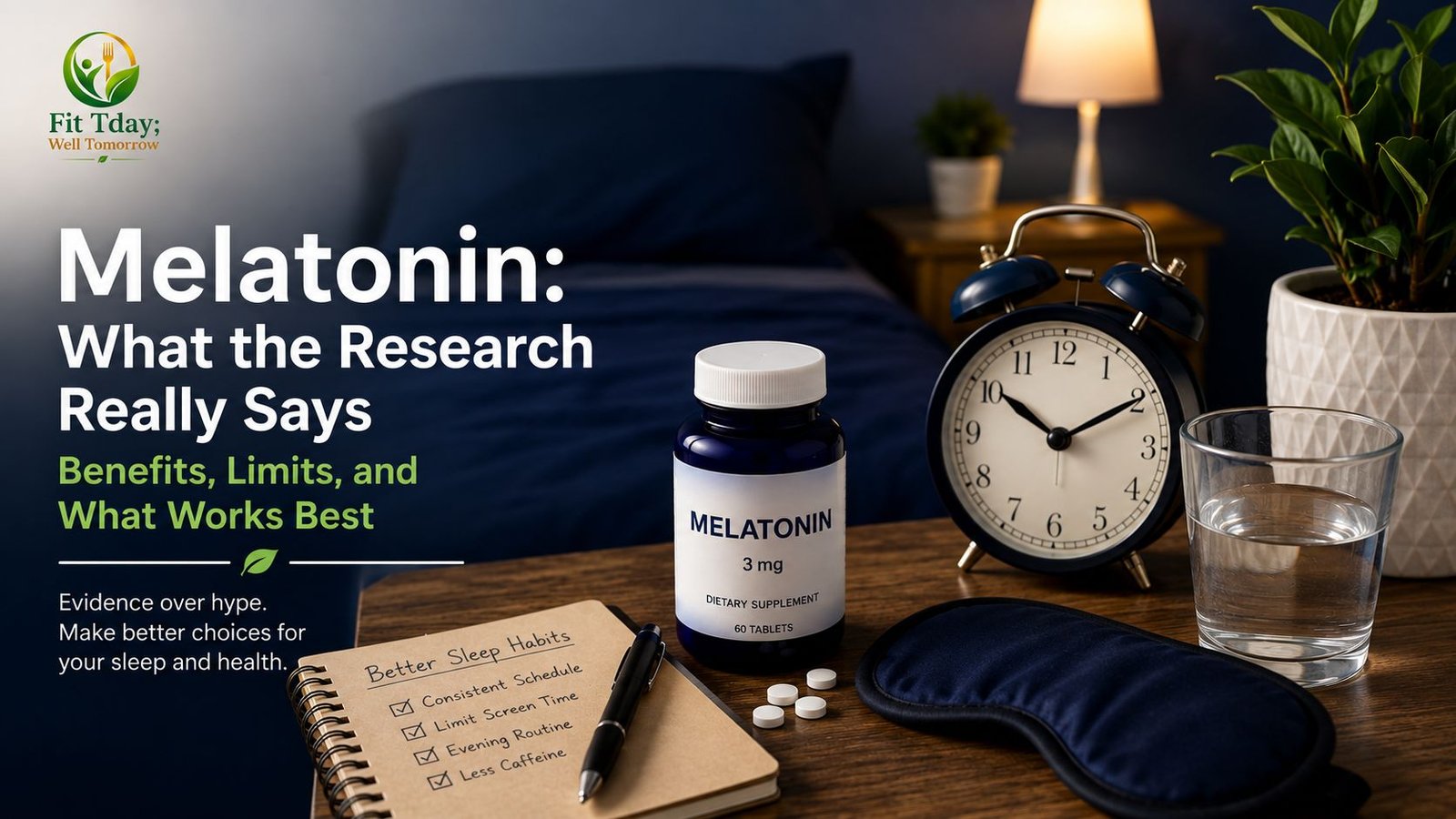
Melatonin works well for a narrow set of problems and poorly for the one most people buy it for. Guidelines back it, with weak recommendations, for jet lag and for genuine body-clock disorders, where pooled trials show it shortening the time taken to fall asleep by roughly 23 to 39 minutes. For ordinary adult insomnia, it shortens the time you take to fall asleep by roughly seven to nine minutes, and the American Academy of Sleep Medicine advises clinicians not to use it for that purpose. In India, melatonin is not a food supplement at all. It has been on the national list of approved new drugs since 12 March 1998, as a 3 mg tablet.
That gap between what melatonin is sold as and what it actually does is the whole story. Here is what the research and the regulations say.
Melatonin is a hormone made mainly in the pineal gland. Light falling on the retina travels through the retinohypothalamic tract to the suprachiasmatic nucleus, the body’s master clock, which in turn controls how much melatonin the pineal gland releases. Bright light suppresses it. Darkness releases it.
That single fact explains most of melatonin’s behaviour. It is a signal that says night has begun. It is not a sedative.
Luis F. Buenaver, a sleep specialist at Johns Hopkins Medicine, puts it plainly: melatonin “doesn’t make you sleep” but rather “puts you into a state of quiet wakefulness that helps promote sleep”. If you are expecting the switch-off feeling of a sleeping tablet, you will be disappointed, and you will probably conclude the dose was too low and take more. That is the wrong conclusion.
Taken by mouth, melatonin has an elimination half-life of roughly one to two hours, varying with the formulation. Doses used in research have ranged from 0.1 mg to 10 mg, usually taken up to two hours before bed.
Does melatonin work for insomnia?
For adults with chronic insomnia, the honest answer is that it barely does anything.
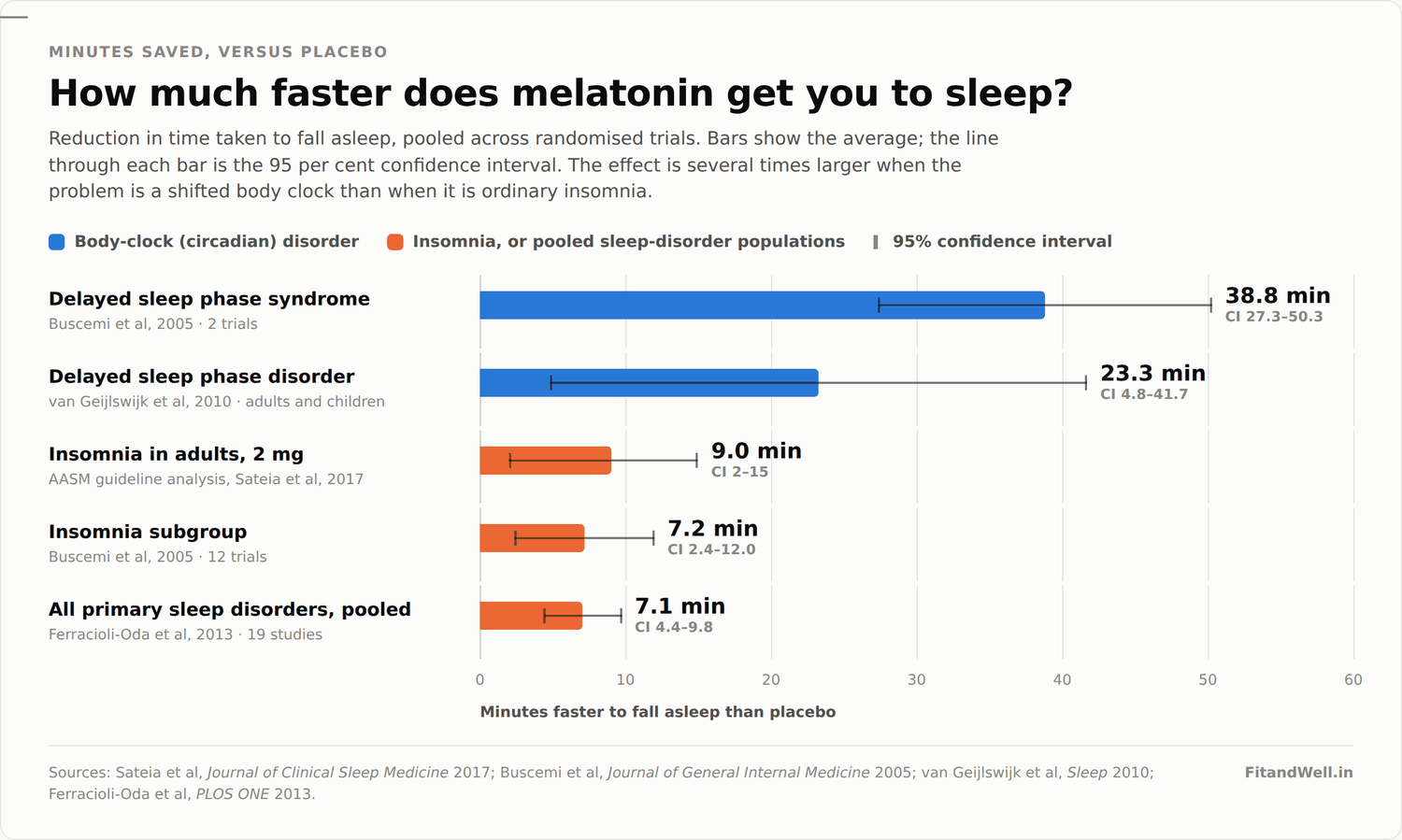
The American Academy of Sleep Medicine’s 2017 clinical practice guideline, by Sateia and colleagues in the Journal of Clinical Sleep Medicine, went through the trial evidence drug by drug. Its verdict on melatonin: “We suggest that clinicians not use melatonin as a treatment for sleep onset or sleep maintenance insomnia (versus no treatment) in adults.” The recommendation is graded weak, and the quality of the underlying evidence is rated very low. In the pooled trials, at 2 mg, melatonin reduced the time to fall asleep by about 9 minutes more than placebo, with a confidence interval running from 2 to 15 minutes.
Every recommendation in that guideline is graded weak, so this is not melatonin being singled out. The AASM adds that “the guideline does not recommend one drug over another since few comparative efficacy studies have been conducted among these agents”, and it positions medication generally as something for people who cannot access cognitive behavioural therapy for insomnia, or who are still symptomatic after it.
The meta-analyses land in the same place. Ferracioli-Oda, Qawasmi and Bloch pooled 19 studies and 1,683 people in PLOS ONE in 2013. Melatonin cut sleep onset latency by 7.06 minutes (95% CI 4.37 to 9.75) and added 8.25 minutes of total sleep (95% CI 1.74 to 14.75), with a small improvement in sleep quality (standardised mean difference 0.22, 95% CI 0.12 to 0.32). Their own summary calls the effects “modest”, notes helpfully that they “do not appear to dissipate with continued melatonin use”, and concedes that “the absolute benefit of melatonin compared to placebo is smaller than other pharmacological treatments for insomnia”.
An earlier meta-analysis by Buscemi and colleagues in the Journal of General Internal Medicine in 2005 found the same shape. Sleep onset latency fell by 11.7 minutes overall, but the insomnia subgroup, drawn from twelve trials, improved by only 7.2 minutes (95% CI 2.4 to 12.0). They concluded that “melatonin is not effective in treating most primary sleep disorders with short-term use (4 weeks or less)”.
Nine minutes is nothing. It is also not what most people are hoping to buy.
The one insomnia exception: adults over 55
Older adults are treated differently, and this is where the UK diverges most clearly from the American guideline. The British Association for Psychopharmacology’s 2019 consensus statement by Wilson and colleagues rates prolonged-release melatonin at evidence level Ib for this group, on the finding that “PR melatonin improves sleep onset latency and quality in patients over 55”, and makes a grade B recommendation that “[w]hen a hypnotic is indicated in patients over 55 years prolonged release melatonin should be tried first”. UK practice matches that: the NHS says melatonin is used there mainly for short-term sleep problems in people aged 55 and over.
Note the framing. It is not that melatonin works well in older adults. It is that when a sleeping tablet is going to be prescribed at all in this age group, the BAP says prolonged-release melatonin is the one to try first.
Where melatonin genuinely works
The same 2005 analysis contains the clue. In the delayed sleep phase subgroup, from two trials, melatonin shortened sleep onset latency by 38.8 minutes (95% CI 27.3 to 50.3). That is roughly five times the effect seen in insomnia, from the same hormone. The difference is not the drug. It is the problem being treated.
Jet lag
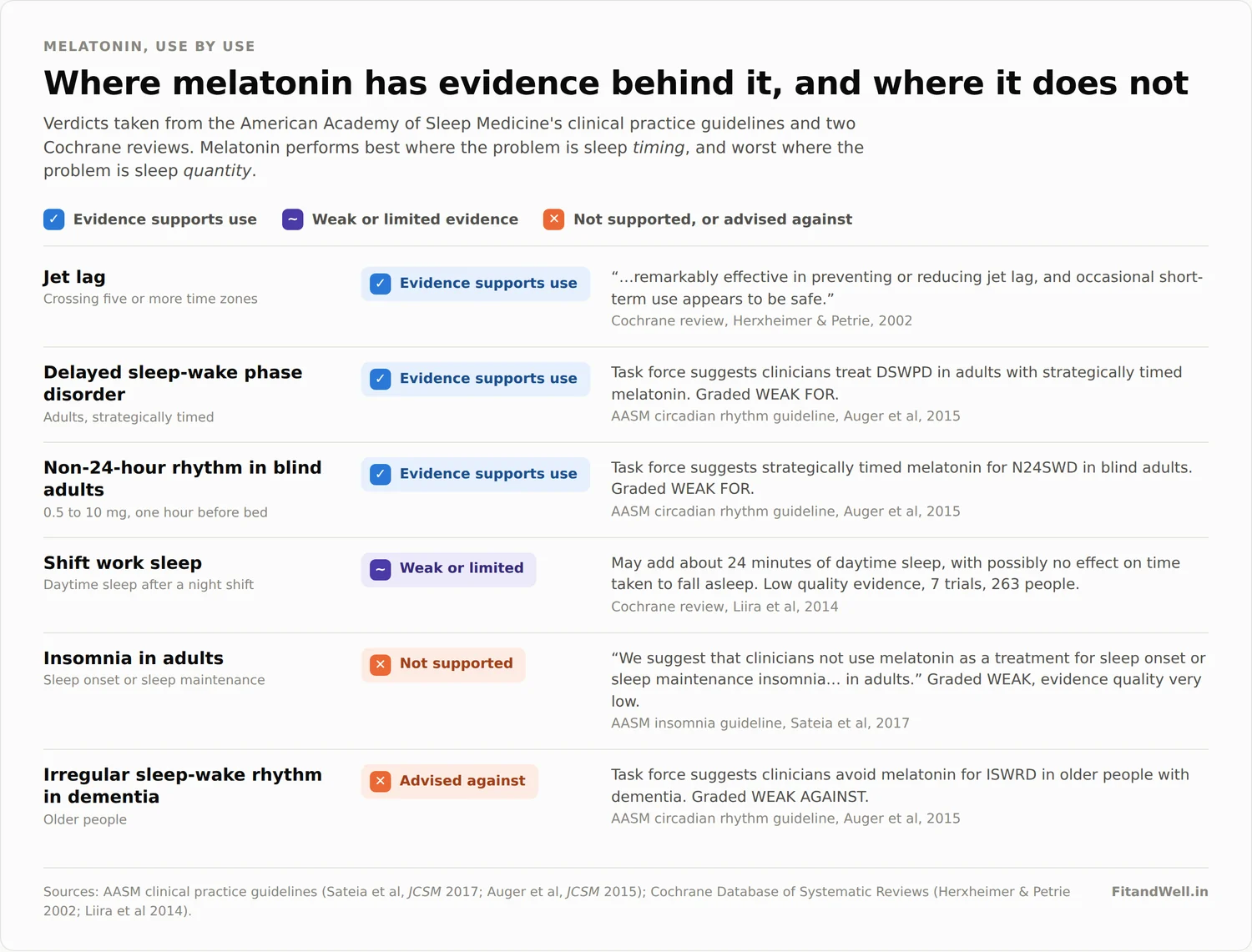
This is melatonin’s strongest indication. The 2002 Cochrane review by Herxheimer and Petrie concluded that “melatonin is remarkably effective in preventing or reducing jet lag, and occasional short-term use appears to be safe”. Nine trials of adequate quality contributed; eight of ten showed effectiveness, and the estimated number needed to treat was 2.
Three practical points from that review. Daily doses between 0.5 and 5 mg work about equally well, and going above 5 mg adds nothing. The tablet should be taken close to the target bedtime at the destination, between 10 pm and midnight local time. And taking it at the wrong hour “is liable to cause sleepiness and delay adaptation to local time”, which is the failure mode most travellers stumble into. The review recommends it for adults crossing five or more time zones, particularly flying east, with optional use across two to four zones.
Delayed sleep-wake phase disorder
If you consistently cannot fall asleep until the early hours and cannot wake in time for work, your clock may be genuinely shifted rather than broken. The AASM’s 2015 guideline on circadian rhythm sleep-wake disorders, by Auger and colleagues, suggests clinicians treat this in adults with strategically timed melatonin, a weak recommendation. The dosing in the supporting evidence was 5 mg taken between 7 pm and 9 pm for 28 days, well before bedtime rather than at it.
A 2010 meta-analysis in Sleep by van Geijlswijk, Korzilius and Smits, covering five adult trials with 91 people and four child trials with 226, found melatonin advanced the body’s own melatonin onset by 1.18 hours and the clock time of falling asleep by 0.67 hours, and shortened sleep onset latency by 23.27 minutes (95% CI 4.83 to 41.72). Wake-up time and total sleep time did not change significantly. Melatonin moved the clock. It did not manufacture extra sleep.
Non-24-hour rhythm in blind adults
For people without light perception, whose clock has nothing to anchor to, the AASM suggests strategically timed melatonin, with doses in the evidence ranging from 0.5 to 10 mg taken an hour before bedtime.
Shift work
Weaker. The 2014 Cochrane review by Liira and colleagues found that people taking melatonin “may sleep for 24 minutes longer during the daytime after the night shift, but there may be no effect on other sleep outcomes, such as time needed to fall asleep”, on low-quality evidence from seven trials and 263 participants. Doses ranged from 1 to 10 mg and side effects were rare. Twenty-four extra minutes of daytime sleep is worth having if you work nights. It is not a solution to shift work.
Where it is advised against
For irregular sleep-wake rhythm disorder in older people with dementia, the AASM guideline suggests clinicians avoid melatonin. This matters because sundowning and night wandering are exactly the situations in which families reach for it. If an older relative’s sleep and orientation are deteriorating together, that is a reason to see a doctor rather than to buy a supplement, and worth reading alongside what the evidence does and does not support on nutrition and cognitive decline.
What is melatonin’s legal status in India?
Melatonin sits on the drug side of the line in India, not the supplement side.
It appears on the Central Drugs Standard Control Organisation’s list of new drugs approved in India between 1991 and 2000 as “Melatonin 3mg Tablet”, approved on 12 March 1998, “For sleep disorders, jet lag and regulation of circadian rhythm disorders” (the typographical errors are in the original record).
The Indian Psychiatric Society’s Clinical Practice Guidelines for Sleep Disorders, published by Gupta and colleagues in the Indian Journal of Psychiatry in 2017, confirm the practical position: “Melatonin is available as a 3 mg tablet formulation.” On what it is for, the guidelines are blunt. Melatonin “[m]ay be used to induce sleep; however, data do not support its efficacy as a hypnotic agent. It is rather used as a chronobiotic.” They add that “[j]et lag disorder can be managed by timed melatonin administration”, and note that “recent studies find melatonin as efficacious as clonazepam” for REM sleep behaviour disorder, with a better adverse effect profile and most patients responding to a 3 mg dose.
On the food side, melatonin does not appear anywhere in the Food Safety and Standards (Health Supplements, Nutraceuticals, Food for Special Dietary Use, Food for Special Medical Purpose, Functional Food and Novel Food) Regulations, 2016, in the consolidated version dated 29 September 2021. It is not on the permitted nutraceutical ingredient lists.
So the Indian position is closer to the United Kingdom’s than to America’s. In the UK, the NHS states flatly that “melatonin is available on prescription only”, mainly for short-term sleep problems in people aged 55 and over, sold under brand names including Circadin, Adaflex, Ceyesto, Slenyto and Syncrodin, usually for up to 13 weeks. In the United States, by contrast, melatonin is regulated by the FDA as a dietary supplement and sold freely over the counter.
If you are in India and considering melatonin, treat it as what it legally is: a prescription medicine with a specific job. Ask a doctor which problem you are actually treating.
How much, and when
Timing matters more than dose, and this is the part almost everyone gets wrong.
For jet lag, Cochrane found 0.5 to 5 mg equally effective, taken close to your destination bedtime. For delayed sleep-wake phase disorder, the AASM evidence used 5 mg in the early evening, hours before you intend to sleep, because the point is to move the clock forward rather than to make you drowsy at bedtime. For general use, Johns Hopkins advises 1 to 3 mg two hours before bedtime, and suggests using it nightly for one to two months, then stopping to reassess how you sleep without it.
Here is what the evidence actually used, use by use.
| Use | Dose in the evidence | When it was taken | Source |
|---|---|---|---|
| Jet lag | 0.5 to 5 mg | Close to the destination bedtime, 10 pm to midnight local time | Cochrane, 2002 |
| Delayed sleep-wake phase disorder, adults | 5 mg | Between 7 pm and 9 pm, for 28 days | AASM, 2015 |
| Delayed sleep-wake phase disorder, children and adolescents with no other conditions | 0.15 mg per kg | 1.5 to 2 hours before habitual bedtime, for 6 nights | AASM, 2015 |
| Non-24-hour rhythm, blind adults | 0.5 to 10 mg | One hour before bedtime | AASM, 2015 |
| Shift work | 1 to 10 mg | Not specified in the review | Cochrane, 2014 |
| General use, Johns Hopkins advice | 1 to 3 mg | Two hours before bedtime | Johns Hopkins Medicine |
More is not better. The Cochrane jet lag review found no additional benefit above 5 mg, and higher doses and extended-release formulations are associated with more drowsiness, daytime sedation, nausea and headache.
Safety, side effects and who should be careful
Short-term use appears safe for most people. The US National Center for Complementary and Integrative Health, in guidance updated in May 2024, states that “short-term use of melatonin supplements appears to be safe for most people, but information on the long-term safety of supplementing with melatonin is lacking”. The 2005 meta-analysis found evidence of safety with use of three months or less.
The NHS says some people may get a headache, or feel tired, sick or irritable the day after taking it. Drinking alcohol or smoking can stop melatonin working as well as it should.
Take medical advice before using melatonin if any of the following apply.
- Epilepsy or blood thinners. Cochrane noted that “case reports suggest that people with epilepsy, and patients taking warfarin may come to harm from melatonin”, and NCCIH says people with epilepsy and those on blood thinners need to be under medical supervision.
- Pregnancy and breastfeeding. NCCIH is explicit that safety research here is lacking. Johns Hopkins advises against use.
- Autoimmune conditions, seizure disorders and depression. Johns Hopkins advises against melatonin in these groups.
- Diabetes or high blood pressure. Johns Hopkins advises checking with a doctor first, because melatonin may raise blood sugar and blood pressure.
- Other sleep or anxiety medication. Melatonin should not be casually combined with benzodiazepines, zolpidem or eszopiclone. Fluvoxamine, a potent CYP1A2 inhibitor, raises melatonin levels considerably and needs caution.
The quality problem with melatonin products
Where melatonin is sold as a supplement rather than a licensed medicine, what is in the bottle is often not what is on the label.
A 2017 analysis by Erland and Saxena in the Journal of Clinical Sleep Medicine tested 31 products from 16 brands. Actual melatonin content ranged from 83 per cent below to 478 per cent above the declared amount, and more than 71 per cent of products missed the label claim by more than 10 per cent. Variability between lots of the same product reached 465 per cent. Unlabelled serotonin turned up in 26 per cent of the products, which the researchers flagged because significant quantities of it “could lead to serious side effects”.
The picture had not improved by 2023. Pieter Cohen of Cambridge Health Alliance and colleagues analysed 25 melatonin gummy products for a JAMA research letter published in April 2023. Twenty-two of the 25, or 88 per cent, were inaccurately labelled, with only three within 10 per cent of the declared quantity. Actual melatonin ranged from 74 to 347 per cent of what the label said. One product contained no detectable melatonin at all, but did contain 31.3 mg of cannabidiol.
This is the practical argument for the Indian and British regulatory approach. Every quality failure above was found in products sold as supplements rather than as licensed medicines.
Melatonin and children
Be careful here.
NCCIH advises that parents considering giving their children melatonin should first speak with a health care provider. The AASM’s 2015 guideline does suggest strategically timed melatonin for children and adolescents with delayed sleep-wake phase disorder and no other conditions, a weak recommendation, with dosing in the evidence of 0.15 mg per kilogram taken 1.5 to 2 hours before habitual bedtime for six nights. That is a specific circadian diagnosis, timed deliberately, under supervision.
The risk of casual availability shows up in the American data. A report by Lelak and colleagues in the CDC’s Morbidity and Mortality Weekly Report, published on 2 June 2022, found that US poison centres logged 260,435 paediatric melatonin ingestions between 2012 and 2021. The annual number rose 530 per cent, from 8,337 in 2012 to 52,563 in 2021. Among the 27,795 children who received care at a healthcare facility, 4,097 (14.7 per cent) were hospitalised and 287 (1.0 per cent) required intensive care. Two children died. Some 94.3 per cent of the ingestions were unintentional, which is what happens when a hormone is packaged as a sweet.
If melatonin is not the answer, what is?
If your problem is that you cannot fall asleep or stay asleep on a normal schedule, the AASM guideline points to cognitive behavioural therapy for insomnia before any drug.
Before you reach for anything, check whether you are treating the right problem. Persistent daytime exhaustion that does not lift with more sleep is often not a sleep disorder at all. It can be iron deficiency anaemia, or an underactive thyroid. If low mood or anxiety is part of the picture, that needs its own attention, and our guide to mental health in India is a starting point.
For the wind-down itself, a structured relaxation practice such as yoga nidra is a different lever from anything a tablet offers. And light, not tablets, is what reaches the suprachiasmatic nucleus, so getting outdoors early works on the same pathway: a daily walk is free and takes the morning slot.
If sleep problems have lasted more than a few weeks, or you are falling asleep during the day, see a doctor rather than self-treating. Melatonin is a prescription medicine in India for a reason.
Frequently asked questions
Is melatonin available over the counter in India?
Melatonin is regulated as a drug in India, not as a food supplement. It has been on CDSCO’s list of approved new drugs since 12 March 1998 as a 3 mg tablet, and it does not appear in India’s 2016 health supplement and nutraceutical regulations as consolidated in September 2021. Treat it as a prescription medicine and ask a doctor before using it.
How long does melatonin take to work?
It has an elimination half-life of about one to two hours, and research doses are usually taken up to two hours before bed. Johns Hopkins suggests 1 to 3 mg two hours before bedtime. For delayed sleep-wake phase disorder, the AASM evidence used doses in the early evening, hours before intended sleep, because the goal is to shift the clock rather than to sedate.
Is 10 mg of melatonin better than 3 mg?
No evidence supports that. The Cochrane jet lag review found daily doses between 0.5 and 5 mg similarly effective, with no additional benefit above 5 mg. Higher doses and extended-release forms are associated with more drowsiness, daytime sedation, nausea and headache.
Can I take melatonin every night?
Johns Hopkins suggests nightly use for one to two months, then stopping to assess your sleep. In the UK, courses usually run up to 13 weeks. There is evidence to suggest safety with use of three months or less, and NCCIH says information on long-term safety is lacking.
Does melatonin help with anxiety or depression?
It is not a treatment for either. The AASM guideline advises against melatonin for insomnia in adults, and the Indian Psychiatric Society guidelines describe melatonin as a chronobiotic rather than a hypnotic. If low mood or anxiety is driving your sleep problem, that is what needs treating.
Is melatonin safe for children?
Only under medical supervision. NCCIH advises parents to speak with a health care provider first. The AASM does suggest timed melatonin for children and adolescents with delayed sleep-wake phase disorder and no other conditions, with 0.15 mg per kilogram taken 1.5 to 2 hours before habitual bedtime in the supporting evidence, but that is a diagnosis and a dosing schedule, not a bedtime habit.
Why is melatonin sold freely in the US but not in India or the UK?
Regulatory classification. The US FDA regulates melatonin as a dietary supplement, so it is sold over the counter. The NHS states that in the UK melatonin is available on prescription only. India licensed it as a drug in 1998 and never added it to its permitted nutraceutical ingredient lists.
This article is for information and does not replace advice from your own doctor. Melatonin is a prescription medicine in India. Talk to a qualified clinician before starting, stopping or changing any treatment, particularly if you are pregnant, take other medication, or have epilepsy, diabetes, high blood pressure or an autoimmune condition.
Sources
- Sateia MJ, Buysse DJ, Krystal AD, Neubauer DN, Heald JL. Clinical Practice Guideline for the Pharmacologic Treatment of Chronic Insomnia in Adults. Journal of Clinical Sleep Medicine, 2017;13(2). American Academy of Sleep Medicine.
- American Academy of Sleep Medicine. Guideline provides clinical recommendations for insomnia drugs, 14 February 2017.
- Auger RR, et al. Clinical Practice Guideline for the Treatment of Intrinsic Circadian Rhythm Sleep-Wake Disorders. Journal of Clinical Sleep Medicine, 2015;11(10):1199-1236.
- Herxheimer A, Petrie KJ. Melatonin for the prevention and treatment of jet lag. Cochrane Database of Systematic Reviews, 22 April 2002.
- Liira J, Verbeek JH, Costa G, Driscoll TR, Sallinen M, Isotalo LK, Ruotsalainen JH. Pharmacological interventions for sleepiness and sleep disturbances caused by shift work. Cochrane Database of Systematic Reviews, 2014.
- Ferracioli-Oda E, Qawasmi A, Bloch MH. Meta-Analysis: Melatonin for the Treatment of Primary Sleep Disorders. PLOS ONE, 2013;8(5):e63773.
- Buscemi N, Vandermeer B, Hooton N, et al. The Efficacy and Safety of Exogenous Melatonin for Primary Sleep Disorders: A Meta-analysis. Journal of General Internal Medicine, 2005;20.
- van Geijlswijk IM, Korzilius HPLM, Smits MG. The Use of Exogenous Melatonin in Delayed Sleep Phase Disorder: A Meta-analysis. Sleep, 2010;33(12):1605-1614.
- Central Drugs Standard Control Organisation. List of New Drugs Approved in India from 1991 to 2000. Government of India.
- Gupta R, Das S, Gujar K, Mishra KK, Gaur N, Majid A. Clinical Practice Guidelines for Sleep Disorders. Indian Journal of Psychiatry, 2017. Indian Psychiatric Society.
- Food Safety and Standards Authority of India. Food Safety and Standards (Health Supplements, Nutraceuticals, Food for Special Dietary Use, Food for Special Medical Purpose, Functional Food and Novel Food) Regulations, 2016, consolidated version dated 29 September 2021.
- NHS. About melatonin. Last reviewed 13 February 2023.
- National Center for Complementary and Integrative Health. Melatonin: What You Need To Know. Last updated May 2024.
- Savage RA, Zafar N, Yohannan S, Miller JMM. Melatonin. StatPearls, last updated 9 February 2024.
- Johns Hopkins Medicine. Melatonin for Sleep: Does It Work?
- American Academy of Sleep Medicine. Study finds that melatonin content of supplements varies widely, reporting Erland LAE and Saxena PK, Journal of Clinical Sleep Medicine, 15 February 2017.
- Lelak K, Vohra V, Neuman MI, Toce MS, Sethuraman U. Pediatric Melatonin Ingestions, United States, 2012-2021. Morbidity and Mortality Weekly Report, 2 June 2022. US Centers for Disease Control and Prevention.
- Good Morning America. Melatonin gummies may not contain what they claim, lab analysis shows, 26 April 2023, reporting Cohen PA, Avula B, Wang Y, Katragunta K, Khan I, JAMA, 2023;329(16):1401-1402.
- Wilson S, Anderson K, Baldwin D, et al. British Association for Psychopharmacology consensus statement on evidence-based treatment of insomnia, parasomnias and circadian rhythm disorders: An update, 2019. Document record; quoted text from the author’s manuscript copy in the University of Southampton repository.