
Waking up at 3 am is usually normal biology rather than a warning sign. By that point in the night, most of your deep sleep is behind you, REM periods are at their longest, and brief awakenings tend to occur close to a REM transition. It crosses into chronic insomnia when difficulty staying asleep runs three or more nights a week for more than three months despite adequate opportunity to sleep. Separately, and whatever the frequency, loud snoring with witnessed pauses in breathing is a reason to see a doctor rather than wait.
What is actually happening in your brain at 3 am
Sleep is not one continuous state. A complete cycle takes roughly 90 to 110 minutes, and most adults move through four to six of them in a night, according to StatPearls’ physiology review of sleep stages.
The two halves of the night are not alike. Deep, slow-wave sleep is front-loaded: the US Institute of Medicine’s sleep physiology review states that most of it ‘occurs during the first third of the night’. REM sleep runs the other way, increasing as the night goes on and reaching its longest stretch in the final third.
So by 3 am the architecture has already shifted. Dr Nancy Foldvary-Schaefer, a sleep medicine specialist at Cleveland Clinic, put the timing plainly in May 2025. For adults who go to sleep at a standard time, around 10 pm, she says that ‘3 a.m. is typically when you’re in REM sleep’.
Brief awakenings at these transitions are ordinary. The Institute of Medicine review notes that younger adults ‘may experience brief awakenings, but they are usually minor and occur close to an REM sleep transition’, and that sleep ‘remains relatively consolidated’ despite them. Cleveland Clinic puts it more bluntly: night-time awakenings are a common phenomenon.
The 3 am hormone finding people misquote
There is one genuinely striking piece of circadian research here, and it is worth stating precisely rather than loosely. In a 2022 study in Frontiers in Neuroscience, Bowles and colleagues measured the cortisol awakening response in 34 adults kept on artificial sleep and wake cycles in dim light, so that body clock timing could be separated from sleep itself. The response peaked at a circadian phase corresponding to roughly 3:40 to 3:45 am.
That is a real finding about the body clock, and it fits the sense many people have that the small hours are when the system starts revving. It is not evidence that your cortisol is ‘too high’ or that your adrenal glands are failing. It was a laboratory study of 34 people, and the authors themselves flag that their second cortisol sample was taken slightly later than the usual 30 to 45 minutes after waking.
Why do I wake at 3 am and not some other time?
Partly because 3 am sits in the half of the night when REM periods are longest, and brief awakenings occur close to those transitions. Partly because whatever is waking you is often running on a schedule of its own.
Your bladder. Nocturia, meaning regularly getting up at night to urinate, is worth ruling in first. StatPearls reports that one in three adults over 30 makes at least two trips to the bathroom nightly, and about half of adults over 65 get up at least once. It also flags something people miss: nocturia occurs in about 50 per cent of patients with obstructive sleep apnoea, and apnoea ‘should be considered a possible diagnosis in all patients with nocturia’.
Alcohol. The popular version says a nightcap knocks you out and then wakes you at 3 am. The evidence is more specific. A 2025 systematic review and meta-analysis of 27 studies in Sleep Medicine Reviews found alcohol delays the onset of REM sleep and shortens it, with those effects appearing at around two standard drinks. But it found ‘large uncertainty’ in the effect on wake after sleep onset, meaning the direct claim that alcohol causes night waking is not well established. What is established is that it distorts the part of the night that 3 am belongs to.
Anxiety and a busy mind. StatPearls notes that chronic insomnia may result from an imbalance between sleep-inducing and arousal-inducing mechanisms, and lists hyperarousal among the factors that keep it going once it has started. If your worst thinking happens at 3 am, the work of changing your relationship with that thinking belongs to the daytime, and our guide to mindfulness for stress and anxiety is a place to start.
Reflux. StatPearls’ review of gastro-oesophageal reflux disease advises avoiding meals for at least three hours before bedtime, and reports improvement in reflux symptoms and pH monitoring results when the head end of the bed is raised. Our guide to GERD causes, symptoms, treatment and diet covers the condition in more depth.
Caffeine, later than you think. Caffeine’s half-life in the average adult is about five hours, and StatPearls’ guidance is to avoid substantial intake for at least six hours before bed, given what it calls caffeine’s significant disruptive effects on sleep. A 5 pm cutting-chai is inside that window for most people going to bed at 10 pm.
Menopause. A 2025 narrative review in the Journal of Clinical Medicine reports sleep disturbance in 16 to 47 per cent of women during perimenopause, rising to 35 to 60 per cent after menopause. Crucially, ‘most flushes, measured objectively, coincide with awakenings’. NICE guidance says women should be offered HRT for vasomotor symptoms, meaning hot flushes and night sweats, after discussing the short-term (up to five years) and longer-term benefits and risks.
Age itself. This is the reason most people are looking for and least often told.
How much night waking is normal at your age?
More than you probably think, and it climbs steadily.
A large pooled analysis of normal sleep laboratory values, by Boulos and colleagues in the Lancet Respiratory Medicine in 2019, drew on 169 studies and 5,273 healthy adults. For every decade of adult age, time spent awake after falling asleep rose by 9.7 minutes (95% CI 6.9 to 12.4) and the arousal index rose by 2.1 events per hour (95% CI 1.5 to 2.6). Total sleep time fell by 10.1 minutes per decade (95% CI 7.5 to 12.8) and sleep efficiency by 2.1 per cent (95% CI 1.5 to 2.6).
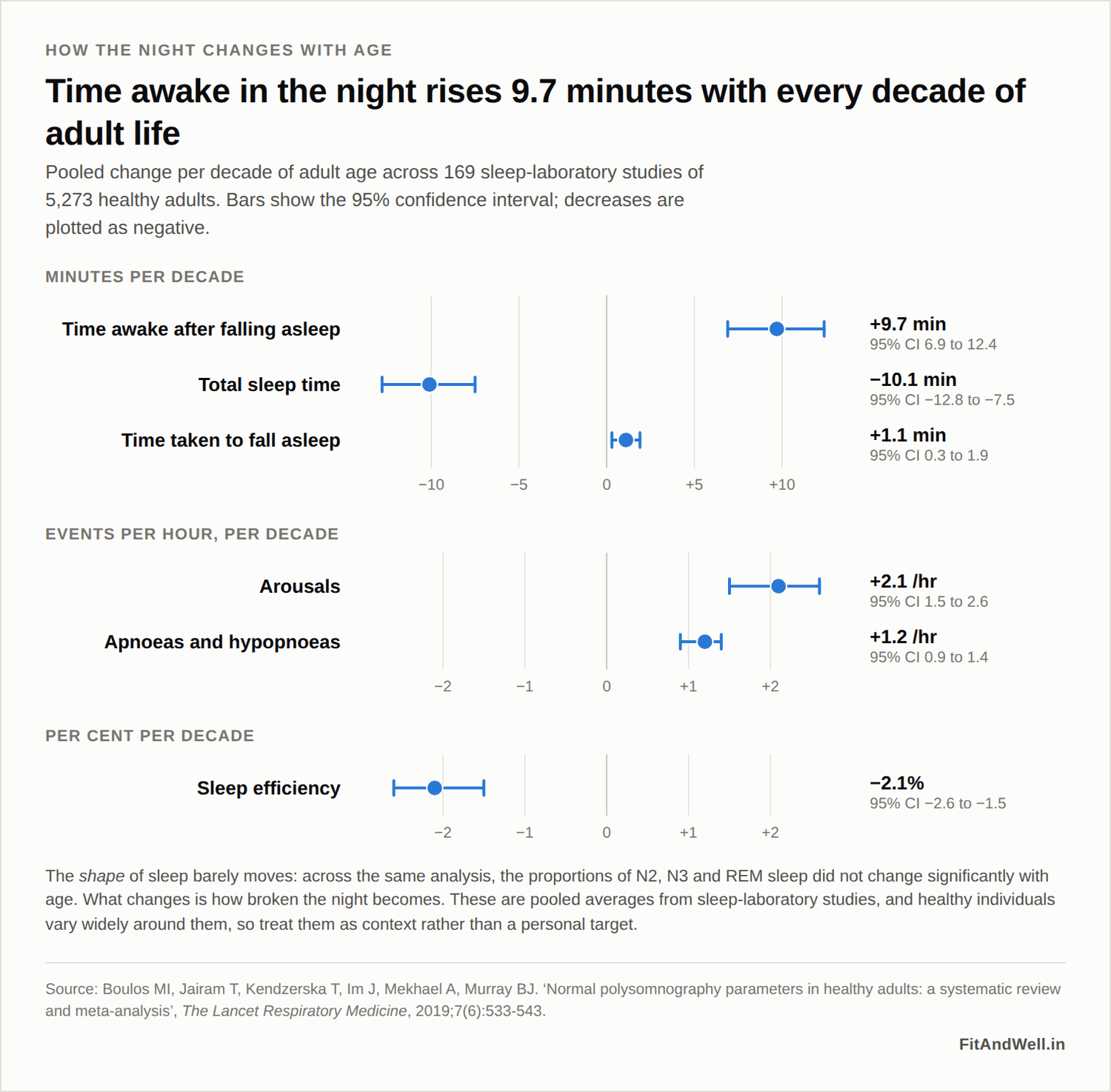
Notably, the proportions of N2, N3 and REM sleep did not change significantly with age in that analysis. The night does not restructure itself. It just becomes more broken.
The Institute of Medicine review records two changes alongside each other. Slow-wave sleep declines by about 2 per cent per decade between the ages of 20 and 60, and older adults experience more frequent awakenings during a sleep episode.
One caution against over-reading any of this. A 2018 reference dataset of 206 healthy adults aged 19 to 73, published in the Journal of Clinical Sleep Medicine, concluded that sleep parameters vary so widely between healthy people that reference values are hard to specify at all, and that ‘giving patients feedback about deviations from the norm in their sleep profile may give rise to ill-founded concerns and worry’. That was written about sleep laboratory reports. It is worth holding in mind before reading too much into any single night’s summary, including one from a sleep-tracking wearable.
When night waking becomes insomnia
The diagnostic line is clear. Chronic insomnia means difficulty falling asleep, staying asleep or getting quality sleep, occurring three or more nights a week for more than three months, despite adequate opportunity to sleep.
StatPearls puts the numbers at roughly 30 to 36 per cent of adults reporting at least one insomnia symptom, and 6 to 10 per cent meeting the strict ICSD-3 or DSM-5-TR criteria.
In India, the clearest picture is in older adults. An analysis of 31,358 people aged 60 and over from the Longitudinal Ageing Study in India, published in PLOS ONE in 2022, found around 36 per cent reported insomnia symptoms. One of its three questions was specifically about having ‘woke up during the night and had trouble getting back to sleep’. Symptoms were more common in people with hypertension, diabetes, chronic lung disease and physical inactivity. The study was cross-sectional and used self-reported sleep, so it cannot tell us which came first. If you have any of those conditions, our guides to managing hypertension in India and the early signs of high blood sugar are a sensible next read, and daytime movement matters here too, which is where the health hazards of prolonged sitting become relevant.
What to do at 3 am tonight
The single most useful instruction is also the least intuitive: do not lie there.
Stimulus control, one of the core components of insomnia treatment, means lying down only when sleepy, getting out of bed if you cannot fall asleep within 15 to 20 minutes, and repeating that through the night. Cleveland Clinic gives the same practical window: give yourself 15 to 20 minutes, and if you are still awake, get up.
What you do once you are up matters less than the fact that you got up. Cleveland Clinic’s list is short and deliberately dull: ‘Meditate. Read something boring. Drink decaffeinated tea. Listen to calming music. Practice deep breathing.’ It is firm about what to avoid: ‘Whatever you do, just don’t use your cell phone, check email or use any other electronic devices’. A guided relaxation practice fits this slot, and yoga nidra for sleep and stress relief is one option.
On screens, the honest position is that the evidence is softer than the headlines. A 2022 meta-analysis of 12 laboratory studies in Lighting Research & Technology concluded that evening light affects sleep latency, sleep efficiency and slow-wave sleep, but the individual effect sizes had confidence intervals crossing zero, and the authors reported no apparent effect from a single evening light exposure using standard light measures. Getting off your phone at 3 am is good advice mainly because scrolling keeps you mentally switched on, not because of a proven blue-light dose effect.
What actually works, and what does not
The treatment picture is unusually settled for a common complaint.
The American Academy of Sleep Medicine’s 2021 clinical practice guideline makes exactly one strong recommendation: cognitive behavioural therapy for insomnia, or CBT-I. It conditionally suggests multicomponent brief therapies plus three single-component ones: stimulus control, sleep restriction therapy and relaxation therapy. StatPearls notes that international guidelines consistently place CBT-I as first-line.
The same guideline is equally clear about what does not work on its own. It states that ‘sleep hygiene should not be used as a single-component treatment for chronic insomnia disorder in adults’. The list of tips about dark rooms and regular bedtimes is a useful floor, not a treatment.
How much difference does CBT-I make to the specific problem of waking in the night? A 2016 meta-analysis in BMJ Open of internet-delivered CBT-I, pooling 15 studies with 1,013 treated and 591 control participants, found wake after sleep onset fell by 22.31 minutes (95% CI 13.50 to 31.11) and the number of night-time awakenings fell by 0.52 (95% CI 0.28 to 0.76). Insomnia Severity Index scores dropped by 5.88 points. Its authors note the trials were small and mostly conducted in Europe, and that they did not search for unpublished literature or ongoing trials, so treat the precision with some caution.
Sleeping tablets are a different trade. StatPearls lists their disadvantages as cognitive and motor impairment, next-day sedation, rebound insomnia, and longer-term risks including dependence, falls, hip fractures and dementia. They have a place, decided with a doctor, but they are not the first move.
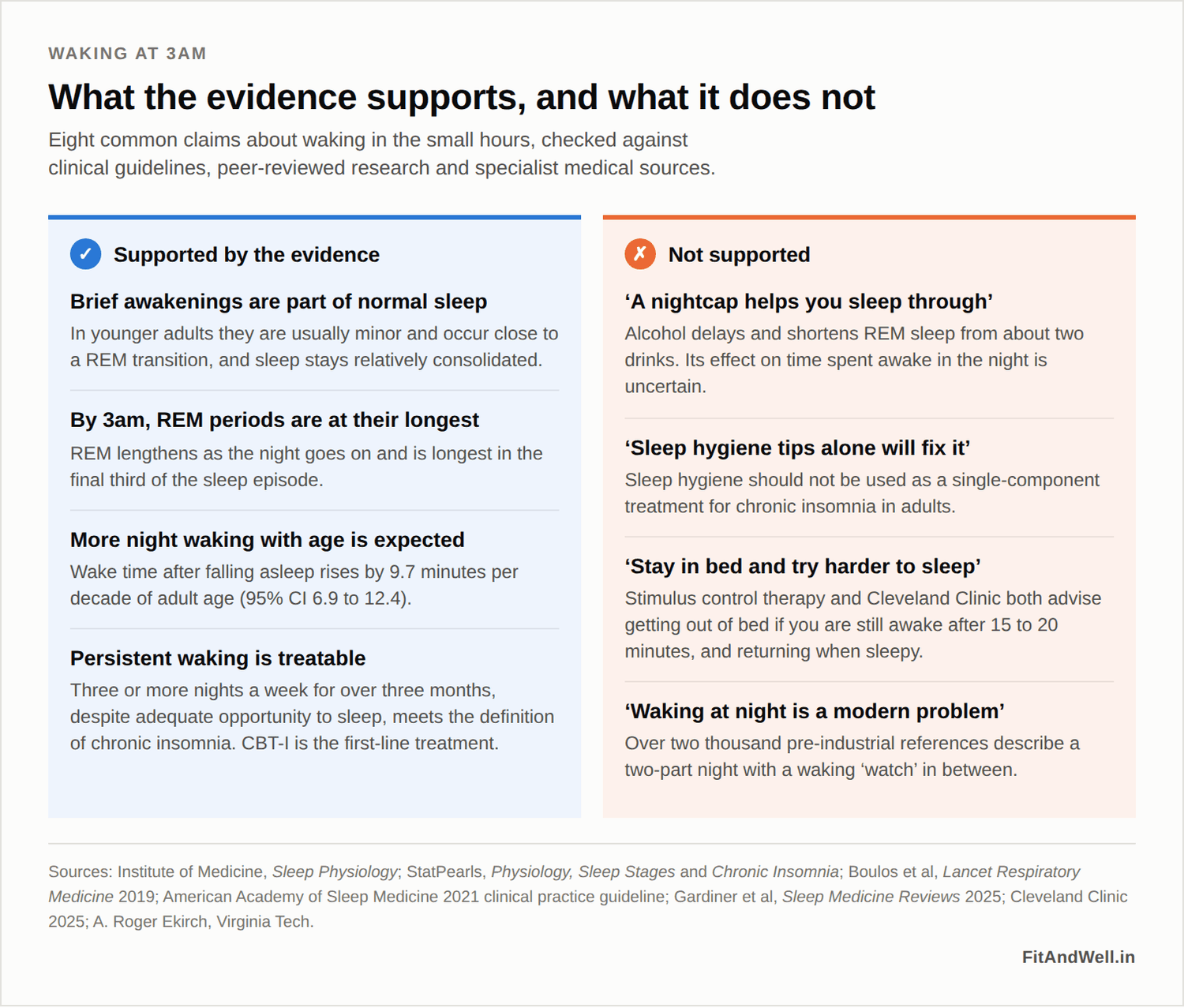
Waking at night is not a modern invention
Before you conclude that something has gone wrong with you specifically, it is worth knowing that consolidated eight-hour sleep is historically unusual.
The historian A. Roger Ekirch has documented a pre-industrial pattern of two sleeps, separated by a period of wakefulness, with people ‘naturally awakening after the “first sleep” … around midnight or in the first hours of morning’. He found upwards of two thousand references to it across novels, letters, court records and other sources. Francis Bacon called the gap ‘between sleeps’; it was generally known as a ‘watch’. The pattern faded across the nineteenth century.
This is history, not a prescription, and it does not mean your broken night is healthy. It does mean that lying awake for a while in the small hours is not evidence of a body doing something unprecedented.
When to see a doctor
Book an appointment rather than waiting it out if any of the following apply.
- Your partner reports loud, disruptive snoring, or has watched you stop breathing. Those are hallmark features of obstructive sleep apnoea, alongside excessive daytime sleepiness, morning headaches, nocturnal reflux and nocturia.
- Getting up to urinate at night is new for you, or happening more often than it used to. Two trips a night is common, particularly after 65, but a change in your own pattern is worth checking, not least because nocturia occurs in about half of people with sleep apnoea.
- Night waking has run three or more nights a week for more than three months and your days are suffering.
- You are relying on alcohol or over-the-counter sedatives to get back to sleep.
- Any new or worrying night-time symptom is waking you. As general safety advice, this deserves prompt medical attention rather than a wait-and-see approach.
Obstructive sleep apnoea is graded by the apnoea-hypopnoea index, the number of breathing events per hour of sleep.
| Severity | Apnoea-hypopnoea index (events per hour) |
|---|---|
| Mild | 5 to 15 |
| Moderate | Above 15 to 30 |
| Severe | Above 30 |
In-laboratory polysomnography remains the gold standard, and home testing can underestimate severity by at least 20 per cent. CPAP is the most effective treatment, although nearly half of people stop using it within the first month, which is a reason to ask about mask fitting and follow-up rather than a reason to avoid treatment.
If low mood or anxiety is driving the wakefulness, treat that as a medical issue in its own right rather than a character flaw. India still carries a heavy stigma around mental health, and it stops people from asking for help that works.
Frequently asked questions
Is waking up at 3 am normal?
Usually, yes. Brief awakenings tend to occur close to REM transitions, and by 3 am REM periods are at their longest. Nighttime awakenings are common, and the time healthy adults spend awake in the night rises by 9.7 minutes for every decade of adult age (95% CI 6.9 to 12.4).
How long should I lie in bed if I wake at 3 am?
About 15 to 20 minutes. Both Cleveland Clinic and the stimulus control component of insomnia treatment give the same window: if you are still awake after that, get out of bed, do something calm and low-light, and go back when you feel sleepy.
Does a drink before bed help me stay asleep?
No, and it works against the part of the night you are struggling with. A 2025 meta-analysis found alcohol delays and shortens REM sleep at around two standard drinks, though its effect on time spent awake in the night was uncertain.
Is waking in the night a modern problem?
No. The historian A. Roger Ekirch has documented over two thousand references to a two-part night in pre-industrial sources, with a waking interval known as a ‘watch’ between the first and second sleep. The pattern faded across the nineteenth century.
Will sleeping tablets fix waking at 3 am?
They are not the first-line answer. The American Academy of Sleep Medicine’s strong recommendation is for cognitive behavioural therapy for insomnia. Hypnotics carry next-day sedation, rebound insomnia and longer-term risks including dependence and falls, so any decision to use them belongs with your doctor.
Does sleep hygiene advice help?
As a foundation, yes, but not as a treatment on its own. The AASM guideline states that sleep hygiene should not be used as a single-component treatment for chronic insomnia in adults.
Conclusion
If you wake at 3 am occasionally, drop back off without much of a fight and feel fine the next day, there is probably nothing to fix. If it happens most nights, or you are waking to urinate repeatedly, or someone has heard you stop breathing, that is a conversation with a doctor rather than a problem to solve with a new pillow.
This article is for general information and is not a substitute for individual medical advice. Speak to your doctor before starting or stopping any treatment, and about any new or persistent night-time symptoms.
Sources
- Patel AK, Reddy V, Shumway KR, Araujo JF. Physiology, Sleep Stages. StatPearls, NCBI Bookshelf.
- Institute of Medicine (US) Committee on Sleep Medicine and Research. Sleep Physiology, in Sleep Disorders and Sleep Deprivation: An Unmet Public Health Problem. National Academies Press.
- Cleveland Clinic. Why You Keep Waking Up at 3 a.m., 22 May 2025.
- Bowles NP, Thosar SS, Butler MP, et al. The circadian system modulates the cortisol awakening response in humans. Frontiers in Neuroscience, 2022;16:995452.
- McNamara S, Spurling BC, Bollu PC. Chronic Insomnia. StatPearls, NCBI Bookshelf, updated 28 March 2025.
- American Academy of Sleep Medicine. New guideline supports behavioral, psychological treatments for insomnia.
- Ye YY, Chen NK, Chen J, et al. Internet-based cognitive-behavioural therapy for insomnia (ICBT-i): a meta-analysis of randomised controlled trials. BMJ Open, 2016;6(11).
- Gardiner C, Weakley J, Burke LM, et al. The effect of alcohol on subsequent sleep in healthy adults: a systematic review and meta-analysis. Sleep Medicine Reviews, 2025.
- Leslie SW, Sajjad H, Singh S. Nocturia. StatPearls, NCBI Bookshelf, updated 17 February 2024.
- Slowik JM, Sankari A, Collen JF. Obstructive Sleep Apnea. StatPearls, NCBI Bookshelf, updated 4 March 2025.
- Evans J, Richards JR, Battisti AS. Caffeine. StatPearls, NCBI Bookshelf, updated 29 May 2024.
- Antunes C, Aleem A, Curtis SA. Gastroesophageal Reflux Disease. StatPearls, NCBI Bookshelf, updated 3 July 2023.
- Muhammad T, Gharge S, Meher T. The associations of BMI, chronic conditions and lifestyle factors with insomnia symptoms among older adults in India. PLOS ONE, 2022;17(9):e0274684.
- Ekirch AR. Segmented Sleep. Virginia Tech.
- Troìa L, Garassino M, Volpicelli AI, et al. Sleep Disturbance and Perimenopause: A Narrative Review. Journal of Clinical Medicine, 2025;14:1479.
- Cajochen C, Stefani O, Schöllhorn I, Lang D, Chellappa SL. Influence of evening light exposure on polysomnographically assessed night-time sleep: a systematic review with meta-analysis. Lighting Research & Technology, 2022;54(6).
- Boulos MI, Jairam T, Kendzerska T, Im J, Mekhael A, Murray BJ. Normal polysomnography parameters in healthy adults: a systematic review and meta-analysis. Lancet Respiratory Medicine, 2019;7(6):533-543.
- Hertenstein E, Gabryelska A, Spiegelhalder K, et al. Reference Data for Polysomnography-Measured and Subjective Sleep in Healthy Adults. Journal of Clinical Sleep Medicine, 2018;14(4):523-532.
- National Institute for Health and Care Excellence. Menopause: identification and management, recommendations, NICE guideline NG23.