
How Much Sleep Do You Actually Need, By Age?
This is a question most of us have asked ourselves, especially after a night of poor sleep: How much sleep do I actually need? Is seven hours enough, or should you be aiming for eight or nine? And does the answer change as you get older?
The short answer is yes, it does. Sleep needs change throughout our lives, with babies and children requiring considerably more sleep than adults. Most adults need seven to nine hours a night, while the American Academy of Sleep Medicine (AASM) and Sleep Research Society recommend at least seven hours for people aged 18 to 60.
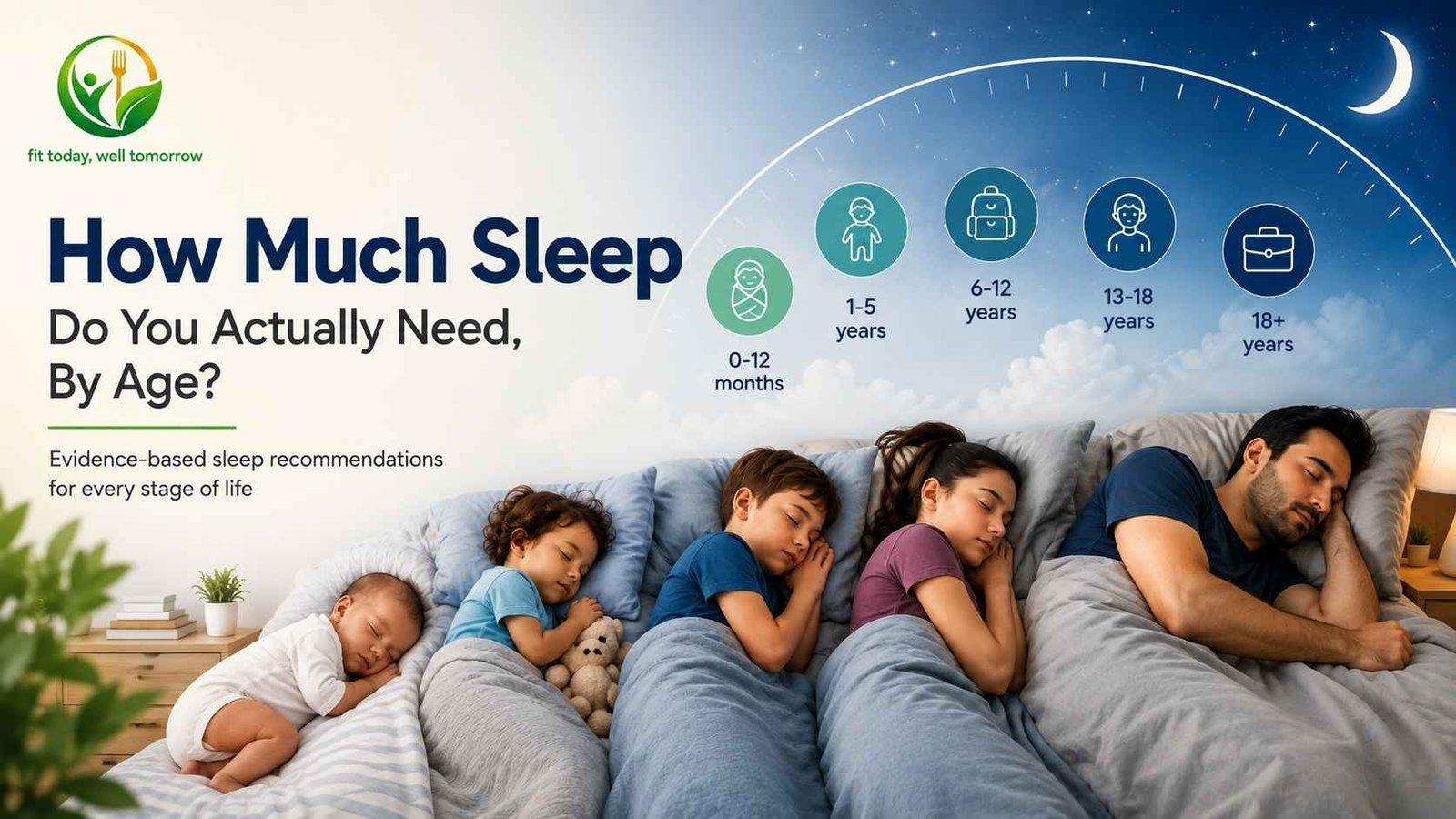
For children, the numbers are much higher. Babies aged 4 to 12 months generally need 12 to 16 hours of sleep in 24 hours, including naps. School-age children need around 9 to 12 hours, while teenagers typically need 8 to 10 hours.
But there is more to healthy sleep than simply hitting a number. These recommendations are useful starting points, but your ideal amount of sleep can vary from person to person. The real test is how you feel and function during the day—whether you wake feeling refreshed, stay alert without constantly reaching for caffeine, and can get through the day without needing an alarm or regular naps.
So, before worrying about whether you are getting exactly eight hours, it helps to understand what the recommended range actually looks like at each stage of life.
Recommended Sleep by Age: The Quick Table
The table below brings together the main recommendations from the American Academy of Sleep Medicine (AASM), the World Health Organisation (WHO) for children under five, and the US Centers for Disease Control and Prevention (CDC).
The recommendations can differ slightly between organisations and age groups. Where there is a meaningful difference, we explain it further below rather than simply choosing one set of figures.
Recommended Sleep by Age: The Quick Table
The table below brings together the main recommendations from the American Academy of Sleep Medicine (AASM), the World Health Organisation (WHO) for children under five, and the US Centers for Disease Control and Prevention (CDC).
The recommendations can differ slightly between organisations and age groups. Where there is a meaningful difference, we explain it further below rather than simply choosing one set of figures.
Recommended sleep by age: the quick table
The figures below come from the American Academy of Sleep Medicine (AASM) consensus statements, the World Health Organisation guidelines for under-fives, and the US Centres for Disease Control and Prevention. Where a body disagrees with another, the article says so further down rather than picking a favourite.
| Age | Recommended sleep in 24 hours | Naps included? |
|---|---|---|
| 0 to 3 months | 14 to 17 hours (WHO) | Yes |
| 4 to 11 or 12 months | 12 to 16 hours | Yes |
| 1 to 2 years | 11 to 14 hours | Yes |
| 3 to 5 years | 10 to 13 hours | Yes, a nap may be part of it |
| 6 to 12 years | 9 to 12 hours | No |
| 13 to 18 years | 8 to 10 hours | No |
| 18 to 60 years | 7 or more hours | No |
| 61 to 64 years | 7 to 9 hours | No |
| 65 years and over | 7 to 8 hours (CDC) or 7 to 9 hours (National Institute on Ageing) | No |
One important gap: the AASM deliberately issues no recommendation for babies under four months, “due to the wide range of normal variation”. If you have a newborn, there is no number to fall short of.
Why Do Recommended Sleep Hours Drop as You Get Older?
If you look at the recommended sleep ranges by age, one thing stands out immediately: the amount of sleep we need changes dramatically as we grow up.
A baby may need as much as 16 hours of sleep in 24 hours. By the teenage years, that recommendation has fallen to 8 to 10 hours. Once we reach adulthood, it settles into a much narrower range and remains fairly consistent for decades.
But the numbers alone do not tell the whole story. The WHO guidelines for children under five, for example, emphasise the importance of good-quality sleep, including naps, with regular sleep and wake-up times. In other words, when it comes to young children, it is not just about how many hours they sleep. A regular and healthy sleep routine matters too.
Babies and Toddlers: Sleep Is Part of Development
During the first few years of life, sleep takes up a surprisingly large part of the day. That is because babies and young children are going through rapid physical and cognitive development, and sleep plays an important role in that process.
For infants aged four to eleven months, the WHO recommends 12 to 16 hours of good-quality sleep in 24 hours, including naps. This is consistent with the AASM recommendation of 12 to 16 hours for four- to twelve-month-olds.
The recommended amount gradually decreases as children grow. Children aged one to two years should get 11 to 14 hours, while three- to four-year-olds need 10 to 13 hours, including naps where needed.
And yes, naps count.
If a toddler sleeps for 10 hours at night and takes a two-hour afternoon nap, that adds up to 12 hours and falls comfortably within the recommended range. Parents do not need to think of daytime naps as separate from their child’s total sleep.
School-Age Children: 9 to 12 Hours
By the time children reach school age, their sleep needs have come down, but they still need considerably more sleep than adults.
The AASM recommends 9 to 12 hours of sleep per 24 hours for children aged 6 to 12. According to the organisation, getting enough sleep regularly is associated with better attention, behaviour, learning, memory, emotional regulation, quality of life, and mental and physical health.
That list is important because many of these are areas where parents may notice changes first. A child who is struggling to concentrate, becoming unusually irritable or finding schoolwork harder than usual may not simply be having a difficult phase. Their sleep may be part of the picture.
That does not mean every behavioural or learning problem is caused by insufficient sleep. It does mean that sleep is one of the first things worth looking at when a child is consistently tired or struggling during the day.
Teenagers: 8 to 10 Hours, but the School Bell Says Otherwise
Teenagers are generally recommended to get 8 to 10 hours of sleep per 24 hours. The AASM sets this range for ages 13 to 18, while the CDC uses it for ages 13 to 17.
The problem is that getting those hours is often harder than it sounds.
Part of the reason is biological. During adolescence, the body’s internal clock naturally shifts later. Crowley and colleagues, writing in Sleep Medicine in 2007, described how sleep and wake timing shifts later during the second decade of life.
Melatonin, the hormone that helps signal to the body that it is time for sleep, also follows this shift. Its evening rise occurs later during adolescence. As a result, a teenager who is told to go to bed at 10 pm may not simply be choosing to stay awake. Their body may not yet be ready for sleep.
This is commonly referred to as sleep phase delay. A National Academies workshop report describes it simply: teenagers have a natural tendency to fall asleep later and wake up later. The report also notes that the onset of melatonin occurs later in adolescents, which can make it harder to fall asleep early in the evening.
There is an important distinction here. Teenagers do not necessarily need less sleep just because they are getting older. Research summarised by the National Academies indicates that sleep needs remain relatively unchanged while the amount of time adolescents actually spend sleeping decreases.
So a teenager who sleeps for six hours is not necessarily someone who has outgrown the need for eight or nine hours. They may simply be getting less sleep than their body requires.
This creates a difficult mismatch. Their body clock pushes bedtime later, while school schedules often require them to wake early. As Crowley and colleagues observed, early rising for school is unwelcome and forced for most adolescents.
The consequences can be serious. The AASM consensus statement says insufficient sleep among teenagers is associated with an increased risk of self-harm, suicidal thoughts, and suicide attempts.
If a teenager is regularly sleeping only five or six hours and is also experiencing significant changes in mood or behaviour, it is worth taking seriously. A conversation with a doctor can be more useful than simply imposing stricter rules around bedtime or phone use.
Adults: Seven Hours Is a Floor, Not a Goal
Once we reach adulthood, the recommended range becomes much more stable.
The joint consensus statement from the AASM and Sleep Research Society puts the recommendation clearly: adults should regularly sleep seven or more hours per night to promote optimal health. This recommendation applies to adults aged 18 to 60.
The wording matters. Seven hours is a minimum recommendation, not a target that everyone should aim to hit exactly.
For many adults, the practical sweet spot is somewhere between seven and nine hours. The NHS advises that most healthy adults need around 7 to 9 hours of sleep a night, while the National Sleep Foundation similarly recommends that adults aged 18 to 64 aim for seven to nine hours.
That does not mean sleeping for more than nine hours is automatically unhealthy. The AASM notes that longer sleep may be appropriate in certain circumstances, including for young adults, people recovering from sleep debt, and people dealing with illness.
In other words, there is no magic number that applies equally to every adult. The recommendations give us a useful range, but your sleep needs also depend on your age, health, recent sleep history and how well you function during the day.
Adults: seven hours is a floor, not a goal
The joint consensus statement from the AASM and the Sleep Research Society is short and unambiguous: “Adults should sleep 7 or more hours per night regularly to promote optimal health.” It applies to adults aged 18 to 60.
Note the phrasing. Seven or more. It is a minimum, not a target to hit exactly. The NHS puts the practical range slightly differently, advising that “most healthy adults need around 7 to 9 hours of sleep a night”, and the National Sleep Foundation agrees that adults aged 18 to 64 “should aim for seven to nine hours”.
Sleeping more than nine hours regularly is not automatically a problem. The AASM notes it “may be appropriate for young adults, individuals recovering from sleep debt, and individuals with illnesses”.
Older adults: do you really need less sleep after 65?
Here the guidelines genuinely disagree, and it is worth being honest about that rather than smoothing it over.
The CDC’s table lists 7 to 8 hours for adults aged 65 and over, and the National Sleep Foundation says that over 65 “you may need a little less: seven to eight hours is recommended”. The National Institute on Aging takes the opposite position, stating that older adults “need about the same amount of sleep as all adults”, which it puts at seven to nine hours each night.
The gap between these positions is about one hour at the top of the range, which is small. What is not in dispute is that sleep itself changes with age even where the requirement does not. The NIA describes it well: older adults “tend to go to bed earlier and wake up earlier than younger adults, and the amount of time spent in each type of sleep decreases. Sleep tends to be shorter and lighter, and you may wake up more often during the night.”
That is a change in the quality and structure of sleep, not proof that the body needs less of it. Waking more often during the night is common with age. It is not, on its own, evidence that seven hours has stopped being necessary.
Naps are often blamed for this, usually without evidence. A 2022 systematic review in Frontiers in Ageing Neuroscience by Souabni and colleagues found “minimal evidence to indicate that napping is detrimental for older adults’ nighttime sleep”, and reported that a 30-minute nap opportunity “decreased sleepiness compared to the control condition”. The popular rule that naps must stay under 20 minutes, or they will wreck your night, is not well supported by that review.
What happens when you regularly sleep too little
The AASM and Sleep Research Society list the associations directly. Sleeping under seven hours a night regularly “is associated with adverse health outcomes, including weight gain and obesity, diabetes, hypertension, heart disease and stroke, depression, and increased risk of death”. They also cite “impaired immune function, increased pain, impaired performance, increased errors, and greater risk of accidents”.
The CDC names type 2 diabetes, heart disease, high blood pressure and stroke among the conditions linked to insufficient sleep.
These are associations drawn largely from observational data, so they do not prove that short sleep causes each outcome on its own. But the direction is consistent across very large datasets, and at least one experiment shows the mechanism at work. In a study reported by the NIH in February 2019, 36 healthy adults restricted to five hours a night saw insulin sensitivity fall by around 27% over two weeks and gained roughly three pounds, about 1.4 kg. Weekend recovery sleep did not prevent it. As the NIH’s write-up put it, “weekend recovery or catch-up sleep does not appear to be an effective countermeasure strategy to reverse sleep loss induced disruptions of metabolism”.
Can you sleep too much?
The data says yes, though the interpretation is contested.
A 2016 meta-analysis in Scientific Reports by Shen, Wu and Zhang pooled 35 prospective cohort studies covering 1,526,609 participants. Compared with seven hours a night, four hours carried a relative risk of death of 1.07 (95% CI 1.03 to 1.13). Eleven hours carried a relative risk of 1.55 (95% CI 1.47 to 1.63). The authors concluded that “7 hours/day of sleep duration should be recommended to prevent premature death among adults”.
A dose-response meta-analysis published in the Journal of the American Heart Association in 2017 found the same U-shape. Below seven hours, all-cause mortality rose by 6% per hour lost (RR 1.06, 95% CI 1.04 to 1.07). Above seven hours, it rose by 13% per hour gained (RR 1.13, 95% CI 1.11 to 1.15).
Read that carefully before panicking about a long lie-in. These are observational studies, and they cannot separate long sleep that causes harm from long sleep that is a symptom of existing illness. Neither meta-analysis claims to have done so.
The practical reading is this. If you have started needing ten hours to function when eight used to do, the useful response is to ask why, not to set an earlier alarm. Persistent unexplained tiredness is a reason for a blood test, and conditions such as iron deficiency anaemia are picked up that way.
How to find your own number
Guidelines describe populations. You are one person, and the range exists because people differ. The National Sleep Foundation acknowledges that “an additional hour or two on either side of a given range may be appropriate, depending on the person”.
Harvard Medical School’s Division of Sleep Medicine describes a practical way to find yours. “During two weeks, when you have a flexible schedule or perhaps are on vacation, pick a consistent bedtime and do not use an alarm clock to wake up.” Expect the first few days to be misleading, because you will be “paying off your sleep debt”. After that, the pattern settles, “probably in the range of 7 to 9 hours”.
Two weeks of leave is a luxury most people do not have. In that case, the AASM’s checklist is a reasonable substitute. You may need more sleep if you depend on an alarm clock to wake up, drive drowsy, rely on caffeine to get through the day, make more mistakes than usual, feel forgetful, are irritable, or fall ill often.
The alarm clock item is the most useful one. As the AASM puts it, “if you are getting enough sleep, you should be able to wake up on time without a morning alarm”.
What about people who genuinely need only six hours?
They exist, and they are rare. Researchers at UC San Francisco identified people carrying a mutation in the DEC2 gene who “averaged only 6.25 hours of sleep per night”, while study participants without the mutation averaged 8.06 hours. A second short-sleep gene, ADRB1, was reported in Neuron in 2019.
The mutation is rare, and the same researchers acknowledged it “couldn’t account for all” natural short sleepers. The practical point stands: the odds that you personally carry one of these variants are very low, and feeling fine on six hours after years of six hours is not the same as being fine on six hours.
Regularity may matter as much as duration
One of the more useful recent findings suggests the clock face matters more than we assumed. Windred and colleagues, writing in SLEEP in 2024, tracked 60,977 UK Biobank participants wearing accelerometers, with a mean follow-up of 6.30 years.
The most regular sleepers had a hazard ratio for all-cause mortality of 0.70 (0.59 to 0.83) compared with the least regular. The authors concluded that “sleep regularity is a stronger predictor of all-cause mortality than sleep duration”.
This is one study in one cohort, and it measured a short window of wrist accelerometry rather than a lifetime of habits. But it is large, it used objective measurement rather than self-report, and its practical implication is easy to act on: if your schedule will not stretch to eight hours, holding your bedtime and wake time steady across the week may be the higher-yield change.
Where India stands
Reliable national data on sleep duration in India is thin, so treat the numbers below as indicative rather than definitive.
A 2019 review in the National Medical Journal of India by Akhtar and Mallick recommended “at least 7-8 hours of sleep every night” for adults and “10 hours of sleep every night” for children, and cited a study putting insomnia “as high as 33% among adults in India”.
A LocalCircles survey released on 15 March 2024, drawing over 41,000 responses from 309 districts, reported that 61% of respondents got less than six hours of uninterrupted sleep. Within that, 38% reported four to six hours and 23% reported up to four hours. This is a self-selected online survey rather than a representative sample, and the metric is uninterrupted sleep rather than total sleep, so it overstates the shortfall against the seven-hour guideline. It still points in an uncomfortable direction.
That same survey found that 72% of respondents wake to use the washroom at least once a night. Read alongside the headline figure, it suggests the problem for many respondents is broken sleep rather than a late bedtime alone.
Older clinical data is scarce. A small 2010 study of 104 adults at AIIMS in Delhi, published in the Indian Journal of Sleep Medicine, found 57.7% slept between seven and nine hours, with 44.8% of women and 35.6% of men sleeping under seven hours. The sample is small and hospital-based, so it cannot be generalised to the country.
What to do if you are consistently short
Start with the change the evidence points at most directly. Hold your bedtime and wake time steady across the week, weekends included, since sleep regularity outperformed sleep duration as a predictor of mortality in the UK Biobank analysis. It is also the instruction the WHO gives for young children, who are told to keep “regular sleep and wake-up times” alongside their hours.
Build the day around it. Breaking up long uninterrupted sitting and setting a realistic daily walking target are easier to sustain than a gym plan abandoned in a fortnight, and sleep sits alongside them as one of the levers in evidence-based weight management.
If your mind is loud at bedtime rather than your body being tired, a structured wind-down gives it something to do. Yoga nidra is one option, and it is worth saying plainly that it is a relaxation practice rather than a replacement for the hours themselves.
When to see a doctor
Hours are only half the question. If you are spending eight hours in bed and still exhausted, the problem is not duration.
The NHS advises that if “you regularly find it hard to fall asleep, stay asleep or wake up too early, you may have insomnia”, and that this is worth raising with a GP. In India, the equivalent step is your general physician.
Raise it too if you snore heavily, or someone tells you that you stop breathing in your sleep, or you wake unrefreshed despite spending enough hours in bed. PCOS is associated with a higher prevalence of obstructive sleep apnoea, so it is worth mentioning if that applies to you.
Persistent fatigue that does not lift with rest can be a symptom rather than a sleep problem. Hypothyroidism is one example of a condition that presents that way and is picked up on a blood test. Low mood and anxiety can disturb sleep too, and support in India is more available than many people realise.
None of this is a reason to panic. It is a reason to get tested rather than to keep adjusting your bedtime.
Frequently asked questions
Is six hours of sleep enough for an adult?
For most adults, no. The AASM and Sleep Research Society recommend seven or more hours a night for adults aged 18 to 60, and regularly sleeping less than seven is associated with obesity, diabetes, hypertension, heart disease, stroke, depression and increased risk of death. A rare genetic variant is associated with averaging around 6.25 hours a night, but it is rare, and you almost certainly do not have it.
Do older adults need less sleep?
Only slightly, if at all, and the guidelines disagree. The CDC and the National Sleep Foundation put 65-and-over at seven to eight hours, while the National Institute on Ageing says older adults “need about the same amount of sleep as all adults”, which it gives as seven to nine hours. What clearly does change is the structure of sleep: it becomes shorter, lighter and more broken with age.
How many hours should a teenager sleep?
Eight to ten hours per 24 hours. The AASM sets that range for ages 13 to 18 and the CDC for ages 13 to 17. Teenagers find early bedtimes hard because sleep timing shifts biologically later during adolescence, a pattern called sleep phase delay. Their sleep need does not fall, only their opportunity.
Do naps count towards the daily total?
For young children, yes. The AASM and WHO recommendations for infants through to age five include naps in the 24-hour total, with the WHO putting it as sleep “which may include a nap” for three- and four-year-olds. For adults, the recommendations refer to night-time sleep, though a systematic review of napping in older adults found minimal evidence that naps harm night-time sleep, and found a 30-minute nap reduced sleepiness.
Can you catch up on lost sleep at the weekend?
Not fully, at least not metabolically. In a study reported by the NIH in 2019, 36 adults restricted to five hours a night lost about 27% of their insulin sensitivity over two weeks and gained roughly three pounds. Weekend recovery sleep did not prevent either. The researchers concluded that catch-up sleep “does not appear to be an effective countermeasure strategy to reverse sleep loss induced disruptions of metabolism”.
Is sleeping nine or ten hours a night bad for you?
Long sleep is consistently associated with higher mortality in large cohort studies, with one dose-response meta-analysis finding a 13% higher risk per hour above seven. But long sleep may be a symptom of an underlying illness rather than a cause of harm, and these observational studies cannot distinguish between the two. A new and persistent need for much more sleep than usual is worth investigating medically rather than rationing.
What matters more, how long I sleep or when?
Both, and possibly timing more than expected. In 60,977 UK Biobank participants followed for a mean of 6.3 years, the most regular sleepers had a 30% lower hazard of death than the least regular, and the researchers concluded that sleep regularity predicted mortality more strongly than sleep duration did.
This article is for general information and is not a substitute for personal medical advice. If your sleep is persistently poor, or you feel tired despite sleeping enough hours, speak to your doctor.
Sources
- American Academy of Sleep Medicine and Sleep Research Society. Recommended Amount of Sleep for a Healthy Adult: A Joint Consensus Statement.
- American Academy of Sleep Medicine. Recommended Amount of Sleep for Pediatric Populations: A Consensus Statement.
- Centers for Disease Control and Prevention. About Sleep. Last reviewed 20 November 2023.
- World Health Organization. Guidelines on Physical Activity, Sedentary Behaviour and Sleep for Children under 5 Years of Age: Recommendations. Geneva, 2019.
- National Institute on Aging. Sleep and Older Adults. Reviewed 6 February 2025.
- NHS. Sleep problems, Every Mind Matters. Modified 20 August 2026.
- National Sleep Foundation. How Much Sleep Do You Really Need?
- Shen X, Wu Y, Zhang D. Nighttime sleep duration, 24-hour sleep duration and risk of all-cause mortality among adults: a meta-analysis of prospective cohort studies. Scientific Reports, 2016.
- Yin J, et al. Relationship of Sleep Duration With All-Cause Mortality and Cardiovascular Events: A Systematic Review and Dose-Response Meta-Analysis of Prospective Cohort Studies. Journal of the American Heart Association, 2017;6(9):e005947.
- Windred DP, et al. Sleep regularity is a stronger predictor of mortality risk than sleep duration: a prospective cohort study. SLEEP, 2024;47(1):zsad253.
- National Institutes of Health. Weekend catch-up can’t counter chronic sleep deprivation. NIH Research Matters, 28 February 2019.
- Crowley SJ, et al. Sleep, circadian rhythms, and delayed phase in adolescence. Sleep Medicine, 2007.
- National Academies Press. Sleep Needs, Patterns, and Difficulties of Adolescents: Summary of a Workshop. Washington DC, 2000.
- Souabni M, et al. Benefits and risks of napping in older adults: a systematic review. Frontiers in Aging Neuroscience, 2022.
- University of California San Francisco. After 10-Year Search, Scientists Find Second ‘Short Sleep’ Gene. August 2019.
- American Academy of Sleep Medicine. Seven signs you may need more sleep. Sleep Education, updated 13 September 2022.
- Division of Sleep Medicine, Harvard Medical School. Assess Your Sleep Needs.
- Akhtar N, Mallick H. Recommendations for a National Sleep Policy in India. The National Medical Journal of India, 2019.
- LocalCircles. How India Sleeps. 15 March 2024.
- Sharma VK, Dwivedi SN, Tripathi M. Sleep habits and associated phenomenon in Indian adults. Indian Journal of Sleep Medicine, 2010.