
Last Updated on August 30, 2026
Intermittent fasting works for weight loss, but not because of the fasting. The largest analysis to date, a network meta-analysis of 99 randomised trials published in The BMJ in June 2025, found that fasting schedules and ordinary calorie counting produce broadly similar results, and that in trials running 24 weeks or longer the difference disappears entirely. If you find it easier to eat nothing until noon than to weigh out portions at every meal, intermittent fasting is a reasonable tool. If you do not, you are giving up nothing by skipping it.
That is the honest headline, and it is more useful than the version most articles give you. What follows is what the trials actually measured, where the real benefits sit, what the 2024 heart-disease scare was worth, and how any of this fits an Indian plate.
What intermittent fasting actually is
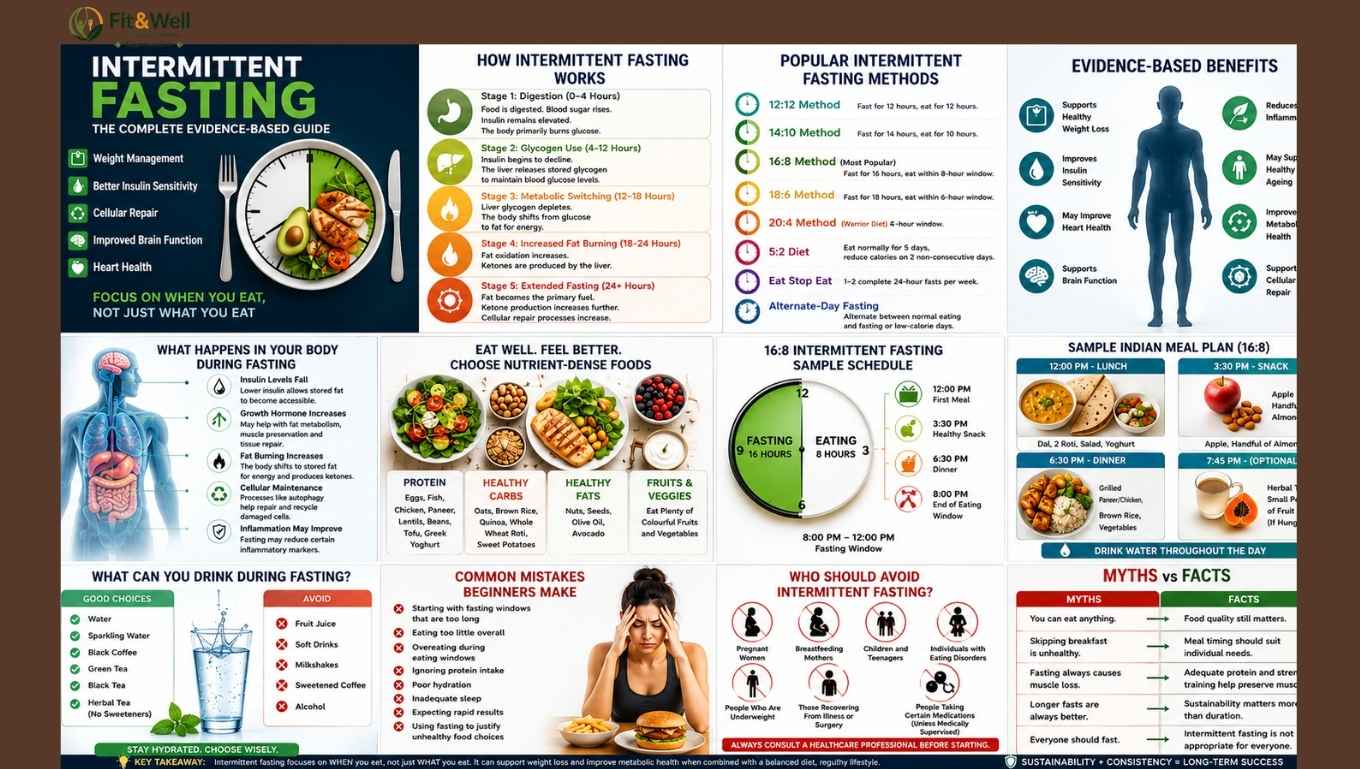
Intermittent fasting is an eating pattern that governs when you eat rather than what. Johns Hopkins Medicine describes it as “an eating plan that switches between fasting and eating on a regular schedule”.
The mechanism its proponents point to is metabolic switching. After enough hours without food, in the Johns Hopkins description, “the body exhausts its sugar stores and starts burning fat”. That switch is real. Whether it delivers anything beyond the calorie reduction that usually comes with it is the question the trials have spent a decade trying to answer.
Expect a settling-in period. Johns Hopkins notes it takes two to four weeks for the body to adapt, and that headaches, nausea and anxiety are common while it does.
The main methods
| Method | How it works | What the evidence says |
|---|---|---|
| 16:8 (time-restricted eating) | Eat within a 6 to 8 hour window, fast the rest | Easiest to sustain. Weakest for weight loss of the three fasting types |
| 5:2 (whole-day fasting) | Eat normally five days, restrict to one 500 to 600 calorie meal on two | Middle of the pack |
| Alternate-day fasting | A very low intake day every other day | The only method that beat ordinary calorie restriction in the BMJ analysis, and only just |
What the evidence actually shows for weight loss
The June 2025 BMJ network meta-analysis by Semnani-Azad and colleagues pooled 99 randomised trials covering 6,582 adults, average age 45 and two-thirds female. It is the most complete picture available.
Alternate-day fasting was the only fasting strategy to beat continuous calorie restriction, by 1.29 kg (95% CI −1.99 to −0.59). It also beat time-restricted eating by 1.69 kg and whole-day fasting by 1.05 kg. All three findings were rated moderate certainty.
Read those numbers carefully. The best-performing fasting method wins by a little over a kilogram against ordinary dieting, and the popular 16:8 approach came last among the fasting styles. The BMJ team rated the overall certainty of evidence as low to moderate, and flagged high heterogeneity between trials and small sample sizes.
Commenting on the study for the Science Media Centre, Professor Naveed Sattar put it plainly: “there is nothing magical about intermittent fasting for weight loss beyond being another way for people to keep their total calorie intake lower.” Dr Amanda Avery noted that in trials of 24 weeks or more, “there was no difference between IF and CER in the weight changes seen.”
Two landmark trials had already pointed the same way. The TREAT trial (Lowe et al, JAMA Internal Medicine, 2020) put 116 adults on a noon-to-8pm window for 12 weeks. The fasting group lost 0.94 kg, the control group 0.68 kg, and the difference between them was not statistically significant. The authors concluded that “time-restricted eating, in the absence of other interventions, is not more effective in weight loss than eating throughout the day.”
A 12-month trial by Liu and colleagues in the New England Journal of Medicine in 2022 randomised 139 people to an 8am-to-4pm window alongside calorie restriction, or to calorie restriction alone. The window group lost 8 kg and the calorie-only group 6.3 kg, a difference of 1.8 kg that did not reach significance.
Where intermittent fasting does look genuinely useful
Weight is not the only outcome, and this is where the picture improves.
Blood sugar in metabolic syndrome. A randomised trial published in Annals of Internal Medicine in October 2024 gave 108 adults with metabolic syndrome a personalised 8 to 10 hour eating window, cutting at least four hours from a baseline that averaged 14.19 hours. HbA1c improved by 0.10% against standard care (95% CI −0.19 to −0.003), with no major adverse events. Modest, but real, and achieved on top of existing medication.
Type 2 diabetes remission. The most striking result comes from a 2023 trial in the Journal of Clinical Endocrinology & Metabolism. Seventy-two people with type 2 diabetes were randomised to a Chinese Medical Nutrition Therapy protocol using five modified fasting days at around 840 kcal alternating with ten unrestricted days, run over six cycles in three months.
At three months, 47.2% of the fasting group were in remission against 2.8% of controls. At twelve months, it was 44.4% against zero. HbA1c fell by 1.75% in the fasting arm while rising 0.37% in controls, and medication costs dropped 77.22%.
That is a large effect from a small trial with a specific protocol, in a Chinese population, and it has not yet been replicated in India. Treat it as promising rather than settled. If you are managing blood sugar, our guide to the glycaemic index of Indian foods covers the other half of the equation, and a home glucometer makes the effect of any change visible within days.
Cholesterol. The BMJ analysis found alternate-day fasting lowered total and LDL cholesterol compared with time-restricted eating. It found no difference between fasting, calorie restriction and unrestricted eating for HbA1c across the whole trial set, which is worth holding alongside the diabetes findings above.
The muscle question
This is the part most fasting guides skip, and it matters more in India than elsewhere.
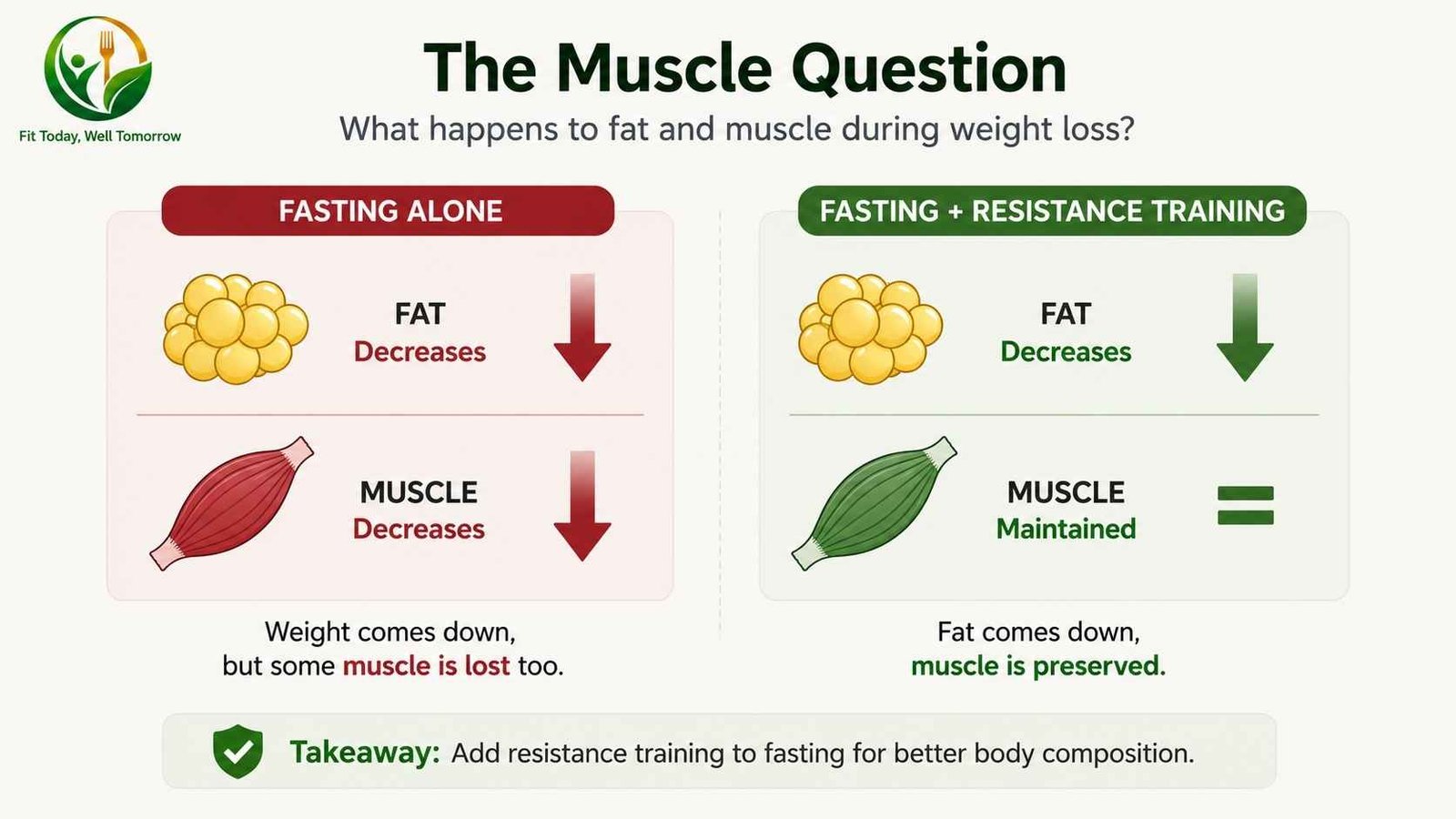
TREAT found something its headline weight numbers hid. The fasting group lost significantly more appendicular lean mass index than controls (−0.16 kg/m², 95% CI −0.27 to −0.05, P = .005). In plain terms, a meaningful share of what the fasting group lost was muscle from their arms and legs.
The fix appears to be exercise. A 2025 meta-analysis in the International Journal of Obesity pooled 15 studies and 338 participants who combined time-restricted eating with training. Fat mass fell by roughly 1.3 kg more than in exercise-only controls, while fat-free mass showed no significant change. The authors concluded that fasting with exercise “may reduce fat mass … while preserving FFM”, adding that more studies are needed.
The practical reading: if you fast, train. Even a daily walking routine is better than fasting alone, and breaking up long stretches of sitting matters independently of when you eat.
The 2024 heart-death headline, explained
In March 2024, headlines worldwide reported that an 8-hour eating window was linked to a 91% higher risk of cardiovascular death. If you remember one alarming thing about intermittent fasting, it is probably this. It deserves context.
The finding came from an abstract presented at an American Heart Association conference, analysing over 20,000 US adults in NHANES data from 2003 to 2018. The AHA’s own release stated that “research abstracts are considered preliminary until published in a peer-reviewed scientific journal”, and the authors themselves wrote that the association “does not mean that time-restricted eating caused cardiovascular death”.
The methodological objections were severe. Speaking to TCTMD, Dr Pam Taub pointed out that only 414 people, about 2% of the sample, actually ate within an 8-hour window, and there were just 31 cardiovascular deaths among them. Dr Donald Lloyd-Jones noted that the analysis assumed a two-day dietary recall “represents their usual eating pattern over the entirety of follow-up”, and that baseline differences between groups were large. His summary: “It wasn’t their eating time that was causing their higher risk. It was what they brought to the table.” And: “Consumers and the general public should not be alarmed.”
Treat that 91% figure as unresolved rather than as evidence of harm. But it is a fair reminder that long-term safety data on aggressive fasting windows is thin.
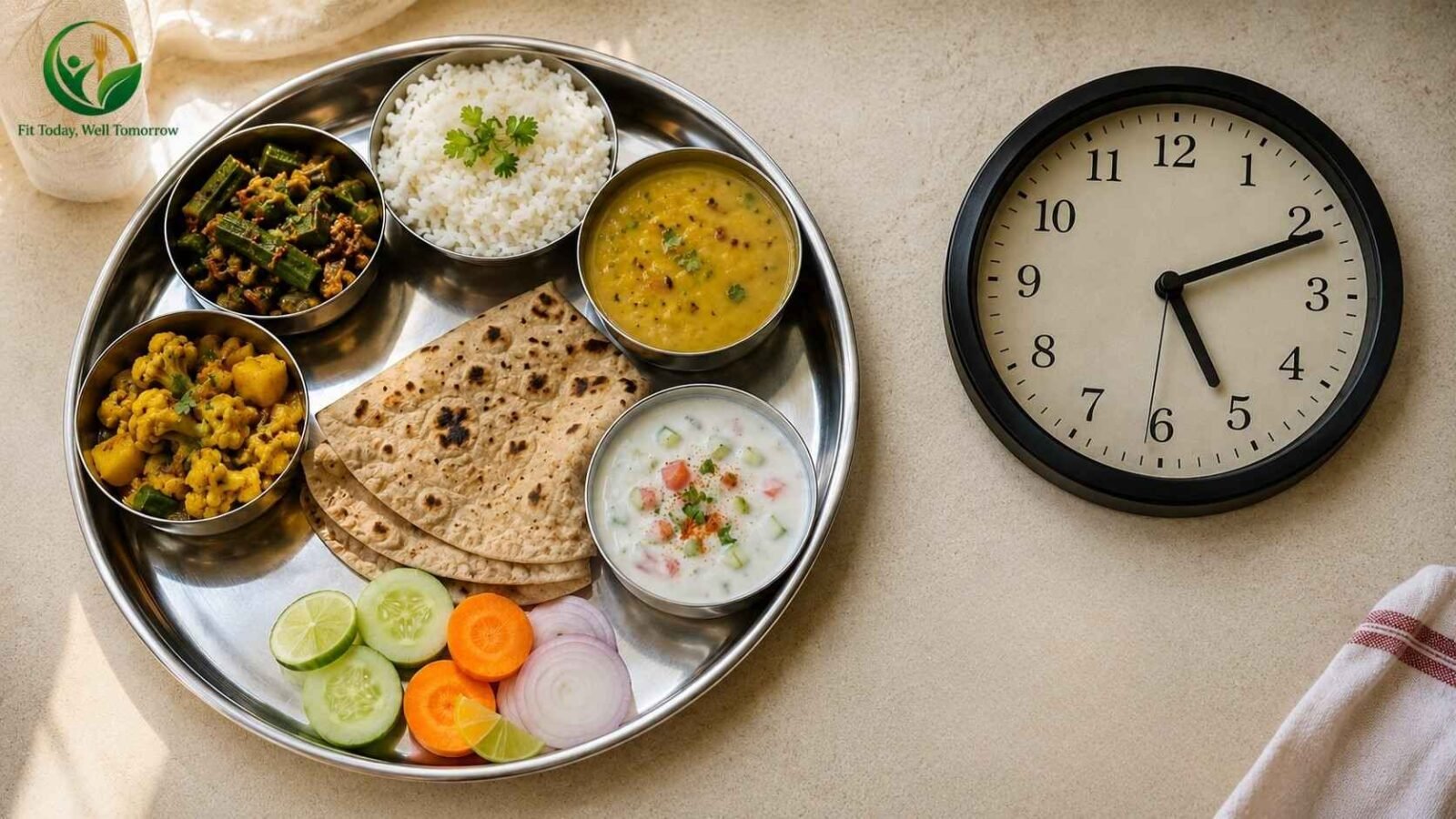
Intermittent fasting on an Indian plate
Here is the first thing to know: the ICMR-National Institute of Nutrition’s Dietary Guidelines for Indians, updated in 2024, does not mention intermittent fasting at all. There is no Indian guideline endorsing it, and no Indian randomised trial of it that we could locate. What follows is the international evidence applied to Indian conditions, not Indian evidence.
What the ICMR-NIN guidelines do say is closer to fasting than most people realise. Guideline 1 advises “restricting meal frequency to two to three times a day” and “not snacking in between”. For someone currently grazing from morning chai to a late dinner, adopting that alone captures much of what a fasting schedule delivers, without the branding.
The Indian context makes two adjustments necessary.
The carbohydrate problem. ICMR-NIN records that cereals supply 50% to 70% of daily energy in Indian diets, against a recommended ceiling of 45%, with a target split of 55% carbohydrate, 10 to 15% protein and 20 to 30% fat. Compressing that same cereal-heavy intake into eight hours does not fix it. If your eating window is two large rice or roti meals, you have changed the timing and nothing else. Swapping in millets and lower-GI staples does more than the window does.
Protein is the binding constraint. Given the lean-mass finding from TREAT, and given that vegetarian Indian diets frequently run low on protein, fasting without deliberately raising protein intake risks losing exactly the tissue you want to keep.
Two more practical points. Late dinners are the norm in much of India, and an 8 pm cutoff is a real behavioural change for most households, not a small one. If you already have acid reflux, an earlier last meal may help that independently of any weight effect.
And the scale of the underlying problem is worth stating. The ICMR-INDIAB national study (Anjana et al, Lancet Diabetes & Endocrinology, 2023) found diabetes in 11.4% of Indian adults, about 101 million people, prediabetes in 15.3% or 136 million, abdominal obesity in 39.5% or 351 million, and hypertension in 35.5% or 315 million. Intermittent fasting is one lever among many against that, and not the strongest one.
Who should not try intermittent fasting?
This list is not negotiable, and it is where a health article earns its keep.
Do not fast if you are pregnant or breastfeeding. NHS guidance is explicit that pregnant and breastfeeding women “should not attempt intermittent fasting”, and Johns Hopkins adds under-18s to that.
Do not fast if you have a history of an eating disorder. The NHS names anorexia and bulimia specifically. A schedule that legitimises not eating is a poor fit for anyone with that history.
If you have diabetes, speak to your doctor first, before you change anything. This is the most important line in this article. The medications that carry hypoglycaemia risk during fasting are sulfonylureas and insulin, per the July 2024 Diabetes & Primary Care factsheet. That same factsheet notes there is no evidence of increased hypoglycaemia during fasting in people with type 2 diabetes on these agents, but only “as long as participants are asked to regularly monitor blood glucose and medication is adjusted per protocol”. The adjustment is the safeguard. Fasting on an unchanged sulfonylurea dose is how people end up hypoglycaemic.
The International Diabetes Federation’s Diabetes and Ramadan: Practical Guidelines 2021 takes the same line for religious fasting, stratifying people into low, moderate and high risk and advising that anyone with diabetes intending to fast “should have a pre-Ramadan medical assessment to evaluate their suitability for fasting”. The same logic applies to any extended fast, religious or otherwise.
The NHS also flags nutritional deficiencies, dehydration and overeating on non-fasting days as general risks.
How to start, if you decide to
- Pick the least ambitious version that changes anything. Cutting a 14-hour eating window to 10 hours was enough to move HbA1c in the Annals trial. You do not need 16:8 on day one.
- Move the evening meal earlier rather than skipping breakfast. Trial windows that showed metabolic benefit skewed early: 8 am to 4 pm in the Liu trial, personalised early windows in the Annals trial.
- Fix the food before the timing. A compressed window of the same cereal-heavy diet is not much of an intervention.
- Protect muscle. Prioritise protein and add resistance work. The evidence that fasting plus exercise preserves fat-free mass is the strongest practical finding in this whole literature.
- Give it three to four weeks. Johns Hopkins puts adaptation at two to four weeks. Judge it after that, not on day three.
- Drink water through the fasting hours. Dehydration is one of the NHS’s named risks.
- Stop if it is making you miserable. Adherence is the only variable that reliably predicts results, and a schedule you resent has already failed. As Dr Avery put it, “compliance with any intervention will make a difference.”
Frequently asked questions about Intermittent Fasting
Does intermittent fasting work better than counting calories?
Mostly no. The 2025 BMJ analysis of 99 trials found alternate-day fasting beat continuous calorie restriction by 1.29 kg, and no other fasting method beat it at all. In trials lasting 24 weeks or more, the difference vanished. Choose whichever you can actually stick to.
Which fasting method is most effective?
Alternate-day fasting produced the largest weight reduction in the BMJ network meta-analysis, beating time-restricted eating by 1.69 kg. It is also the hardest to sustain. The popular 16:8 method performed worst of the three fasting styles for weight.
Can intermittent fasting reverse type 2 diabetes?
A 2023 trial in the Journal of Clinical Endocrinology & Metabolism achieved remission in 47.2% of participants at three months and 44.4% at twelve months, against 2.8% and 0% in controls. That is one 72-person trial using a specific protocol, not yet replicated in India. Promising, not proven. Do not change diabetes medication without your doctor.
Is intermittent fasting safe for the heart?
The 2024 finding linking 8-hour windows to 91% higher cardiovascular death was a conference abstract, not peer-reviewed, based on 414 people and 31 deaths, and its own authors said it does not show causation. Cardiologists publicly urged the public not to be alarmed. Long-term safety data remains limited.
Will I lose muscle?
You can. TREAT found significantly greater loss of appendicular lean mass in the fasting group. Combining fasting with exercise appears to prevent this: a 2025 meta-analysis found fat mass fell by about 1.3 kg more than exercise alone while fat-free mass was preserved.
Can I fast during Navratri, Ramadan or other religious fasts if I have diabetes?
Only after a medical assessment. The International Diabetes Federation’s Ramadan guidance stratifies people with diabetes into low, moderate and high risk and recommends a pre-fasting medical assessment to judge whether fasting is safe for them. That guidance is written for Ramadan, but the reasoning applies to any extended fast. Sulfonylureas and insulin are the drugs that carry hypoglycaemia risk, and they may need adjusting.
Does ICMR recommend intermittent fasting?
No. The 2024 Dietary Guidelines for Indians do not mention it. They do advise limiting meals to two or three a day and not snacking between them, which achieves something similar without a fasting protocol.
How long before I see results?
Allow two to four weeks for your body to adapt, per Johns Hopkins. Headaches, nausea and irritability during that window are common and usually settle.
This article is for general information and is not a substitute for advice from your own doctor. If you take medication for diabetes, blood pressure or any other condition, speak to your clinician before changing when or how much you eat.
Sources
- Semnani-Azad Z, Khan TA, Chiavaroli L, et al. Intermittent fasting strategies and their effects on body weight and other cardiometabolic risk factors: systematic review and network meta-analysis of randomised clinical trials. BMJ, volume 389, 2025. DOI 10.1136/bmj-2024-082007.
- BMJ Group. Intermittent fasting comparable to traditional diets for weight loss. 19 June 2025.
- Science Media Centre. Expert reaction to study comparing evidence on intermittent fasting and traditional calorie reduction diets for weight loss. June 2025.
- Lowe DA, Wu N, Rohdin-Bibby L, et al. Effects of Time-Restricted Eating on Weight Loss and Other Metabolic Parameters in Women and Men With Overweight and Obesity: The TREAT Randomized Clinical Trial. JAMA Internal Medicine, 2020;180(11):1491–1499.
- Manoogian ENC, Wilkinson MJ, O’Neal M, et al. Time-Restricted Eating in Adults With Metabolic Syndrome: A Randomized Controlled Trial. Annals of Internal Medicine, October 2024.
- Yang X, Zhou J, Shao H, et al. Effect of an Intermittent Calorie-restricted Diet on Type 2 Diabetes Remission: A Randomized Controlled Trial. Journal of Clinical Endocrinology & Metabolism, 2023;108(6):1415–1424.
- Hays HM, Sefidmooye Azar P, Kang M, Tinsley GM, Wijayatunga NN. Effects of time-restricted eating with exercise on body composition in adults: a systematic review and meta-analysis. International Journal of Obesity, 2025.
- Society for Endocrinology. Calorie restriction with or without time-restricted eating in weight loss. The Endocrinologist, issue 144, Summer 2022, summarising Liu D et al, New England Journal of Medicine 2022;386:1495–1504.
- American Heart Association. 8-hour time-restricted eating linked to a 91% higher risk of cardiovascular death. 18 March 2024.
- TCTMD. Intermittent Fasting Study Sparks Debate Over Increases in CV Mortality. 2024.
- Johns Hopkins Medicine. Intermittent Fasting: What Is It, And How Does It Work?
- ICMR-National Institute of Nutrition. Dietary Guidelines for Indians. 2024 edition.
- Anjana RM, Unnikrishnan R, Deepa M, et al. Metabolic non-communicable disease health report of India: the ICMR-INDIAB national cross-sectional study (ICMR-INDIAB-17). Lancet Diabetes & Endocrinology, 2023;11:474–489. Figures as reported in Lessons Learnt from the ICMR-INDIAB Study, The National Medical Journal of India.
- NHS. Intermittent fasting. MyHealth London.
- At a glance factsheet: Intermittent fasting for the management of weight and diabetes. Diabetes & Primary Care, volume 26, number 3, 8 July 2024.
- International Diabetes Federation and DAR International Alliance. Diabetes and Ramadan: Practical Guidelines 2021.