
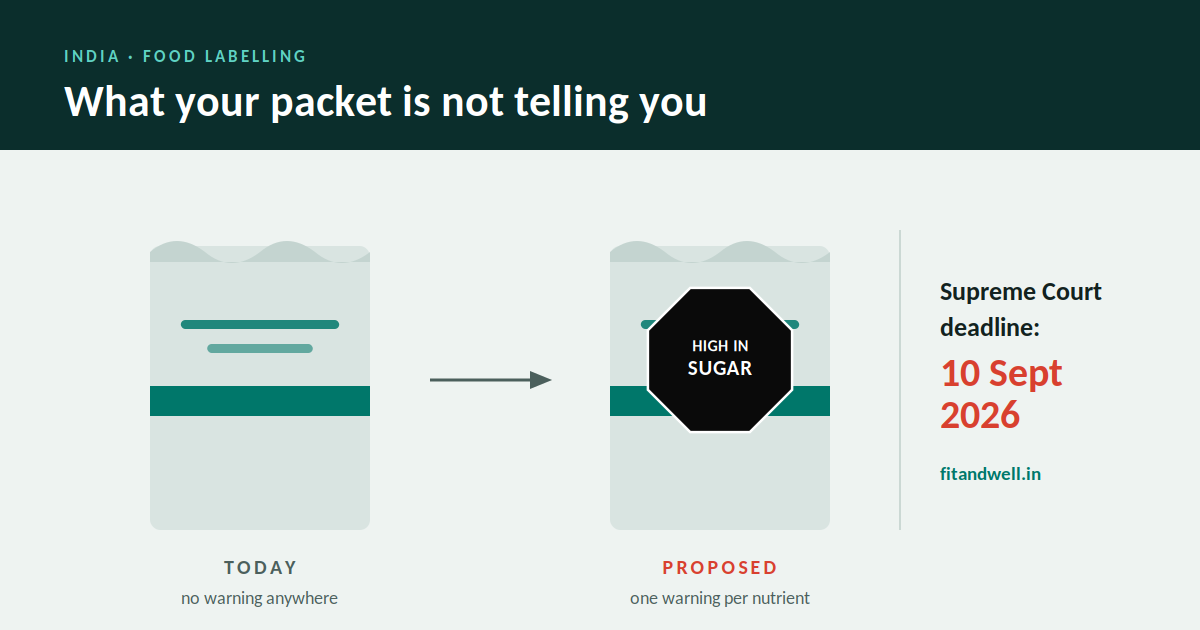
India still has no Food Warning Labels in India on the front of a packet. Nothing on a biscuit wrapper or a bottle of soft drink has to tell you it is high in sugar, salt or saturated fat, and the only nutrition information the law guarantees is the small table on the back.
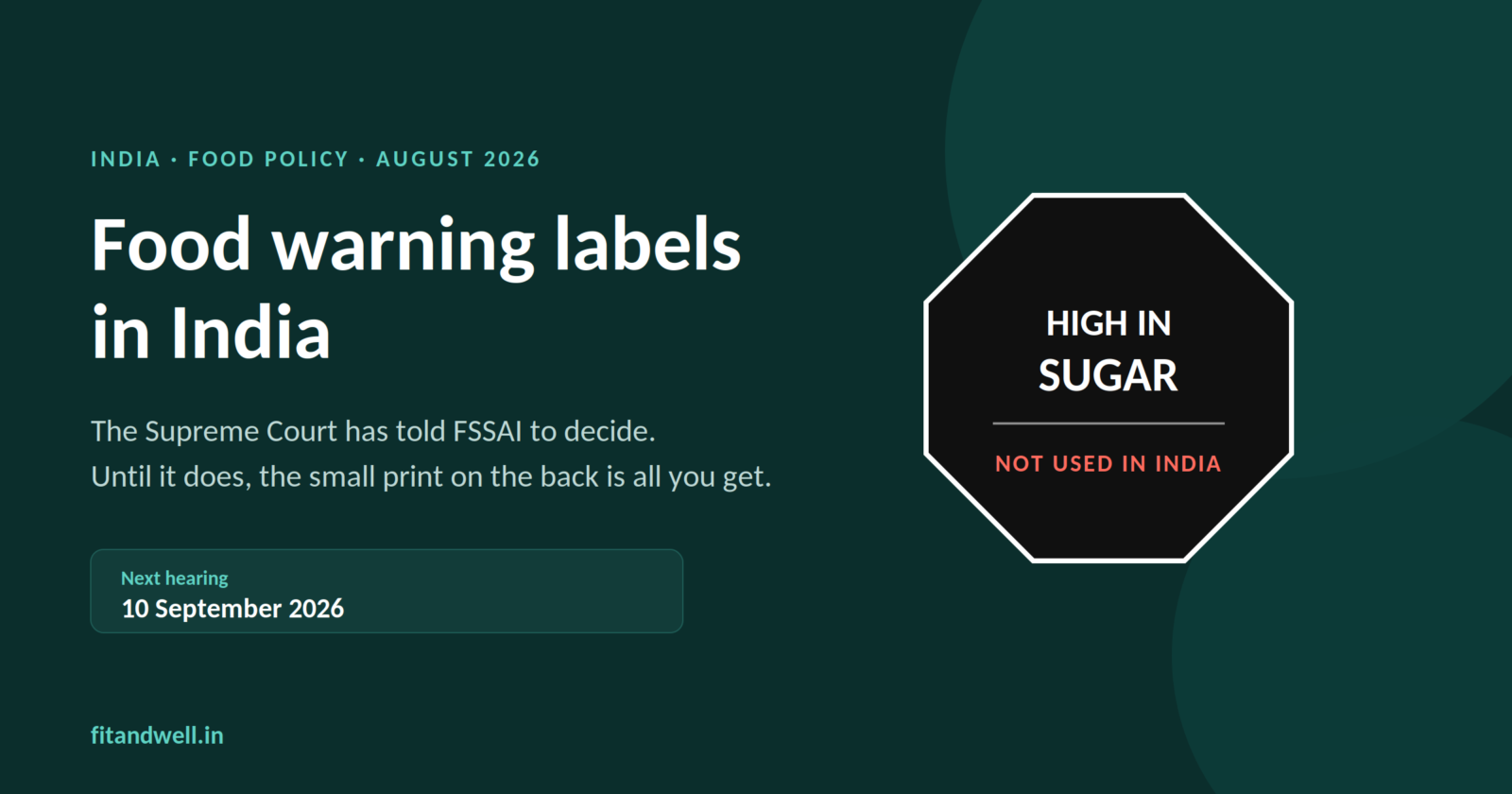
That may be about to change. On 13 August 2026, the Supreme Court gave the Union government two weeks to place its final decision on front-of-pack labelling on record, with the next hearing listed for 10 September 2026.
Until that decision lands, the back-of-pack table is the tool you have. This guide covers what the court has actually ordered, what the food regulator has offered instead, what the evidence says about whether these labels work, and how to read an Indian food label properly in the meantime.
In short
- India requires nutrition information only on the back of the pack. No product has to tell you it is high in sugar, salt or saturated fat.
- On 13 August 2026 the Supreme Court gave the Union government two weeks to file its final decision, warning that it would otherwise dictate the judgment itself. The next hearing is 10 September 2026.
- FSSAI has proposed printing recommended daily limits rather than warnings. The format research, including two large Indian studies, points the other way.
- Until the rules change, the per 100 g column, the added sugar line and the sodium figure are the three things worth reading.
What Is a Front-of-Pack Warning Label?
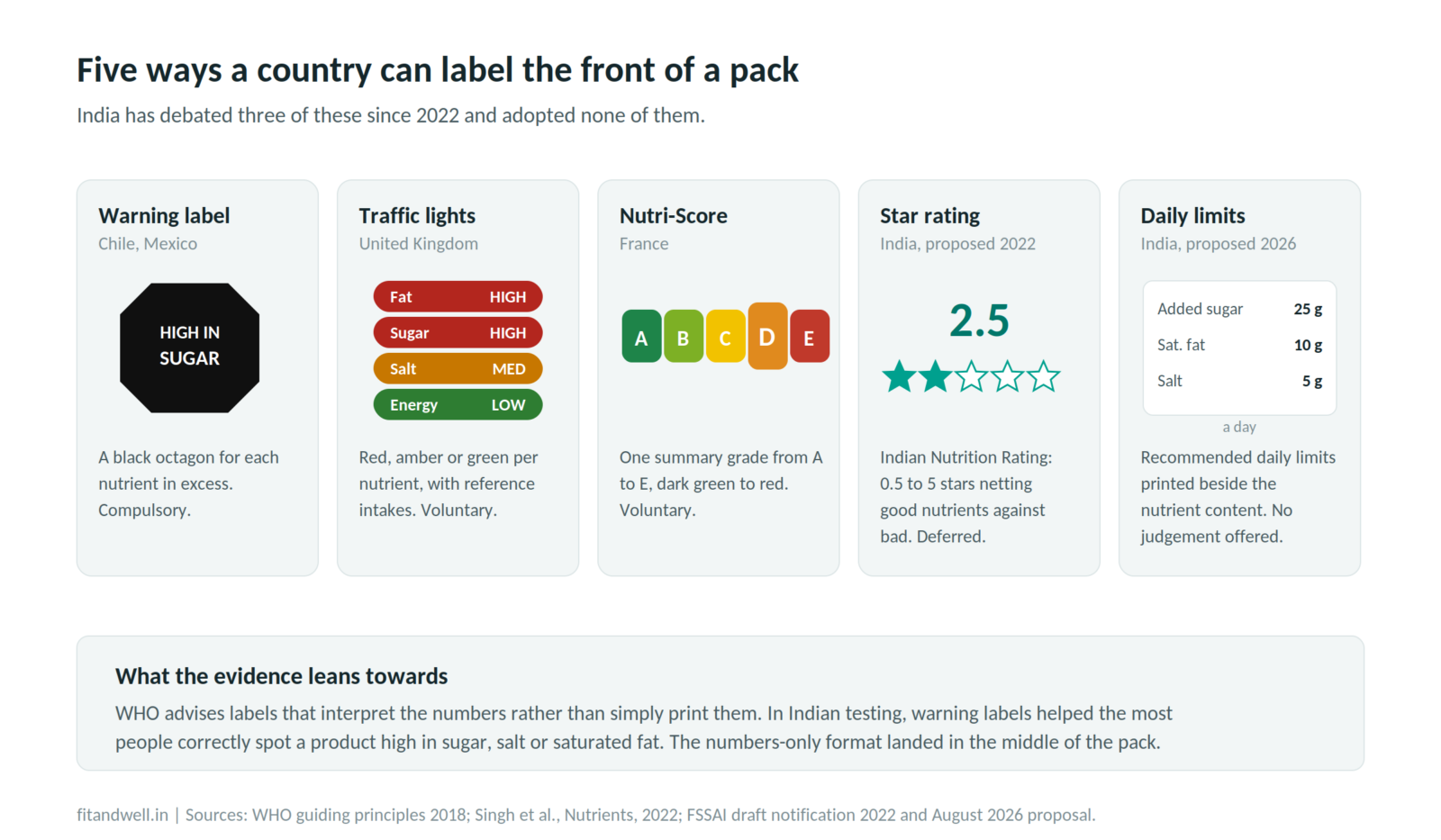
A front-of-pack label is a short, standardised signal printed on the front of a packet that tells you, at a glance, whether the food inside is high in a nutrient linked to chronic disease. Chile pioneered the strictest version: a black octagonal warning symbol for each nutrient in excess, flagging products high in calories, sugar, sodium or saturated fat. Mexico uses the same octagons, and products carrying them face marketing restrictions as well.
Other countries interpret the numbers more gently. The United Kingdom uses voluntary red, amber and green traffic lights per nutrient. France uses Nutri-Score, a single summary grade from A to E on a dark green to red scale.
India has proposed two systems since 2022 and adopted neither.
What Did the Supreme Court Actually Say?
The case is 3S and Our Health Society v Union of India, and it has already been through several rounds. The court originally disposed of it on 9 April 2025 with a direction to act, then granted the expert committee three months, then another three months to 15 July 2025. The committee’s final report was noted by the court on 20 January 2026.
On 10 February 2026, the bench went further and pointed at specific wordings: interpretive warnings on the lines of ‘High Sodium Level’, ‘High Sugar Level’ and ‘High Saturated Fat Level’.
That is the order the August hearing turned on. Sitting on 13 August 2026, Justices J B Pardiwala and K Vinod Chandran told the regulator that the February order was ‘not merely a suggestion but a direction’, and asked openly whether ‘FSSAI is bowing down to the manufacturing industry’.
The bench gave the Centre two weeks, in terms that leave little room for another extension: ‘This is your last chance. Next time we will dictate the judgment.’
The court did not dictate a design. It left the visual appearance of the label, whether coloured indicators, interpretive words, symbols, numbers or percentages, to the Union in consultation with experts. What it has run out of patience with is the delay, not any particular graphic.
The matter returns to court on 10 September 2026.
What Has FSSAI Proposed Instead?
Two things, four years apart, and neither is a warning.
The first was the Indian Nutrition Rating, notified in draft on 13 September 2022. It would have given each product between half a star and five stars, calculated by setting energy, saturated fat, total sugar and sodium against ‘positive’ nutrients per 100 g or 100 ml. Compliance would have been voluntary for 48 months before becoming mandatory. The draft drew more than 14,000 public comments, produced no consensus, and was deferred.
The second is on the table now. In a proposal dated 3 August 2026, FSSAI put forward a pictorial display of the recommended daily limits for added sugar, saturated fat and salt, printed alongside the product’s nutrient content per 100 g and its serving size. Those limits are 25 g of added sugar, 10 g of saturated fat and 5 g of salt a day, drawn from the 2024 ICMR-NIN dietary guidelines.
The regulator also asked for more time: further research, a systematic mapping of packaged foods, consumer surveys and wider stakeholder consultation before anything is implemented.
The difference between the two approaches matters more than it sounds. A warning label makes the judgement for you. A table of daily limits hands you two numbers and asks you to do the arithmetic in the aisle.
FSSAI told the court that most industry organisations had opposed warning labels, preferring an approach that lets consumers make informed decisions ‘without creating fear amongst the consumers’. Whether a warning is fear or information is, in effect, the question the court is now being asked to settle.
There is also a question about how the star proposal was arrived at. The Reporters’ Collective has documented that FSSAI commissioned the underlying consumer study from IIM Ahmedabad, a business school rather than a public health institution, and that experts wrote to the Prime Minister’s Office calling the research ‘methodologically unsound and unfit to guide a major health policy’.
The same reporting found that at a stakeholder meeting on 30 June 2021, industry representatives outnumbered consumer groups by roughly six to one. FSSAI has not accepted that characterisation, and the court record shows the regulator arguing for more evidence rather than less.
Do Front-of-Pack Labels Actually Work?
This is where the evidence is stronger than most reporting suggests, though it is not unanimous.
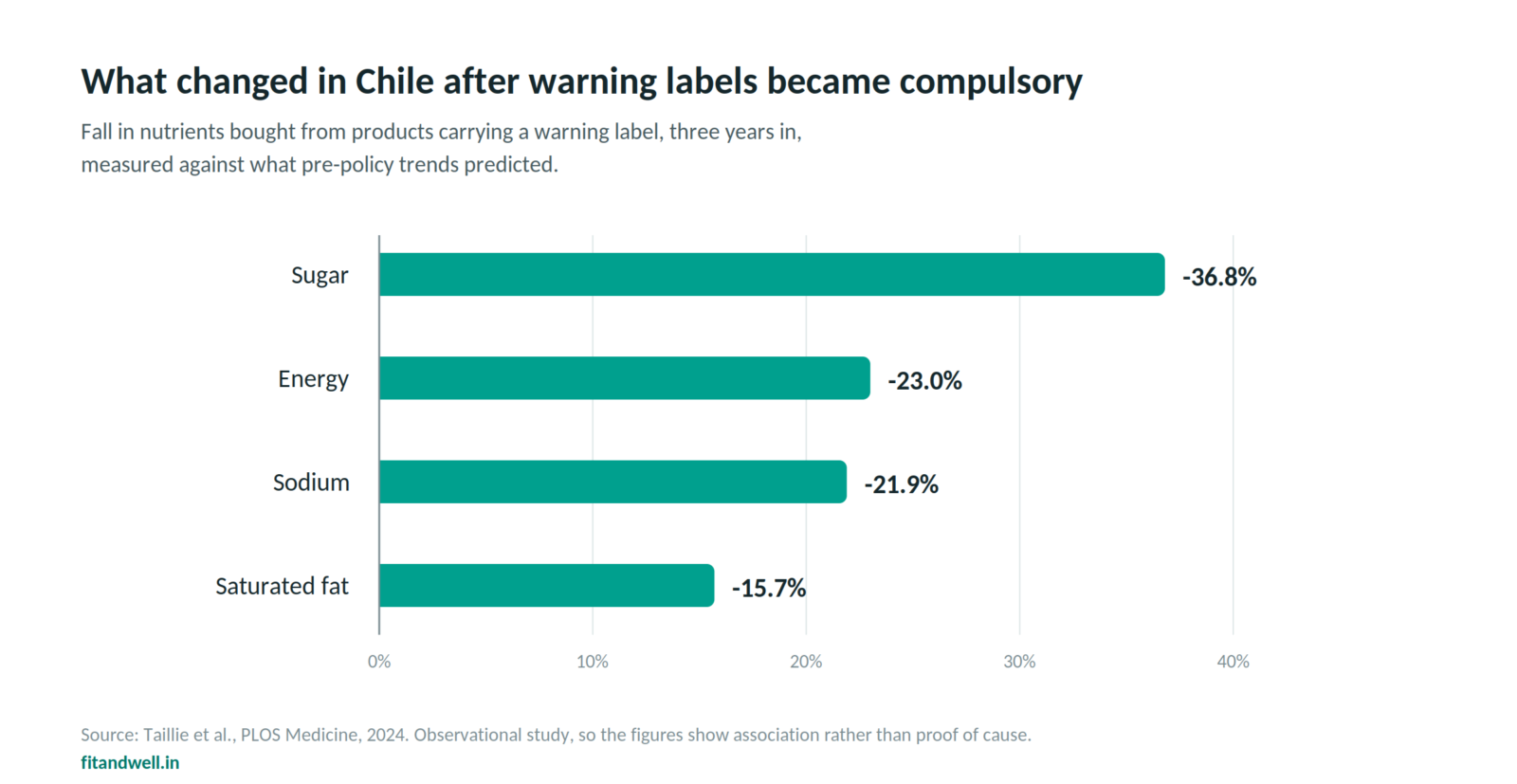
Chile is the natural experiment. Three years after its labelling, marketing and school sales law came in, purchases of products carrying a warning label had fallen sharply against what pre-policy trends predicted: sugar bought from those products down 36.8%, energy down 23.0%, sodium down 21.9% and saturated fat down 15.7%, according to an interrupted time series analysis published in PLOS Medicine in 2024.
Two honest limits on that. It is an observational study, so it shows association rather than proof of cause. And Chile changed three things at once, so the label cannot be separated cleanly from the marketing restrictions and school sales ban that came with it.
Purchases are a proxy. Body weight is not. A cohort study of more than 300,000 Chilean children aged four to six, published in The Lancet in 2026 and led by Professor Guillermo Paraje, found that after 18 months of exposure to the policy, the probability of excess weight fell by 2.85% in girls and 2.40% in boys.
Paraje says the findings ‘offer strong evidence for policymakers around the world’, supporting mandatory warning labels, school restrictions and marketing bans as practical tools against childhood obesity.
On format, the World Health Organisation’s guiding principles are explicit: ‘interpretive FOPL systems that use interpretational aids and minimise numerical information are most useful for aiding consumer comprehension’, and the process should be government-led.
A 2021 review in the Annual Review of Nutrition went further, concluding that there is sufficient evidence for governments to mandate front-of-pack labelling, that ‘Guideline Daily Amount labels should be avoided’, and that warning label systems like Chile’s are likely to deliver the largest public health benefit. FSSAI’s current proposal is closest to the daily amounts format that the review advises against.
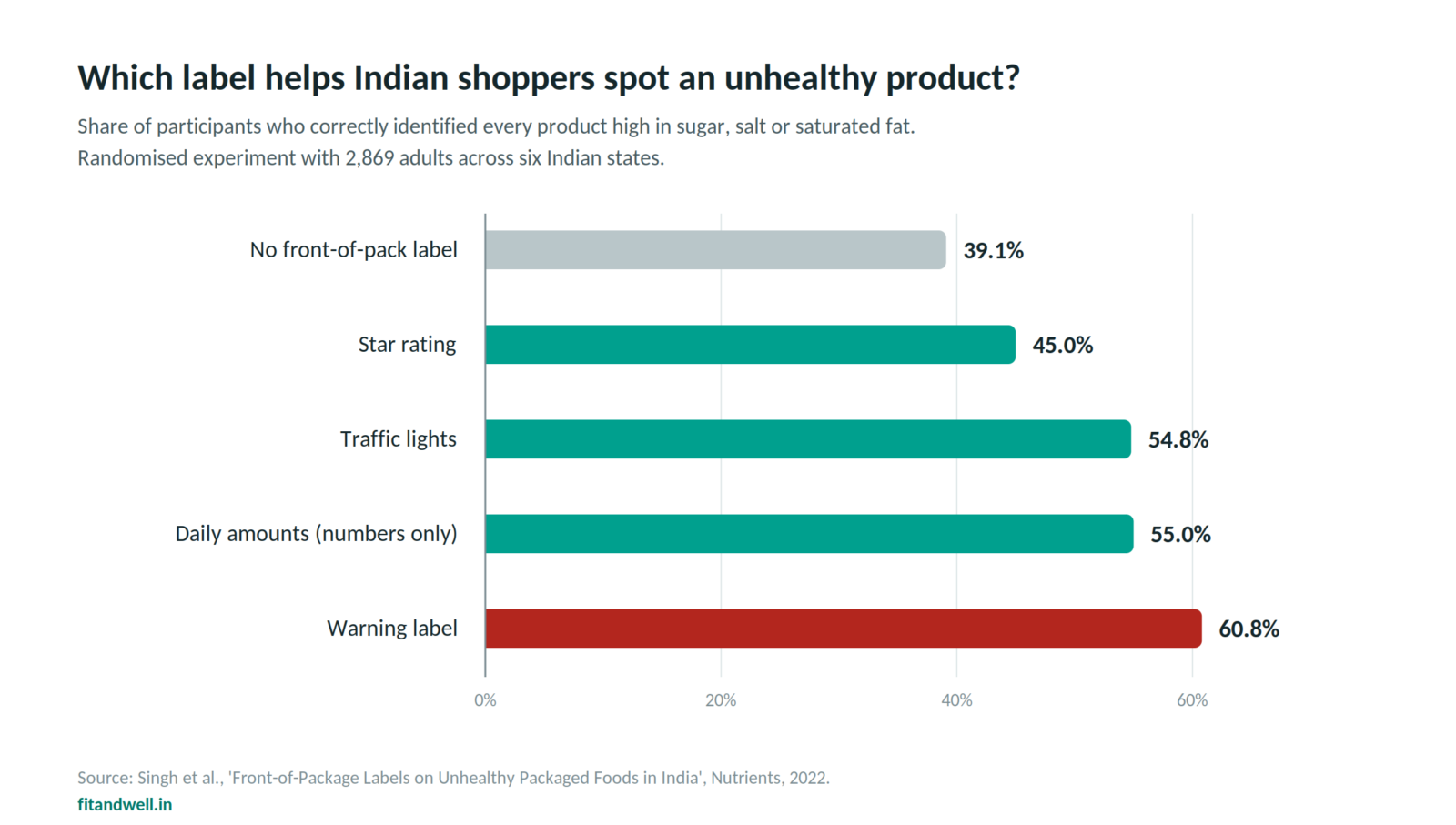
Indian evidence points the same way, with a caveat worth stating. In a randomised experiment with 2,869 adults across six Indian states, published in Nutrients in 2022, 39.1% of participants shown no front-of-pack label correctly identified every product that was high in a nutrient of concern. That rose to 45.0% with a star rating, 54.8% with traffic lights, 55.0% with daily amounts and 60.8% with a warning label.
Here is the caveat. None of the labels reduced stated intentions to buy the product. They helped people see what was in the packet, which is not the same as changing what goes into the trolley.
A much larger Indian study, covering 20,564 people and published in Food Quality and Preference in 2023, found that summary formats, star ratings and warning labels ranked higher on ease of identification and understanding than the formats that simply present numbers. Two independent Indian datasets, then, agree on the general shape of the answer even while disagreeing about which summary format wins.
Why This Matters in India Specifically
Consumption has moved faster than the rules. India’s ultra-processed food market grew by more than 150% between 2009 and 2023, a figure the Supreme Court itself cited from the Economic Survey 2025-26 while noting that obesity doubled among both men and women over the same period.
Those two curves are the reason a label is in front of judges at all. If you want the fuller picture of what rising obesity means clinically, our guide to obesity, its causes and treatment covers it in depth.
Salt is the other half of the story. WHO recommends under 2,000 mg of sodium a day, equivalent to less than 5 g of salt or just under a teaspoon, and estimates that around 1.7 million deaths a year are associated with consuming too much of it.
Global average intake in 2021 was about 11 g of salt a day, more than double the recommendation. In a country with a fast-growing packaged food market, a good deal of that arrives already mixed in, which is why the label matters for anyone managing blood pressure.
Parliament has already said the current labels are not doing the job. The Committee on Subordinate Legislation, chaired by MP Milind Deora, reported on 16 December 2025 that existing labels are ‘often difficult for average consumers to interpret’ and that nutrition tables were ‘frequently printed in very small fonts’. It recommended front-of-pack labelling in an easily readable tabular format and a prescribed minimum font size.
How to Read an Indian Food Label Today
Until the front of the pack changes, the back of it is where the truth is. Here is how to get at it quickly.
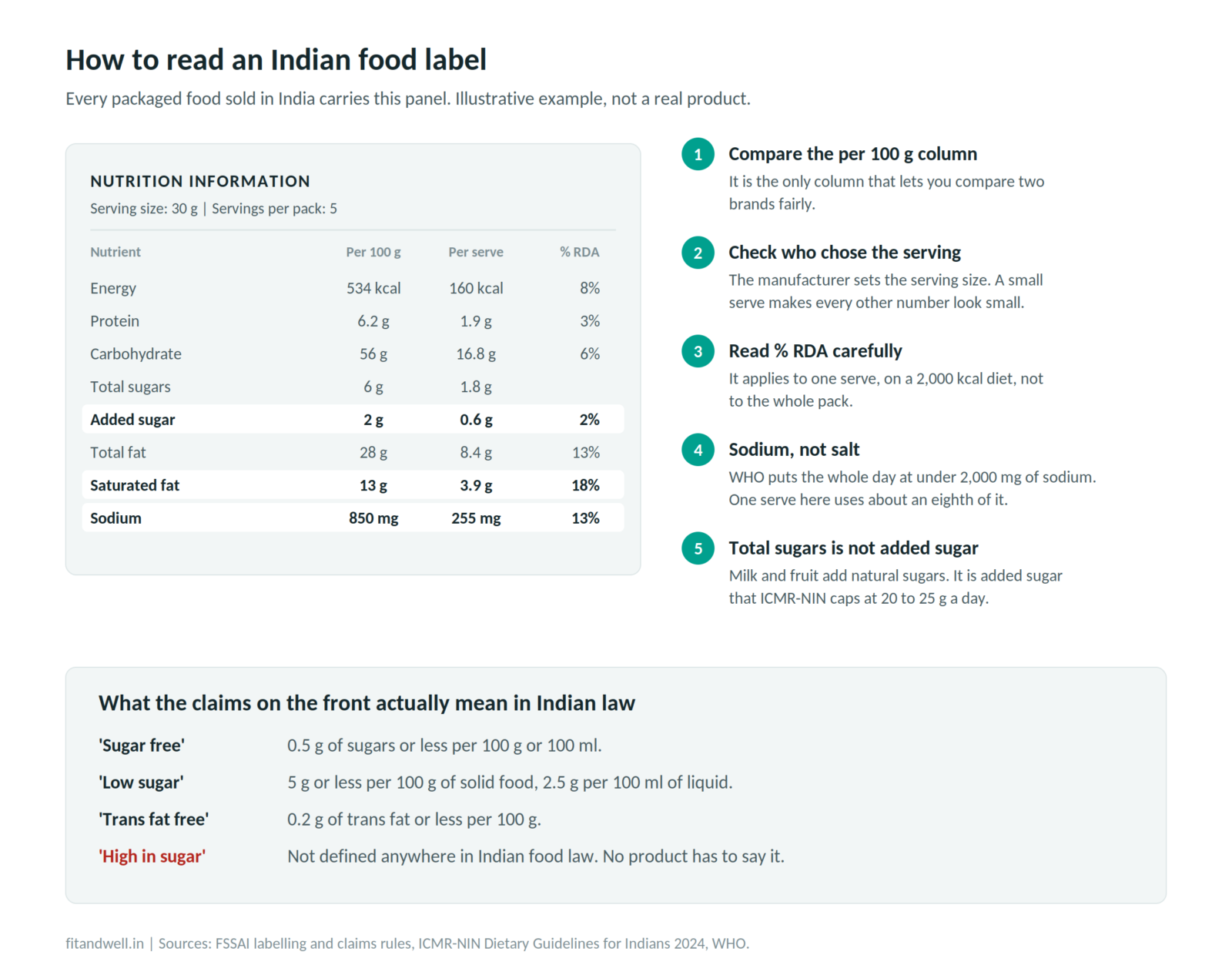
Read the per 100 g column, not the per serve column. Indian rules require nutrient information per 100 g or 100 ml, and the percentage contribution to recommended daily allowance per serving, based on a 2,000 kcal diet. The per 100 g figure is the only one that lets you compare two brands fairly, because it is the only one the manufacturer cannot influence.
Check who chose the serving size. The company does. A 30 g serve on a 150 g packet makes every number on the label look reassuring, and almost nobody eats a fifth of a small packet of chips.
Find the three numbers that matter. Added sugar, sodium and saturated fat. ICMR-NIN’s 2024 guidelines put added sugar at 20 g to 25 g a day for adults, and under 5% of total energy. WHO puts sodium at under 2,000 mg a day. Total fat should stay at or below 30% of energy.
Do not confuse total sugars with added sugar. Milk and fruit contribute natural sugars, which is why a flavoured yoghurt and a plain one can both show sugar on the panel while being very different products. Added sugar is the line that maps to the ICMR-NIN cap.
Watch sodium, not salt. Indian labels declare sodium in milligrams, not salt in grams. In the example above, one 30 g serve carries 255 mg of sodium, which is roughly an eighth of the whole day’s WHO limit, spent on a snack.
Read the claims on the front as legal definitions, not compliments. ‘Sugar free’ means no more than 0.5 g of sugars per 100 g or 100 ml. ‘Low sugar’ means no more than 5 g per 100 g of solid food, or 2.5 g per 100 ml of liquid. A ‘trans fat free’ logo is permitted at up to 0.2 g of trans fat per 100 g.
Notice what is missing from that list. Indian food law defines ‘low’ and ‘free’. It does not define ‘high’. As Dr Arun Gupta of Nutrition Advocacy in Public Interest pointed out in April 2026, a company may advertise what its product does not contain, while nothing compels it to tell you what it has too much of. That asymmetry is the whole argument for a warning label.
Treat a claim on the front as a reason to turn the pack over. In a 2024 analysis in Frontiers in Nutrition, all 23 Indian packaged chip products examined carried a nutrition-related claim, yet 56.5% exceeded WHO thresholds for total fat and 34.8% for sodium. It is a small sample, and it is chips rather than the whole market, but it makes the point: the claim and the contents are answering different questions.
The same scepticism is worth applying to protein claims, which have multiplied on Indian shelves. Our guide to how much protein Indian vegetarians actually need is a useful benchmark before paying a premium for a fortified snack.
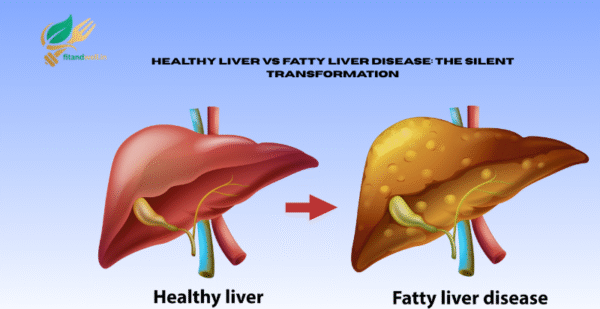
Do the multiplication before you open the packet. If the panel says five servings and you know the packet will not survive the evening, multiply the per serve figures by five and compare that with the daily limits. A diet steadily heavy in refined carbohydrate and sugar is one of the contributors to fatty liver disease, which often develops without symptoms.
A 10-Point Label Checklist
Turn the pack over first. The front is marketing, the back is regulated.
Compare per 100 g. It is the only fair comparison between two brands.
Check the serving size and the number of servings per pack. Then decide honestly how much you will eat.
Look at added sugar against 20 g to 25 g a day, the ICMR-NIN adult limit.
Look at sodium against 2,000 mg a day, the WHO limit.
Look at saturated fat, which is one of the three nutrients the court and the regulator both agree need flagging.
Do not treat ‘low’ or ‘free’ claims as a health verdict. They are threshold definitions, nothing more.
Remember that ‘high in’ has no legal meaning in India. No product is obliged to warn you.
Multiply per serve figures by servings per pack whenever you are likely to finish the packet in one go.
Judge the whole diet, not one packet. No single label decides whether a diet is healthy.
What Happens Next
The Union government’s final decision was due on record within two weeks of the 13 August hearing, and the matter is listed for 10 September 2026. Three outcomes are plausible: the government adopts interpretive warnings close to what the February order described, it proceeds with the daily limits format it proposed in August, or the court, having said it will dictate the judgment, settles the question itself.
One smaller change has already been approved. In June 2024, FSSAI cleared a proposal to display added sugar, salt and saturated fat in bold, larger type on the back-of-pack panel, which addresses legibility without addressing interpretation.
Whatever arrives, a label is a floor rather than a ceiling. Chile’s numbers improved because labelling came packaged with marketing restrictions and school sales bans, not because a black octagon changed minds on its own.
Frequently Asked Questions
Does India have front-of-pack warning labels?
No. As of 26/08/2026, India requires nutrition information on the back of the pack only. Front-of-pack labelling has been under consideration since 2022 and is the subject of continuing Supreme Court proceedings.
What did the Supreme Court order on food labels?
In February 2026, the court directed consideration of interpretive warnings such as ‘High Sugar Level’, ‘High Sodium Level’ and ‘High Saturated Fat Level’. On 13 August 2026 it gave the Union government two weeks to file its final decision, leaving the visual design to the government in consultation with experts. The next hearing is listed for 10 September 2026.
What is the Indian Nutrition Rating?
A star rating system proposed in a draft FSSAI notification of September 2022 awards products between half a star and five stars by comparing energy, saturated fat, sugar, and sodium against positive nutrients. It attracted more than 14,000 comments, reached no consensus and was deferred.
How much sugar and salt should an Indian adult have in a day?
ICMR-NIN’s 2024 dietary guidelines suggest restricting added sugar to 20-25 g per day for adults, keeping it under 5% of total energy. WHO recommends less than 2,000 mg of sodium a day, equivalent to under 5 g of salt.
Does ‘sugar free’ mean there is no sugar in it?
Not exactly. In Indian law, the claim is allowed when a product contains no more than 0.5 g of sugars per 100 g or 100 ml. It also says nothing about fat, salt, refined flour or total calories.
Which column on the label should I read?
The per 100 g or per 100 ml column. The per serve column depends on a serving size the manufacturer chose, so it is not comparable between products.
Do warning labels actually change what people buy?
The evidence is encouraging but not absolute. Chilean purchase data show substantial falls in sugar, sodium and saturated fat bought from labelled products, and a 2026 Lancet study found a small reduction in excess weight among young children. Indian experiments show warning labels help more people correctly identify unhealthy products, though in one trial they did not shift stated purchase intentions.
Are ultra-processed foods the same as packaged foods?
No. Packaged food is a category of convenience, while ultra-processed food is a category of formulation. Many packaged foods, such as plain atta, millets, milk or pulses, are not ultra-processed. ICMR-NIN’s 2024 guidelines advise minimising both ultra-processed foods and foods high in fat, sugar and salt.
Will a label tell me whether a food is healthy?
It will tell you whether a food is high in specific nutrients. Whether your overall diet is healthy depends on the pattern across a week, your activity, your medical history and your medication, none of which fit on a packet.
Medical Disclaimer
This article is for general information and education only. It is not medical advice, and it is not a substitute for a consultation with a qualified doctor, registered dietitian or other healthcare professional.
Nutrition targets such as daily limits for sugar, salt and saturated fat are population-level guidance and may not suit you. People with kidney disease, heart failure, diabetes, hypertension or an eating disorder, and those who are pregnant or breastfeeding, may need very different targets set by their own clinician.
Do not start, stop or change any treatment, diet or supplement based on this article. If you have symptoms that concern you, or a diagnosed condition, speak to your doctor.
The regulatory position described here was accurate on 26/08/2026 and is the subject of ongoing court proceedings, so check the current rules before relying on them.
Sources
- Supreme Court of India, 3S and Our Health Society v Union of India, order of 13/08/2026, reported by LiveLaw
- Supreme Court gives government two weeks to decide on food labelling standard, SCC OnLine, 2026, citing 2026 SCC OnLine SC 1656
- Supreme Court pulls up FSSAI over delay in front-of-pack warning labels, Business Standard, 2026
- Front-of-pack labels: where India stands versus global food labelling systems, Business Standard, 2026
- ICMR-National Institute of Nutrition, Dietary Guidelines for Indians, 2024
- World Health Organisation, Salt reduction fact sheet
- World Health Organisation, Guiding principles and framework manual for front-of-pack labelling for promoting healthy diets, 2018
- Lindsey Smith Taillie and colleagues, ‘Decreases in purchases of energy, sodium, sugar, and saturated fat 3 years after implementation of the Chilean food labelling and marketing law: an interrupted time series analysis’, PLOS Medicine, 2024 (open access)
- Guillermo Paraje and colleagues, The impact of Chile’s multipronged food labelling and advertising law on early childhood excess weight, The Lancet, 2026, summarised by the World Obesity Federation
- Christina A Roberto and colleagues, The influence of front-of-package nutrition labelling on consumer behaviour and product reformulation, Annual Review of Nutrition, 2021
- S K Singh, Lindsey Smith Taillie, Ashish Gupta, Maxime Bercholz, Barry Popkin and Nandita Murukutla, randomised experiment on front-of-package labels in India, Nutrients, 2022
- Ranjan Kumar Ghosh, Rahul Sanghvi and Arvind Sahay, Consumer preference for nutrition front-of-pack-label formats in India: evidence from a large-scale experimental survey, Food Quality and Preference, 2023
- Bhatnagar and colleagues, Nutrient profiling assessment of packaged snack foods with nutrition-related claims available on the Indian market, Frontiers in Nutrition, 2024
- Arun Gupta, Food safety law defines ‘low sugar’ and ‘zero sugar’, why not ‘high sugar’?, Nutrition Advocacy in Public Interest, 2026
- A star-crossed label, The Reporters’ Collective
- India’s FSSAI publishes draft notification on front of pack labelling of packaged food products, USDA Foreign Agricultural Service
- India’s FSSAI issues guidance document on trans fats, USDA Foreign Agricultural Service
- Mandatory nutrient declaration on food labels, Food Label Solutions
- Food labels difficult to read and interpret for consumers, says House panel reviewing FSSAI regulation, Deccan Herald, 2025
- FSSAI mandates bold labelling of sugar, salt and fat on packaged foods, News on AIR, 2024
- India’s new nutrition rating, India Legal