
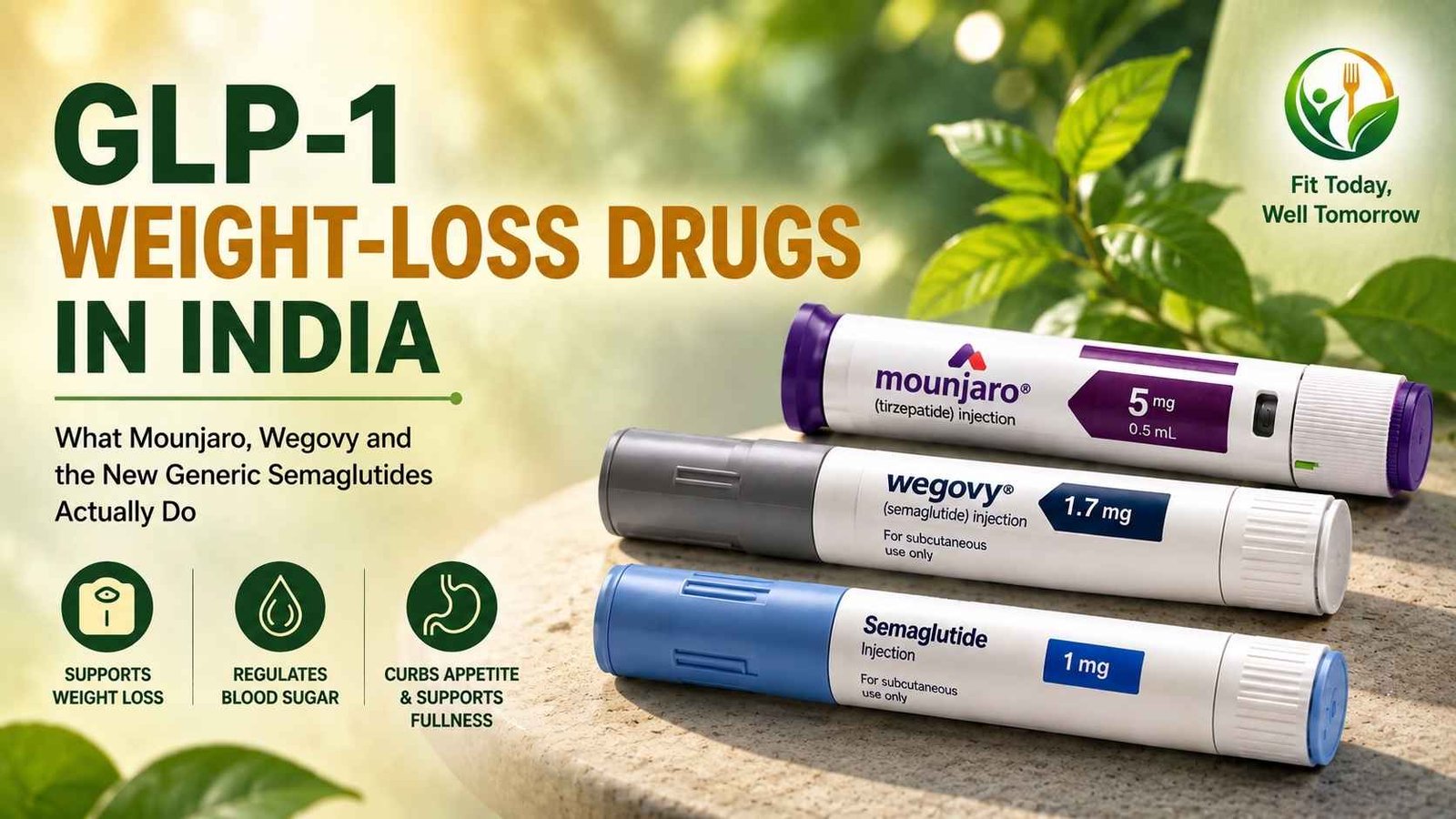
GLP-1 drugs such as tirzepatide (Mounjaro) and semaglutide (Wegovy, Ozempic and now dozens of Indian generics) are injectable or oral medicines that mimic gut hormones controlling appetite and blood sugar. In trials, people taking them lost roughly 14 to 20 per cent of their body weight over 15 to 18 months, far more than diet and exercise alone typically achieve. They are prescription-only medicines with real side effects, and the weight comes back when you stop, so they are best understood as long-term treatment for obesity as a disease rather than a short course for a wedding or a holiday.
That is the honest summary. The rest of this article explains what changed in the Indian market in March 2026, what the evidence actually shows, who they are and are not for, and the questions worth asking your doctor before you start.
What are GLP-1 drugs and how do they work?
GLP-1 stands for glucagon-like peptide-1, a hormone your small intestine releases after you eat. It tells the pancreas to release insulin, slows the rate at which food leaves your stomach, and signals to the brain that you have had enough.
The drugs are engineered copies of that hormone, modified so they survive in the body for days rather than minutes. Semaglutide acts on the GLP-1 receptor alone. Tirzepatide acts on two receptors, GLP-1 and GIP, which is part of why it produces more weight loss in head-to-head testing.
The practical effect people describe is a quieting of what researchers call food noise. Portions shrink because fullness arrives sooner and lasts longer, and the constant background pull towards snacking fades.
None of this is magic, and none of it is willpower either. Obesity involves hormonal and neural circuits that actively defend a higher body weight, which is why conventional weight-loss efforts so often stall and reverse. These drugs work on those circuits directly.
Which GLP-1 drugs are available in India in 2026?
The Indian market changed shape completely in the space of eighteen months. Here is where it stands as of August 2026.
Tirzepatide (Mounjaro) launched in India in March 2025 and became the country’s highest-selling drug by value within seven months, crossing ₹100 crore in October 2025 sales alone, according to Pharmarack data reported by Business Standard. It remains under patent, so there is no Indian generic tirzepatide, and none is expected for years.
Semaglutide arrived in three forms. Wegovy (the 2.4 mg weekly weight-management injection) launched in June 2025. Ozempic (the diabetes version) was approved in September 2025. Rybelsus, the daily oral tablet, has been available for diabetes since 2022.
Generic semaglutide is the big change. Novo Nordisk’s core Indian patent lapsed on 20/03/2026, and more than 40 Indian manufacturers launched their own versions within days, including Dr Reddy’s, Sun Pharma, Cipla, Zydus, Lupin, Alkem, Glenmark, Torrent, Mankind and Natco.
That single event did something India’s health system rarely sees: it cut the price of a frontier medicine by roughly 75 to 95 per cent overnight.
| Product | Molecule | Form | Approximate monthly cost (August 2026) |
|---|---|---|---|
| Mounjaro | Tirzepatide | Weekly injection | ₹14,000 to ₹17,500 depending on dose |
| Wegovy | Semaglutide 2.4 mg | Weekly injection | Around ₹16,400 after the November 2025 cut, reduced further since |
| Generic semaglutide (vial) | Semaglutide | Weekly injection | ₹1,300 to ₹2,200 |
| Generic semaglutide (pen) | Semaglutide | Weekly injection | ₹1,800 to ₹4,500 |
Prices move fast in a market this competitive and vary by city, dose and pharmacy. Treat the table as a rough guide and confirm current pricing locally.
What did the generic launch actually change?
Before March 2026, GLP-1 treatment in India was effectively restricted to people who could spend ₹15,000 to ₹25,000 a month indefinitely. That is a small slice of the country.
Novo Nordisk saw the cliff coming and cut Wegovy’s price by up to 37 per cent in November 2025, taking the highest dose from ₹24,389 to ₹16,400 a month, as Reuters first reported. Further reductions followed through 2026 as the generics arrived. Even so, the copies undercut the branded products by a wide margin.
The affordability question has now flipped into a safety question. When a medicine that needs careful dose titration and monitoring becomes cheaper than a monthly gym membership, the barrier to casual, unsupervised use largely disappears.
India’s Ministry of Health issued a public warning on 24/03/2026, four days after the patent expiry, cautioning that GLP-1 drugs used without proper medical supervision may cause serious adverse effects. The Drugs Controller General of India stepped up surveillance and barred manufacturers from indirect promotion that could encourage off-label use.
The Indian Medical Association and the Federation of All India Medical Associations went further the following day. Both bodies described pharmacists, physiotherapists, gym trainers, wellness clinics and cosmetology centres dispensing or administering these drugs without a qualified physician involved, and asked for prescribing to be restricted to endocrinologists, diabetologists and general medicine specialists.
That is the context any Indian reader needs before the clinical detail. Cheap does not mean casual.
How much weight do these drugs actually help you lose?
The clearest evidence comes from a direct comparison. In SURMOUNT-5, published in the New England Journal of Medicine in 2025, 751 adults with obesity and no diabetes were randomised to tirzepatide or semaglutide at maximum tolerated doses for 72 weeks.
Tirzepatide produced an average 20.2 per cent reduction in body weight. Semaglutide produced 13.7 per cent. In kilograms, that is roughly 22.8 kg against 15.0 kg. Waist circumference fell by 18.4 cm and 13.0 cm respectively.
Those figures line up with the earlier placebo-controlled trials. STEP-1 found 14.9 per cent weight loss with semaglutide 2.4 mg over 68 weeks, and SURMOUNT-1 found 20.9 per cent with tirzepatide 15 mg over 72 weeks.
Now the nuance that most Indian coverage skips. A 2025 meta-analysis in Diabetes, Obesity and Metabolism pooled five randomised trials of semaglutide 2.4 mg in Asian populations, covering 2,614 participants. The placebo-adjusted weight reduction was 8.2 per cent, meaningfully lower than the roughly 12 per cent seen in the predominantly Western STEP trials.
Why the gap is there is not fully settled. Lower starting body weight, different body composition and differences in trial design all plausibly contribute. The practical implication is simple: if you are Indian and someone quotes you a 20 per cent figure, treat it as an upper bound rather than an expectation.
One more thing the headline numbers hide. Participants received structured lifestyle counselling alongside the drug in every one of these studies. The 14 to 20 per cent figures are drug plus diet plus activity, not drug alone.
Do these drugs do anything besides reduce weight?
Yes, and this is the part of the story that has moved fastest.
Heart attacks and strokes. The SELECT trial followed 17,604 adults with existing cardiovascular disease and a BMI of 27 or above, none of whom had diabetes, for an average of 39.8 months. Semaglutide 2.4 mg reduced major adverse cardiovascular events by 20 per cent compared with placebo (6.5 per cent versus 8.0 per cent, hazard ratio 0.80). Published in the New England Journal of Medicine in 2023, it was the first demonstration that treating obesity with a drug changes hard cardiovascular outcomes.
Later analyses of the same trial found the benefit was not fully explained by the weight loss itself, which points to effects on inflammation and the blood vessel wall that are still being worked out.
A 2025 meta-analysis in Diabetes Care found the cardiovascular benefit may be larger in Asian people than in White people, with a hazard ratio of 0.69 against 0.85 across eight outcome trials. If that holds up in dedicated South Asian studies, it matters a great deal for India.
Fatty liver. The ESSENCE trial randomised around 800 adults with MASH (metabolic dysfunction-associated steatohepatitis) and moderate to advanced fibrosis. At 72 weeks, 62.9 per cent on semaglutide achieved resolution of steatohepatitis without worsening fibrosis, against 34.3 per cent on placebo. Fibrosis improved in 36.8 per cent against 22.4 per cent.
On 18/07/2026, CDSCO approved Wegovy for non-cirrhotic MASH with moderate to advanced fibrosis, making it the first GLP-1 approved for the condition in India. Given how common excess fat build-up in the liver is among Indians, this may end up being the more consequential approval of the two.
Blood sugar. These molecules began life as diabetes drugs and remain among the most effective options for lowering HbA1c, which is why they matter to anyone already dealing with insulin resistance and prediabetes.
Who are these drugs actually for?
The international labels generally specify a BMI of 30 or above, or 27 or above with a weight-related condition such as type 2 diabetes, hypertension or sleep apnoea.
Those thresholds were derived from European populations, and they fit Indians poorly. Asian Indians develop metabolic disease at lower body weights and carry more visceral fat at any given BMI.
A 2025 consensus statement led by Anoop Misra and the India Obesity Commission, published in Diabetes and Metabolic Syndrome, proposed a revised two-stage definition for Asian Indians. Stage 1 is a BMI above 23 kg/m² with normal organ function and no comorbidity. Stage 2 requires a BMI above 23 plus excess waist circumference (90 cm for men, 80 cm for women) or a waist-to-height ratio above 0.5, together with functional limitation or an obesity-related disease.
The gap between these two frameworks creates a real clinical dilemma. An Indian man with a BMI of 26, a 96 cm waist, fatty liver and prediabetes has clear stage 2 obesity by Indian criteria, yet sits below the label threshold for the drug unless his comorbidity is counted. This is a conversation to have with a doctor who understands the Indian data, not something to resolve by ordering online.
Equally, someone with a BMI of 24 who wants to lose six kilograms before a wedding is not a candidate, whatever a wellness clinic tells them. The risk-to-benefit calculation that justifies these drugs depends on there being substantial disease risk to reduce.
The scale of India’s problem is not in doubt. A Lancet analysis published on 03/03/2025 projected that 450 million Indian adults will be living with overweight or obesity by 2050, placing India among the top three countries globally.
What are the side effects?
Gastrointestinal effects are near-universal and usually manageable. Nausea, vomiting, diarrhoea, constipation, bloating and burping affect a large majority of users, concentrated in the weeks when the dose is being escalated. A real-world analysis of nearly 165,000 matched patients found 31.9 per cent experienced a gastrointestinal adverse event within a year.
Reflux is common enough to be worth flagging separately, with a documented increase in new-onset GERD in the same analysis. If you already deal with acid reflux, raise it before starting.
Gallbladder disease is a genuine signal. A meta-analysis of 76 randomised trials covering 103,371 patients, published in JAMA Internal Medicine in 2022, found a 37 per cent increased relative risk of gallbladder or biliary disease. The risk more than doubled in trials using weight-loss doses specifically. Rapid weight loss of any kind promotes gallstones, and these drugs produce rapid weight loss.
Gastroparesis, or delayed stomach emptying, is uncommon but real. Cohort studies consistently put the hazard ratio between roughly 1.6 and 3.1 depending on the comparator.
Pancreatitis is where the evidence conflicts outright. A cohort study of 230,415 matched pairs found no significant difference in acute pancreatitis between GLP-1 users and people on other diabetes drugs. A large US veterans analysis mapping 175 health outcomes did find an increased risk of drug-induced pancreatitis. The most reasonable reading is that the absolute risk is low, the relative risk is uncertain, and anyone with a history of pancreatitis should avoid these drugs.
A rare eye condition was added to the label in 2025. After reviewing clinical, epidemiological and post-marketing data, the European Medicines Agency’s safety committee concluded on 06/06/2025 that non-arteritic anterior ischaemic optic neuropathy (NAION), a form of sudden vision loss, is a very rare side effect of semaglutide, affecting up to 1 in 10,000 people. The studies suggested roughly a doubling of an already uncommon risk. Sudden vision changes warrant immediate medical attention.
There is an absolute contraindication worth knowing. These drugs cause thyroid C-cell tumours in rodents. Human data have not shown a consistent increase in medullary thyroid carcinoma, but they remain contraindicated in anyone with a personal or family history of medullary thyroid cancer or MEN2 syndrome. They are also not for use in pregnancy.
What happens to muscle?
This is the section where the popular coverage tends to pick a side, and the literature does not support either side cleanly.
The concern is legitimate. A network meta-analysis of 22 randomised trials in Metabolism found that lean mass loss made up roughly 25 per cent of total weight lost with GLP-1 drugs, and that semaglutide and tirzepatide, the most effective agents for fat loss, were among the least effective at preserving lean tissue.
A larger 2026 meta-analysis in Diabetes, Obesity and Metabolism, covering 20 trials and 15,782 participants, put the range at 25 to 39 per cent, with semaglutide at 35.2 per cent and tirzepatide at 25.4 per cent.
Here is the finding that reframes the debate. In that same analysis, intensive lifestyle intervention produced almost identical proportional lean mass loss at 26.2 per cent, with no statistically significant difference from the drugs.
In other words, losing lean mass alongside fat is what substantial weight loss does, not something peculiar to these medicines.
What changed the picture was resistance training. Adding it brought lean mass loss down to 17.5 per cent of total weight lost, the most favourable profile of any group studied.
There is a further complication. Lean mass measured by DEXA includes organs, bone, fluid and the water held in fat tissue, not just skeletal muscle. MRI-based work suggests the muscle changes seen with these drugs are largely proportionate to the weight lost and to normal ageing, and that muscle quality (specifically fat infiltration and insulin sensitivity) tends to improve.
The practical conclusion is not that muscle loss is a myth, nor that it is a reason to avoid the drugs. It is that anyone taking them should be lifting something heavy two or three times a week and eating enough protein, which for most Indians means paying deliberate attention to protein intake rather than assuming a standard vegetarian diet supplies it. If you have never trained with resistance before, starting is more straightforward than it looks.
Older adults deserve particular caution here, since they start with less muscle and less reserve.
What happens when you stop?
The weight returns. This is the single most consistent finding in the field, and the one most often left out of the marketing.
In the STEP-1 trial extension, participants who had lost an average of 17.3 per cent of their body weight regained 11.6 percentage points of it within a year of stopping, roughly two-thirds of what they had lost. The improvements in blood pressure, lipids and blood sugar drifted back towards baseline alongside the weight.
A 2025 systematic review and meta-regression in eClinicalMedicine modelled the trajectory across 48 studies. At one year after stopping, 60 per cent of the lost weight had returned. The curve then flattened, with regain projected to plateau at 75.3 per cent of the weight lost.
Read that carefully, because it cuts both ways. Most of the weight comes back, but not all of it. Some benefit persists.
A separate meta-analysis in Obesity Reviews found average regain of 9.69 kg after stopping semaglutide or tirzepatide, against 2.20 kg for liraglutide, with regain proportional to how much had been lost in the first place.
And the drop-off rate in real life is high. A JAMA Network Open cohort of 125,474 US adults found 64.8 per cent of those without diabetes had discontinued within a year, most often because of cost or gastrointestinal side effects.
None of this makes the drugs a failure. Blood pressure medication also stops working when you stop taking it. But it does mean the honest framing is ongoing treatment for a chronic condition, and anyone who cannot see themselves affording or tolerating that for years should factor it in before starting.
The counterfeit problem, and how to buy safely
Whenever an expensive, in-demand injectable becomes a mass-market product, counterfeits follow. The World Health Organisation has issued global alerts on falsified semaglutide, and CDSCO has tightened oversight following counterfeit alerts in India.
A few precautions cost nothing. Buy only with a prescription from a licensed pharmacy, and keep the bill. Check that the batch number on the carton matches the pen or vial. Be suspicious of any price dramatically below the going rate for that brand, and of anything sold through social media, WhatsApp groups, gyms or salons.
Do not accept a dose escalation plan from anyone who is not a doctor. The titration schedule exists to limit side effects, and skipping steps is the fastest route to vomiting yourself into dehydration.
If a clinic offers the injection without asking about your thyroid history, pancreatitis history, gallbladder, pregnancy plans or current medication, that is a clinic to walk out of.
What about the pill?
Injections are the main story in India today, but oral options are moving quickly.
Rybelsus, the oral semaglutide tablet taken daily, has been available in India for diabetes for several years, though it must be taken on an empty stomach with a small sip of water and nothing else for thirty minutes.
Orforglipron, a once-daily small-molecule GLP-1 pill, was approved by the US FDA on 01/04/2026 under the brand name Foundayo, with no food or water timing restrictions. In its pivotal trial it produced around 12.4 per cent weight loss at the highest dose, less than the injectables but delivered as a tablet that needs no cold chain. Lilly has filed it in more than 40 countries. Whether and when it reaches India is a question for your doctor rather than an assumption.
A pill that does not need refrigeration matters more in India than in most markets, given the realities of storage and distribution outside large cities.
Common questions
Can I take a GLP-1 drug just to lose 8 to 10 kilograms?
Not appropriately, no. The label thresholds and the risk-to-benefit reasoning both assume meaningful obesity-related health risk. For smaller amounts of weight, the established non-drug strategies carry no side effects and no monthly cost.
Do these drugs help with PCOS?
There is growing interest, since insulin resistance sits at the centre of PCOS and weight loss improves cycles and fertility markers. Evidence specific to PCOS is still limited compared with the obesity and diabetes trials, and these drugs must be stopped well before conception. Discuss it with a gynaecologist or endocrinologist rather than self-starting.
Will I lose hair?
Hair shedding is reported, and it is largely what happens after any rapid weight loss rather than a direct drug effect. It usually settles. Protein and iron intake are worth checking if it does not.
Can vegetarians take them?
Yes. Semaglutide and tirzepatide are synthesised, not animal-derived. The relevant dietary issue is getting enough protein while eating considerably less overall.
Is it safe to drink alcohol on these drugs?
There is no absolute prohibition, but alcohol worsens nausea, adds empty calories, and independently raises pancreatitis risk. Many people find they lose interest in it anyway.
Do I still need to exercise and watch my diet?
Yes, and more deliberately than before. Every trial that produced those headline numbers included structured lifestyle support. Resistance training protects muscle, and the eating habits you build during treatment are what determine how much you keep if you ever stop.
The bottom line
GLP-1 drugs are the most effective obesity medicines yet approved, and the March 2026 generic launch has made them affordable to a large section of India for the first time. For someone with genuine obesity-related disease, particularly fatty liver, prediabetes or established heart disease, that is a meaningful clinical advance rather than a cosmetic one.
They are also prescription medicines with a real side effect profile, an absolute contraindication, a muscle-loss consideration that requires active management, and a rebound effect that makes them a long-term commitment rather than a course of treatment.
The right question is not whether these drugs work. They plainly do. It is whether your particular health situation justifies taking a powerful medicine indefinitely, and that is a question for a qualified doctor who has examined you, not for a pharmacy counter, a gym trainer or an article on the internet, including this one.
This article is for information only and is not a substitute for personalised medical advice. GLP-1 receptor agonists are prescription-only medicines in India. Consult a qualified physician before starting, stopping or changing any treatment.
Sources
- Aronne LJ, Horn DB, le Roux CW, et al. ‘Tirzepatide as Compared with Semaglutide for the Treatment of Obesity.’ New England Journal of Medicine, 2025;393(1):26-36. https://www.nejm.org/doi/full/10.1056/NEJMoa2416394
- Lincoff AM, Brown-Frandsen K, Colhoun HM, et al. ‘Semaglutide and Cardiovascular Outcomes in Obesity without Diabetes.’ New England Journal of Medicine, 2023;389(24):2221-2232. https://www.nejm.org/doi/full/10.1056/NEJMoa2307563
- Wilding JPH, Batterham RL, Calanna S, et al. ‘Once-Weekly Semaglutide in Adults with Overweight or Obesity.’ New England Journal of Medicine, 2021;384(11):989-1002. https://www.nejm.org/doi/full/10.1056/NEJMoa2032183
- Jastreboff AM, Aronne LJ, Ahmad NN, et al. ‘Tirzepatide Once Weekly for the Treatment of Obesity.’ New England Journal of Medicine, 2022;387(3):205-216. https://www.nejm.org/doi/full/10.1056/NEJMoa2206038
- Sanyal AJ, Newsome PN, Kliers I, et al. ‘Phase 3 Trial of Semaglutide in Metabolic Dysfunction-Associated Steatohepatitis.’ New England Journal of Medicine, 2025;392(21):2089-2099. https://www.nejm.org/doi/full/10.1056/NEJMoa2413258
- Zufry H, et al. ‘Efficacy and safety of once-weekly subcutaneous semaglutide 2.4 mg for the management of overweight or obesity in Asian populations: a systematic review, meta-analysis and meta-regression of randomised trials.’ Diabetes, Obesity and Metabolism, 2025. https://dom-pubs.onlinelibrary.wiley.com/doi/10.1111/dom.70073
- Lee MMY, Sattar N, McMurray JJV, et al. ‘Comparative Efficacy of Glucagon-Like Peptide 1 Receptor Agonists for Cardiovascular Outcomes in Asian Versus White Populations.’ Diabetes Care, 2025;48(3):489-493. https://diabetesjournals.org/care/article/48/3/489/157707/
- Karakasis P, Patoulias D, Fragakis N, Mantzoros CS. ‘Effect of glucagon-like peptide-1 receptor agonists and co-agonists on body composition: systematic review and network meta-analysis.’ Metabolism, 2025;164:156113. https://pubmed.ncbi.nlm.nih.gov/39719170/
- Eisa N, et al. ‘Lean Mass Changes With Incretin Therapy Versus Lifestyle Intervention: A Systematic Review and Meta-Analysis of Randomised Controlled Trials.’ Diabetes, Obesity and Metabolism, 2026. https://dom-pubs.onlinelibrary.wiley.com/doi/10.1111/dom.70666
- Wilding JPH, Batterham RL, Davies M, et al. ‘Weight regain and cardiometabolic effects after withdrawal of semaglutide: the STEP 1 trial extension.’ Diabetes, Obesity and Metabolism, 2022;24(8):1553-1564. https://dom-pubs.onlinelibrary.wiley.com/doi/10.1111/dom.14725
- Budini B, et al. ‘Trajectory of weight regain after cessation of GLP-1 receptor agonists: a systematic review and nonlinear meta-regression.’ eClinicalMedicine, 2026. https://www.thelancet.com/journals/eclinm/article/PIIS2589-5370(26)00043-X/fulltext
- Berg S, et al. ‘Discontinuing glucagon-like peptide-1 receptor agonists and body habitus: a systematic review and meta-analysis.’ Obesity Reviews, 2025. https://onlinelibrary.wiley.com/doi/10.1111/obr.13929
- He L, Wang J, Ping F, et al. ‘Association of Glucagon-Like Peptide-1 Receptor Agonist Use With Risk of Gallbladder and Biliary Diseases: A Systematic Review and Meta-analysis of Randomized Clinical Trials.’ JAMA Internal Medicine, 2022;182(5):513-519. https://jamanetwork.com/journals/jamainternalmedicine/fullarticle/2790392
- Xie Y, Choi T, Al-Aly Z. ‘Mapping the effectiveness and risks of GLP-1 receptor agonists.’ Nature Medicine, 2025;31(3):951-962. https://www.nature.com/articles/s41591-024-03412-w
- Niu C, Elkhapery A, et al. ‘Gastrointestinal and Hepatobiliary Safety of Glucagon-like Peptide-1 Receptor Agonists in Patients with Type 2 Diabetes.’ American Journal of Gastroenterology, 2025. https://pubmed.ncbi.nlm.nih.gov/40900093/
- Nathani P, et al. ‘Incidence of Gastrointestinal Adverse Events and Healthcare Resource Utilization in Patients Using Glucagon-Like Peptide-1 Analogs: A Real-World Study.’ Digestive Diseases and Sciences, 2026. https://link.springer.com/article/10.1007/s10620-026-10112-7
- Rodriguez PJ, Cartwright BMG, Gratzl S, et al. ‘Discontinuation and Reinitiation of Dual-Labeled GLP-1 Receptor Agonists Among US Adults With Overweight or Obesity.’ JAMA Network Open, 2025;8(1):e2457349. https://jamanetwork.com/journals/jamanetworkopen/fullarticle/2829779
- Misra A, Vikram NK, Ghosh A, Ranjan P, Gulati S, et al. ‘Revised definition of obesity in Asian Indians living in India.’ Diabetes and Metabolic Syndrome: Clinical Research and Reviews, 2025. https://pubmed.ncbi.nlm.nih.gov/39814628/
- GBD 2021 Adult BMI Collaborators. ‘Global, regional, and national prevalence of adult overweight and obesity, 1990-2021, with forecasts to 2050: a forecasting study for the Global Burden of Disease Study 2021.’ The Lancet, 2025. https://www.thelancet.com/journals/lancet/article/PIIS0140-6736(25)00355-1/fulltext
- European Medicines Agency, Pharmacovigilance Risk Assessment Committee. ‘PRAC concludes eye condition NAION is a very rare side effect of semaglutide medicines Ozempic, Rybelsus and Wegovy.’ 06/06/2025. https://www.ema.europa.eu/en/news/prac-concludes-eye-condition-naion-very-rare-side-effect-semaglutide-medicines-ozempic-rybelsus-wegovy
- World Health Organization. ‘The use of semaglutide medicines and risk of non-arteritic anterior ischemic optic neuropathy (NAION).’ 27/06/2025. https://www.who.int/news/item/27-06-2025-27-06-2025-semaglutide-medicines-naion
- BioSpectrum India. ‘CDSCO approves Wegovy as first and only GLP-1 for adults living with fatty liver disease in India.’ July 2026. https://www.biospectrumindia.com/news/73/28153/cdsco-approves-wegovy-as-first-and-only-glp-1-for-adults-living-with-fatty-liver-disease-in-india.html
- Fierce Pharma. ‘Generic versions of Novo’s semaglutide launch in India.’ March 2026. https://www.fiercepharma.com/pharma/novos-semaglutide-losing-patent-protection-indian-drugmakers-set-launch-their-generics
- Business Standard. ‘Eli Lilly’s Mounjaro tops India pharma charts with ₹100 crore sales in Oct.’ 07/11/2025. https://www.business-standard.com/economy/news/mounjaro-india-top-selling-drug-eli-lilly-anti-obesity-sales-100cr-125110700753_1.html
- Medical Dialogues. ‘Doctors raise alarm over misuse of GLP-1 weight loss drugs, seek curbs on unqualified prescribing.’ 25/03/2026. https://medicaldialogues.in/news/health/doctors/doctors-raise-alarm-over-misuse-of-glp-1-weight-loss-drugs-seek-curbs-on-unqualified-prescribing-167256
- Eli Lilly and Company. ‘FDA approves Lilly’s Foundayo (orforglipron), the only GLP-1 pill for weight loss that can be taken any time of day without food or water restrictions.’ 01/04/2026. https://investor.lilly.com/news-releases/news-release-details/fda-approves-lillys-foundayotm-orforglipron-only-glp-1-pill